
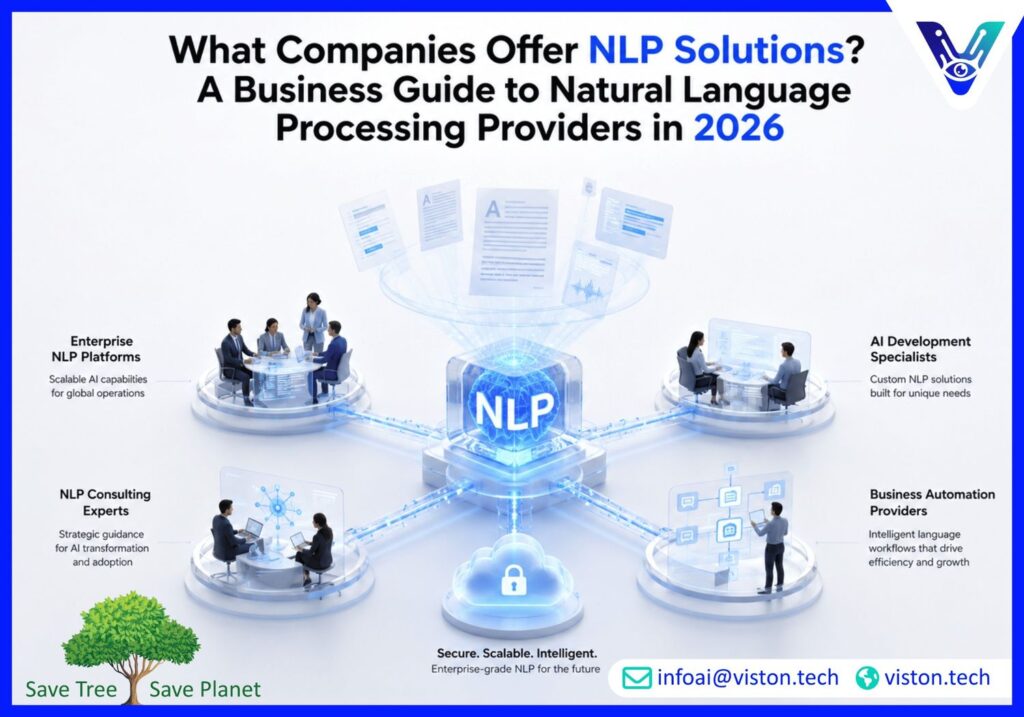
Natural Language Processing (NLP) has become a critical technology for businesses seeking to automate communication, improve customer experiences, analyze large volumes of text data, and enhance operational efficiency. As AI adoption continues to accelerate in 2026, organizations across industries are evaluating NLP solution providers that can help transform language-based processes into measurable business outcomes.
Natural Language Processing is a branch of artificial intelligence that enables computers to understand, interpret, analyze, and generate human language. Modern NLP solutions power a wide range of business applications, including chatbots, virtual assistants, sentiment analysis, document processing, semantic search, content classification, and language translation.
Businesses invest in NLP solutions to address challenges such as:
The right NLP provider can help organizations implement solutions that improve productivity, reduce costs, and create more personalized customer interactions.
The NLP market includes several categories of providers, each serving different business needs and technical requirements.
Large technology companies offer NLP platforms and AI services that businesses can integrate into their applications and workflows. These providers typically offer scalable infrastructure, language models, developer tools, and cloud-based AI services.
Organizations often choose enterprise providers when they require:
These firms focus specifically on building customized Natural Language Processing solutions tailored to business requirements. They often provide consulting, development, implementation, integration, and ongoing optimization services.
Specialized providers can support:
Many consulting organizations now include NLP capabilities as part of broader AI and digital transformation services. These companies often help enterprises align NLP initiatives with strategic business objectives.
Their services commonly include:
When evaluating NLP providers, organizations should focus on business outcomes rather than technology alone.
NLP-powered chatbots help businesses automate customer interactions, answer questions, qualify leads, and provide support around the clock. Modern conversational AI systems can understand context, intent, and natural language queries more effectively than earlier chatbot generations.
Organizations dealing with contracts, invoices, forms, reports, and compliance documents often use NLP solutions to automate information extraction, classification, summarization, and workflow routing.
Businesses use sentiment analysis to understand customer opinions, evaluate feedback, monitor brand perception, and identify emerging trends from reviews, surveys, and customer communications.
NLP enables employees and customers to locate information using natural language queries instead of relying on exact keywords. This improves accessibility and productivity across organizations.
Many businesses implement NLP solutions to categorize content, identify topics, extract entities, and organize large information repositories more efficiently.
Choosing the right NLP provider requires careful assessment of both technical expertise and business alignment.
Providers should understand the terminology, workflows, compliance requirements, and operational challenges specific to your industry.
NLP solutions often need to connect with existing systems such as:
Strong integration capabilities are essential for achieving measurable business value.
As AI adoption grows, businesses require NLP systems that can handle increasing data volumes, user interactions, and operational complexity without sacrificing performance.
Organizations should evaluate how providers handle data security, privacy, governance, access controls, and compliance obligations, particularly when sensitive information is involved.
NLP systems require continuous monitoring, model refinement, workflow optimization, and performance evaluation. Providers should offer long-term support rather than focusing solely on deployment.
Business expectations for AI have evolved significantly. Organizations now seek practical, outcome-focused implementations rather than experimental technology projects.
In 2026, successful NLP initiatives are increasingly expected to deliver:
As language models become more advanced, businesses are also prioritizing responsible AI practices, governance frameworks, transparency, and reliability in their NLP deployments.
Organizations exploring Natural Language Processing Solutions often require more than standalone AI tools. They need solutions that integrate with existing business processes, support operational objectives, and scale alongside organizational growth.
Viston AI focuses on delivering Natural Language Processing Solutions that help businesses automate language-driven workflows, improve customer engagement, enhance knowledge management, and streamline information processing. Its capabilities support applications such as conversational AI, intelligent document processing, semantic search, content analysis, and workflow automation.
Rather than treating NLP as an isolated technology initiative, Viston AI emphasizes practical implementation strategies that connect AI capabilities with real business requirements. This approach helps organizations leverage NLP technologies within existing operational environments while supporting scalability, integration, security, and long-term optimization.
For businesses evaluating NLP providers, the combination of technical expertise, implementation experience, workflow integration, and business-focused delivery remains critical to achieving successful outcomes from AI investments.
NLP solutions are offered by large technology providers, specialized AI development firms, NLP consulting companies, and digital transformation agencies. The right provider depends on business objectives, industry requirements, integration needs, and scalability expectations.
Healthcare, finance, legal services, retail, ecommerce, education, manufacturing, technology, and customer service organizations commonly use NLP solutions to automate processes and improve communication.
No. Modern NLP technologies are accessible to businesses of all sizes. Small and mid-sized organizations increasingly use NLP for customer support automation, document processing, knowledge management, and data analysis.
Implementation timelines vary depending on project complexity, data availability, customization requirements, integrations, and compliance considerations. Simple projects may take weeks, while enterprise initiatives can require several months.
Yes. Viston AI provides Natural Language Processing Solutions designed to support automation, conversational AI, document intelligence, semantic search, and language-driven business processes across various industries.
Understanding what companies offer NLP solutions is an important step for organizations planning AI-driven automation and language intelligence initiatives. The most successful NLP projects combine advanced technology with strong implementation expertise, business alignment, integration capabilities, and ongoing optimization. As Natural Language Processing continues to evolve in 2026, businesses that partner with experienced providers can improve customer experiences, automate complex workflows, and unlock greater value from their data. For organizations seeking practical Natural Language Processing Solutions, Viston AI offers capabilities that help connect AI innovation with meaningful business outcomes.
