
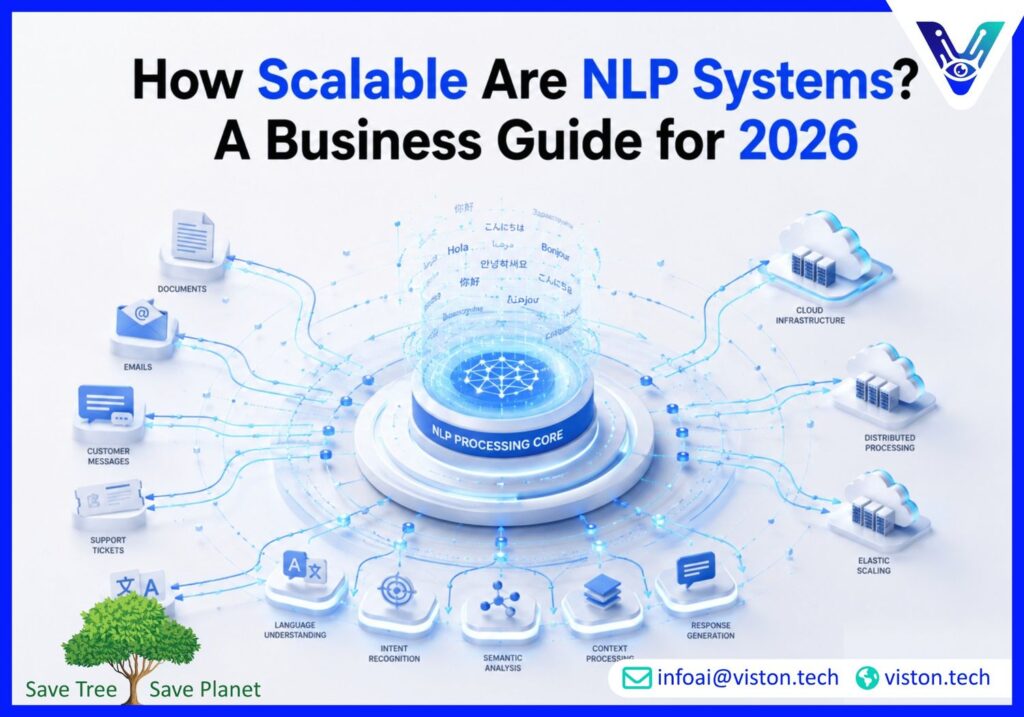
As organizations process growing volumes of customer interactions, documents, emails, support tickets, and digital content, scalability has become a critical requirement for Natural Language Processing (NLP) systems. Businesses investing in NLP solutions need platforms that can handle increasing workloads, support multiple languages, integrate with existing systems, and maintain performance as demand grows. Understanding NLP scalability helps decision-makers evaluate long-term value and operational readiness.
Scalability in NLP refers to the ability of a system to efficiently process larger volumes of language data, support more users, handle additional use cases, and maintain consistent performance without significant degradation.
A scalable NLP system should be capable of:
For businesses, scalability ensures that NLP investments continue delivering value as operations grow and data volumes increase.
The amount of text data an organization generates directly impacts scalability requirements. Customer support platforms, eCommerce websites, healthcare systems, and enterprise applications often process millions of records every month.
Modern NLP architectures are designed to handle large datasets through distributed processing, cloud infrastructure, and automated workflows.
Advanced language models provide powerful capabilities but may require significant computational resources. Scalability depends on selecting the appropriate model size and deployment approach based on business requirements.
Organizations often balance performance, cost, and processing speed when choosing NLP models.
Cloud-native NLP platforms generally offer greater scalability than traditional on-premises deployments. Cloud infrastructure enables businesses to increase processing capacity during peak demand periods without major hardware investments.
Scalable NLP systems must connect seamlessly with CRM platforms, ERP systems, marketing automation tools, customer support software, document repositories, and analytics platforms.
Efficient integrations reduce operational bottlenecks and support enterprise-wide adoption.
The role of NLP has expanded significantly beyond simple text analysis. Organizations now use NLP for customer service automation, sentiment analysis, document processing, content classification, compliance monitoring, knowledge management, and conversational AI.
As adoption increases, scalability becomes essential for maintaining business performance.
Companies receive customer communications through multiple channels, including email, chat, social media, messaging apps, and support portals. NLP systems must process this growing volume efficiently while maintaining service quality.
Businesses expanding internationally often require multilingual NLP capabilities. Scalable systems can support additional languages without requiring entirely separate technology stacks.
Organizations are automating more operational processes than ever before. Scalable NLP solutions help automate repetitive language-based tasks while supporting larger workflows over time.
Executives increasingly rely on insights extracted from unstructured data. Scalable NLP systems enable continuous analysis of customer feedback, operational reports, and business communications at enterprise scale.
As NLP workloads increase, computational requirements can grow significantly. Organizations must carefully manage infrastructure costs while maintaining performance.
Scaling data volume does not automatically improve model quality. NLP systems require ongoing monitoring, optimization, and retraining to maintain accuracy across changing datasets.
Supporting multiple languages introduces additional processing requirements, language-specific nuances, and model management challenges.
Poor-quality input data can negatively affect NLP performance regardless of system scale. Successful deployments require strong data governance practices.
As NLP systems process larger volumes of sensitive information, organizations must address privacy regulations, data protection requirements, and industry-specific compliance standards.
Cloud-based and modular architectures provide greater flexibility for future expansion. Businesses can add capabilities without redesigning entire systems.
Performance monitoring helps identify bottlenecks before they impact operations. Monitoring should include response times, accuracy metrics, throughput, and infrastructure utilization.
Efficient data ingestion, preprocessing, and storage workflows support faster scaling and reduce operational overhead.
Automated model deployment, retraining, and workflow management improve scalability while minimizing manual intervention.
NLP initiatives should be designed with long-term business objectives in mind. Systems built for future expansion can accommodate new use cases, departments, and customer demands more effectively.
Organizations seeking scalable NLP implementations often require more than just language models. They need reliable solutions that integrate with existing business processes, support growth, and deliver measurable operational outcomes.
Viston AI specializes in Natural Language Processing Solutions designed to help businesses transform unstructured language data into actionable insights and automated workflows. The company focuses on building NLP systems that align with real business requirements, whether for customer support automation, sentiment analysis, document intelligence, content classification, or enterprise knowledge management.
A key aspect of scalable NLP deployment is balancing performance, accuracy, security, and operational efficiency. Viston AI helps organizations address these challenges through customized implementation strategies, integration support, model optimization, workflow automation, and ongoing performance monitoring.
By emphasizing scalable architecture, practical business outcomes, and adaptable NLP frameworks, Viston AI enables organizations to expand their language-processing capabilities as operational demands evolve. This approach allows businesses to leverage NLP technologies effectively while supporting future growth and digital transformation initiatives.
Yes. Modern NLP platforms can process millions of documents using distributed computing, cloud infrastructure, and optimized processing pipelines.
In most cases, yes. Cloud environments allow organizations to scale resources dynamically based on workload requirements, improving flexibility and cost efficiency.
Scalability itself does not reduce accuracy, but maintaining model quality requires continuous monitoring, validation, and optimization as data volumes grow.
Yes. Many enterprise NLP solutions are designed to support multilingual processing, making them suitable for global business operations.
Viston AI develops Natural Language Processing Solutions that support business growth through scalable architecture, workflow automation, integration capabilities, and ongoing optimization tailored to organizational needs.
The scalability of NLP systems is one of the most important considerations for organizations investing in language-based automation and analytics in 2026. A scalable NLP solution can efficiently handle increasing data volumes, support additional users and use cases, maintain performance, and adapt to evolving business requirements. By combining strong infrastructure, optimized workflows, and strategic implementation practices, businesses can maximize the value of Natural Language Processing Solutions while preparing for future growth. Organizations working with experienced providers such as Viston AI can better position themselves to build scalable NLP capabilities that deliver long-term operational and business benefits.
