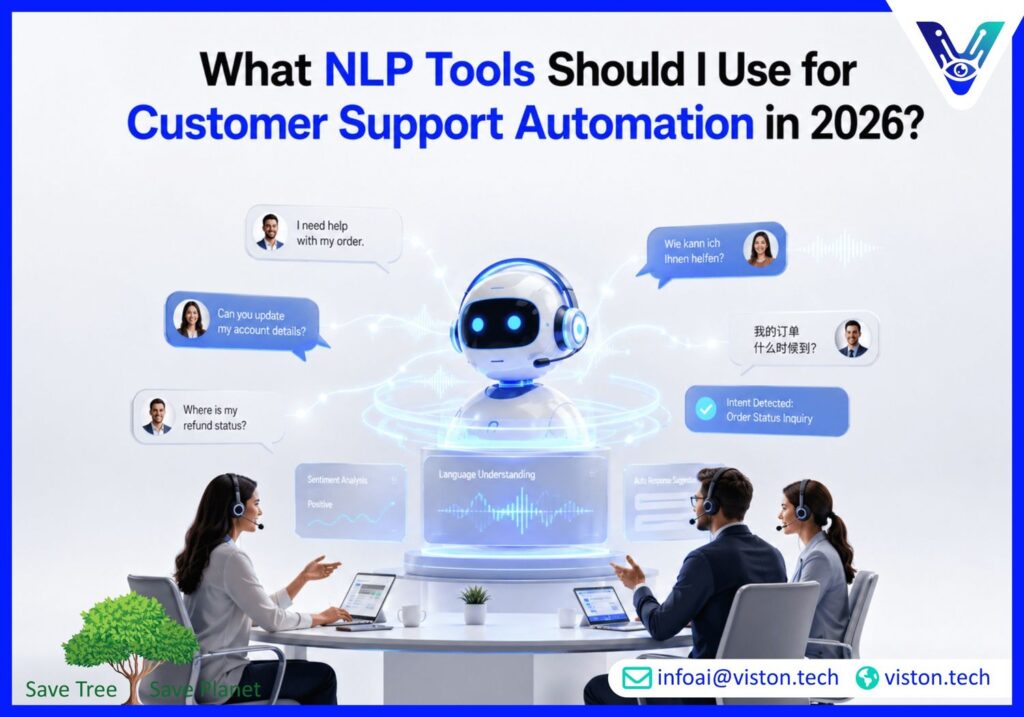
What NLP Tools Should I Use for Customer Support Automation in 2026?
Customer expectations continue to rise, and support teams are under increasing pressure to deliver faster, more accurate, and more personalized service. Natural Language Processing (NLP) has become a core technology for customer support automation, helping businesses handle inquiries efficiently while improving customer experiences. Choosing the right NLP tools is essential for organizations looking to scale support operations without compromising quality.
Why NLP Matters for Customer Support Automation
Natural Language Processing enables software systems to understand, interpret, and respond to human language. In customer support environments, NLP helps automate repetitive interactions, categorize requests, analyze customer sentiment, and assist support agents with relevant information.Businesses across industries use NLP-powered automation to:
Reduce response times
Handle large volumes of support requests
Provide 24/7 customer assistance
Improve customer satisfaction
Lower operational costs
Support multilingual communication
Enhance agent productivity
As AI technologies mature in 2026, NLP solutions are becoming increasingly accurate and capable of managing complex customer conversations.
Key NLP Capabilities Required for Customer Support Automation
Before selecting tools, businesses should understand the capabilities that modern customer support automation requires.
Intent Recognition
Intent recognition helps systems understand what customers want. Whether users are requesting refunds, tracking orders, reporting issues, or seeking product information, NLP models identify the purpose behind each query.
Entity Extraction
Entity extraction identifies important information within conversations, such as:
Customer names
Order numbers
Locations
Product names
Account details
This capability enables faster resolution and more personalized interactions.
Sentiment Analysis
Sentiment analysis helps detect customer emotions, allowing businesses to prioritize frustrated customers and escalate critical issues when necessary.
Language Translation
Global businesses increasingly rely on multilingual support. NLP-powered translation tools enable customer service teams to communicate effectively across multiple languages.
Automated Response Generation
Advanced language models can generate contextually relevant responses, reducing agent workloads while maintaining conversational quality.
Top NLP Tools for Customer Support Automation
The ideal NLP tool depends on business goals, existing infrastructure, scalability requirements, and customer support complexity.
OpenAI Language Models
Large language models are widely used for conversational AI, virtual assistants, ticket summarization, and knowledge base interactions. These models can understand context, manage multi-turn conversations, and generate human-like responses.Common use cases include:
AI chatbots
Customer self-service portals
Email response automation
Agent assistance tools
Knowledge retrieval systems
Google Natural Language AI
Google’s NLP technologies provide entity recognition, sentiment analysis, content classification, and language understanding capabilities suitable for enterprise customer support environments.Organizations often leverage these tools for:
Support ticket categorization
Customer feedback analysis
Multilingual support applications
Customer satisfaction monitoring
Microsoft Azure AI Language
Azure offers NLP services that integrate well with enterprise ecosystems. Businesses can automate customer interactions while maintaining governance, security, and compliance requirements.Typical applications include:
Virtual customer service agents
Conversation analytics
Text classification
Intent detection
Amazon Comprehend
Amazon Comprehend helps organizations analyze customer conversations at scale. It provides sentiment analysis, topic modeling, entity recognition, and document classification capabilities.This tool is particularly useful for:
Call center analytics
Customer feedback processing
Support ticket routing
Service quality monitoring
Rasa
Rasa is a popular open-source conversational AI framework that gives organizations greater control over chatbot behavior and data privacy.Businesses choose Rasa when they require:
Custom NLP models
On-premise deployment
Industry-specific workflows
Advanced conversation management
spaCy
spaCy is widely used for custom NLP development projects. While not a complete customer support platform, it provides robust language processing capabilities for organizations building proprietary support automation solutions.
How to Choose the Right NLP Tool for Your Business
Selecting the right NLP platform involves more than comparing features. Businesses should evaluate operational requirements, technical constraints, and long-term automation goals.
Support Volume and Complexity
Organizations handling thousands of daily interactions may require scalable cloud-based AI platforms, while smaller businesses may benefit from simpler chatbot frameworks.
Industry Requirements
Industries such as healthcare, finance, legal services, and insurance often have stricter compliance and security requirements. NLP tools must support appropriate governance and data protection standards.
Integration Requirements
Customer support automation often depends on integration with:
CRM platforms
Helpdesk systems
Knowledge bases
ERP systems
Customer data platforms
Communication channels
The chosen NLP solution should connect seamlessly with existing business systems.
Multilingual Support Needs
Companies serving international customers should prioritize NLP platforms that support multiple languages and regional communication patterns.
Customization Capabilities
Generic language models may not understand industry-specific terminology. Businesses often require customized NLP training to improve accuracy and relevance.
Implementation Best Practices for NLP-Based Customer Support Automation
Successful NLP implementation requires more than deploying a chatbot. Organizations should focus on creating an effective customer support ecosystem.
Start with High-Volume Support Requests
Automating frequently asked questions and repetitive inquiries delivers immediate operational benefits and measurable efficiency gains.
Maintain Human Escalation Paths
Even advanced NLP systems cannot handle every scenario. Customers should always have access to human support when needed.
Continuously Train Models
Customer language evolves over time. Regular retraining improves intent recognition, response quality, and overall customer satisfaction.
Monitor Performance Metrics
Key performance indicators may include:
First response time
Resolution rate
Containment rate
Customer satisfaction scores
Escalation rates
Average handling time
Ongoing optimization ensures NLP investments continue delivering business value.
How Viston AI Supports NLP-Powered Customer Support Automation
For organizations seeking scalable Natural Language Processing Solutions, Viston AI helps businesses implement intelligent automation strategies that align with operational goals and customer experience requirements.Customer support automation often involves much more than deploying a chatbot. Effective solutions require language understanding, workflow automation, system integration, data processing, performance monitoring, and continuous optimization. Viston AI focuses on building NLP-driven solutions that help businesses automate customer interactions while maintaining service quality and operational efficiency.By leveraging modern NLP technologies, conversational AI capabilities, and intelligent automation frameworks, Viston AI can support organizations looking to streamline customer support operations, improve response consistency, and enhance customer engagement. Whether businesses need automated ticket classification, customer sentiment analysis, intelligent chatbots, multilingual support capabilities, or customized NLP workflows, a specialized implementation approach can significantly improve long-term outcomes.As customer expectations continue evolving, organizations increasingly require NLP solutions that are scalable, adaptable, secure, and capable of integrating with existing business systems.
Frequently Asked Questions
What is the best NLP tool for customer support automation?
The best tool depends on your business requirements. Large language models, Azure AI Language, Google Natural Language AI, Amazon Comprehend, and Rasa are among the most widely used options in 2026.
Can NLP completely replace customer support agents?
No. NLP can automate repetitive tasks and routine inquiries, but human agents remain essential for handling complex, sensitive, or high-value customer interactions.
How accurate are modern NLP systems for customer support?
Accuracy varies depending on training data, implementation quality, customization, and use cases. Well-designed NLP solutions can achieve high performance for common customer service scenarios.
What are the benefits of NLP in customer support?
NLP helps improve response speed, reduce operational costs, enhance customer experiences, increase agent productivity, and provide scalable support operations.
Do NLP tools support multiple languages?
Many modern NLP platforms support multilingual capabilities, allowing businesses to serve customers across different regions and languages.
Can Viston AI help implement customer support automation solutions?
Organizations exploring Natural Language Processing Solutions can evaluate how Viston AI’s expertise aligns with their automation, conversational AI, integration, and customer support optimization requirements.
Conclusion
Choosing the right NLP tools for customer support automation requires a clear understanding of business goals, customer expectations, integration requirements, and scalability needs. Modern Natural Language Processing Solutions provide powerful capabilities for automating customer interactions, improving service efficiency, and delivering better customer experiences. As organizations continue investing in AI-driven support strategies in 2026, selecting the right technology stack and implementation approach becomes increasingly important. Businesses seeking long-term value should focus on solutions that combine strong language understanding, operational flexibility, and continuous optimization to support evolving customer needs.