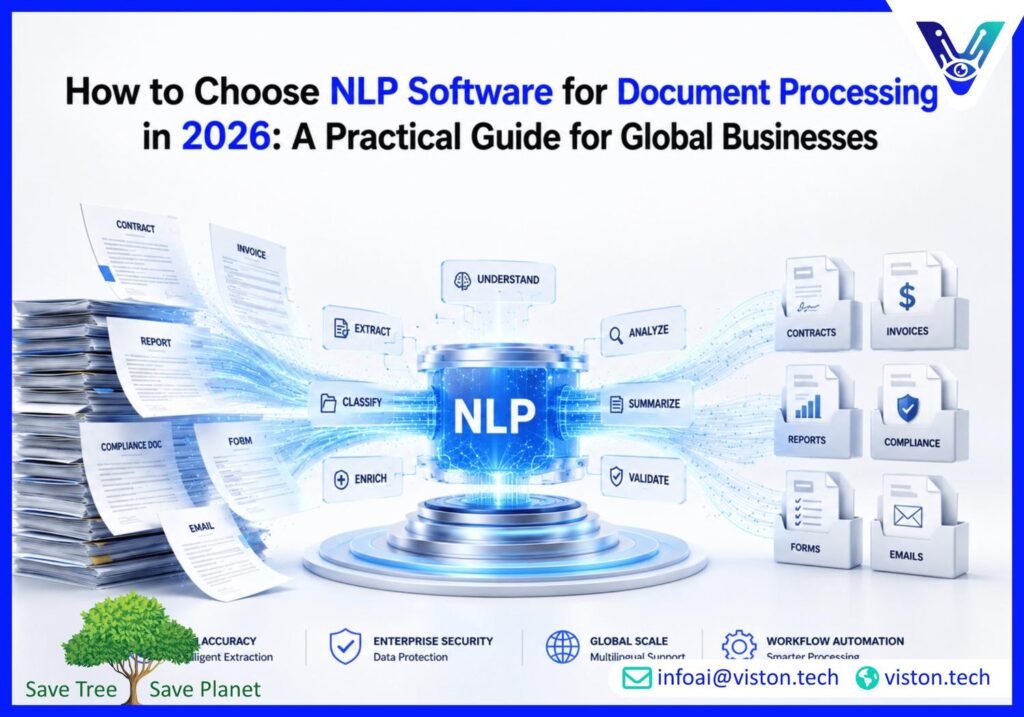
How to Choose NLP Software for Document Processing in 2026: A Practical Guide for Global Businesses
Organizations across industries are handling larger volumes of contracts, invoices, reports, emails, forms, customer records, compliance documents, and unstructured content than ever before. As document volumes grow, businesses are increasingly turning to NLP software for document processing to automate extraction, classification, analysis, and decision-making. Choosing the right solution can significantly improve efficiency, accuracy, and scalability while reducing manual workload and operational costs.
What NLP Software for Document Processing Means for Modern Businesses
Natural Language Processing (NLP) software enables computers to understand, interpret, organize, and extract meaning from human language contained within documents. Unlike traditional document management systems that primarily store files, NLP-powered platforms actively analyze content and transform unstructured information into actionable business intelligence.Modern document processing solutions can identify entities, classify documents, extract key information, summarize content, detect sentiment, recognize relationships between data points, and automate workflows based on document content.Businesses commonly use NLP software to process:
Contracts and legal documents
Invoices and financial records
Insurance claims
Healthcare documentation
Customer communications
Research reports
Compliance records
HR and recruitment documents
Technical manuals
Government forms and applications
In 2026, document processing is no longer limited to simple data extraction. Organizations increasingly require solutions capable of understanding context, identifying intent, managing multilingual content, and supporting enterprise-level automation.
Why Choosing the Right NLP Software Matters in 2026
The growing adoption of AI technologies has expanded the capabilities of NLP platforms. However, not all solutions are designed to address the same business requirements.Selecting an unsuitable platform can result in:
Low extraction accuracy
Poor scalability
Complex implementation challenges
Compliance risks
Integration limitations
High operational costs
Reduced user adoption
Organizations evaluating NLP software should focus on long-term business value rather than feature lists alone.
Accuracy and Context Understanding
Modern NLP solutions must go beyond keyword matching. The most effective platforms understand context, relationships, document structure, and business-specific terminology.This becomes especially important when processing contracts, regulatory documents, healthcare records, or financial reports where contextual interpretation directly affects outcomes.
Multilingual Capabilities
Global organizations increasingly require support for multiple languages and regional document formats. NLP platforms should accurately process multilingual content while maintaining consistency across global operations.
Enterprise Scalability
Document volumes can increase rapidly as organizations grow. Businesses should evaluate whether a solution can efficiently process thousands or millions of documents without compromising performance.
Key Factors to Evaluate When Selecting NLP Software for Document Processing
Decision-makers should assess several critical areas before selecting a document processing platform.
Document Classification Capabilities
Document classification forms the foundation of intelligent document processing. The software should automatically categorize incoming documents and route them through appropriate workflows.Look for solutions capable of handling:
Structured documents
Semi-structured documents
Unstructured documents
Industry-specific document types
Custom classification requirements
Information Extraction Performance
Data extraction remains one of the most important use cases for NLP document processing.Evaluate the software’s ability to:
Extract entities and key fields
Recognize relationships
Handle varying document formats
Process scanned documents
Support OCR integration
Maintain extraction accuracy at scale
Integration Flexibility
Document processing rarely operates in isolation. Modern enterprises require seamless integration with:
CRM platforms
ERP systems
Document management systems
Business intelligence tools
Workflow automation platforms
Cloud storage environments
Custom enterprise applications
Strong API capabilities and integration frameworks help maximize operational value.
Security and Compliance
Many industries operate under strict regulatory requirements. Organizations should ensure their NLP platform supports relevant security standards, access controls, audit logging, data governance policies, and compliance requirements.This consideration is particularly important for sectors such as healthcare, finance, insurance, legal services, and government organizations.
How Different Industries Use NLP Document Processing Solutions
Although document processing requirements vary, NLP technology has become valuable across virtually every industry.
Financial Services
Banks, lenders, and financial institutions use NLP to process loan applications, compliance documentation, customer onboarding records, and risk assessment reports.
Healthcare
Healthcare providers use document processing solutions to analyze clinical records, patient documentation, insurance forms, and medical research data while improving administrative efficiency.
Legal Services
Law firms and legal departments rely on NLP technologies to review contracts, identify clauses, perform due diligence, and accelerate document-intensive legal processes.
Insurance
Insurance organizations automate claims processing, policy analysis, fraud detection, and customer communications through advanced document intelligence capabilities.
Manufacturing
Manufacturers process technical documentation, supplier contracts, quality records, compliance documents, and operational reports using NLP-powered automation.
Government and Public Sector
Government agencies increasingly use NLP solutions to process applications, permits, regulatory submissions, public records, and citizen communications more efficiently.
Implementation Best Practices for Successful NLP Document Processing
Technology selection alone does not guarantee success. Organizations should adopt a structured implementation strategy.
Define Clear Business Objectives
Before deployment, identify specific goals such as reducing processing times, improving data accuracy, enhancing compliance, or automating workflows.
Assess Document Complexity
Different document types require varying levels of NLP sophistication. Understanding document complexity helps determine solution requirements and expected outcomes.
Prepare High-Quality Data
The effectiveness of NLP models often depends on training data quality. Organizations should ensure documents are properly organized, labeled, and representative of real-world scenarios.
Measure Business Outcomes
Key performance indicators may include:
Processing speed improvements
Reduction in manual effort
Extraction accuracy rates
Error reduction
Cost savings
Compliance improvements
Customer experience enhancements
How Viston AI Supports NLP-Powered Document Processing Initiatives
As organizations continue investing in intelligent automation, selecting a technology partner with practical expertise becomes increasingly important. Viston AI focuses on Natural Language Processing Solutions designed to help businesses transform document-heavy workflows into more efficient, scalable, and data-driven operations.Document processing projects often involve challenges such as unstructured data, inconsistent document formats, multilingual content, workflow integration requirements, and evolving business rules. Addressing these challenges requires more than deploying AI models alone. It requires an approach that combines NLP capabilities, automation workflows, system integration, data governance, and ongoing optimization.Viston AI’s Natural Language Processing Solutions are relevant for organizations seeking to improve document understanding, automate information extraction, streamline classification processes, and enhance operational decision-making across diverse business environments. These capabilities can support industries ranging from finance and healthcare to legal services, manufacturing, insurance, and enterprise operations.For global organizations, scalable NLP solutions are increasingly important as document volumes grow and compliance expectations become more complex. By aligning NLP technologies with business objectives, organizations can improve productivity, reduce manual processing burdens, enhance data quality, and create more efficient digital workflows that support long-term operational growth.
Frequently Asked Questions
What is NLP software for document processing?
NLP software for document processing uses artificial intelligence and language understanding technologies to analyze, classify, extract, summarize, and organize information from documents automatically.
How is NLP different from traditional document management systems?
Traditional systems primarily store and retrieve documents, while NLP solutions actively understand document content, extract insights, automate workflows, and support decision-making processes.
Can NLP software process scanned documents?
Yes. Most modern solutions combine Optical Character Recognition (OCR) with NLP technologies to process scanned files, PDFs, forms, and image-based documents.
Which industries benefit most from NLP document processing?
Financial services, healthcare, legal, insurance, government, manufacturing, logistics, and enterprise service organizations commonly benefit from NLP-driven document automation.
What should businesses prioritize when selecting NLP software?
Key considerations include accuracy, scalability, security, compliance support, integration capabilities, multilingual processing, workflow automation features, and long-term operational fit.
How can Viston AI help with document processing initiatives?
Viston AI provides Natural Language Processing Solutions that can support document understanding, information extraction, workflow automation, and intelligent content analysis across various industries and global business environments.
Conclusion
Choosing NLP software for document processing is a strategic decision that can significantly influence operational efficiency, data quality, compliance, and scalability. As AI capabilities continue to evolve in 2026, organizations should focus on solutions that combine strong language understanding, enterprise integration, security, automation, and measurable business outcomes. Businesses evaluating Natural Language Processing Solutions should carefully assess their document workflows, industry requirements, and long-term growth objectives. For organizations seeking specialized support, Viston AI offers capabilities aligned with modern document processing and intelligent automation initiatives across global markets.