Explain NLP Solutions in Simple Terms: A Practical Guide for Businesses in 2026
Businesses generate and receive huge amounts of text-based information every day through emails, customer support conversations, social media, surveys, documents, reviews, and internal communications. Natural Language Processing (NLP) solutions help organizations understand, analyze, and use this language data more efficiently. As AI adoption continues to grow in 2026, NLP has become an important technology for improving customer experiences, automating processes, and making better business decisions.
What Are Natural Language Processing Solutions?
Natural Language Processing, commonly known as NLP, is a branch of artificial intelligence that enables computers to understand, interpret, and respond to human language.In simple terms, NLP solutions allow machines to read, listen to, and understand words in a way that is useful for businesses.Instead of manually reviewing thousands of emails, support tickets, customer reviews, or documents, NLP systems can process this information automatically and extract meaningful insights.Examples of NLP solutions include:
Chatbots and virtual assistants
Sentiment analysis tools
Language translation systems
Document classification solutions
Speech-to-text applications
Text summarization platforms
Information extraction tools
Intelligent search systems
These solutions help organizations save time, improve efficiency, and gain valuable insights from unstructured data.
Why NLP Solutions Matter for Businesses in 2026
Most business data today exists in unstructured formats such as text, voice recordings, customer conversations, and documents. Traditional software often struggles to understand this information effectively.NLP solutions bridge this gap by transforming human language into structured, actionable information.
Improved Customer Service
NLP-powered chatbots and virtual assistants can answer customer questions instantly, reducing response times and improving customer satisfaction.
Faster Data Analysis
Organizations can analyze thousands of documents, reviews, or support tickets within minutes rather than spending days on manual review.
Better Decision-Making
NLP tools identify patterns, trends, customer sentiment, and emerging issues that may otherwise remain hidden.
Enhanced Productivity
Employees can focus on higher-value tasks while NLP solutions automate repetitive language-based processes.
Scalable Operations
As businesses grow, NLP solutions can handle increasing volumes of data without requiring proportional increases in staffing.
How NLP Solutions Work in Simple Terms
Although NLP technology involves complex AI models, its basic process can be understood through a few simple steps.
Step 1: Collect Language Data
The system gathers information from sources such as emails, customer chats, documents, surveys, social media posts, or call transcripts.
Step 2: Understand the Content
NLP algorithms analyze words, phrases, sentence structure, and context to determine what the text means.
Step 3: Extract Important Information
The system identifies key topics, entities, keywords, sentiments, or specific business-related information.
Step 4: Generate Useful Output
The solution then produces insights, classifications, summaries, recommendations, or automated responses based on the analysis.This process enables businesses to turn large volumes of text into actionable intelligence.
Common Business Applications of NLP Solutions
NLP technology is being applied across industries to solve practical business challenges.
Customer Support Automation
Organizations use NLP-powered chatbots and virtual assistants to handle routine inquiries, provide instant responses, and improve service availability.
Sentiment Analysis
Businesses analyze customer feedback, reviews, and social media conversations to understand public opinion about products, services, or brands.
Document Processing
NLP solutions automatically classify, organize, and extract information from contracts, invoices, reports, and other business documents.
Knowledge Management
Employees can quickly find relevant information through intelligent search systems that understand natural language queries.
Language Translation
Global organizations use NLP solutions to communicate effectively across multiple languages and regions.
Voice Applications
Speech recognition technologies convert spoken language into text for analysis, documentation, and workflow automation.
Content Analysis
Marketing and business teams use NLP tools to monitor trends, analyze audience behavior, and improve content strategies.
Key Benefits of NLP Solutions
Organizations investing in NLP solutions often experience significant operational and strategic advantages.
Reduced manual workload
Faster processing of language-based data
Improved customer engagement
Enhanced business intelligence
Better compliance monitoring
More accurate information retrieval
Scalable automation capabilities
Increased operational efficiency
Improved decision support
Greater business agility
These benefits make NLP a valuable component of modern digital transformation initiatives.
How Viston AI Helps Businesses with NLP Solutions
Viston AI specializes in developing intelligent AI-driven solutions that help organizations unlock value from language data through advanced Natural Language Processing capabilities.Businesses often struggle with large volumes of unstructured information spread across customer interactions, documents, support channels, and operational systems. NLP solutions can help transform this data into actionable insights, automated workflows, and improved customer experiences.By leveraging modern AI technologies, Viston AI supports organizations seeking practical NLP implementations that align with business objectives, operational requirements, and scalability needs.Whether the goal is automating customer interactions, improving document processing, extracting valuable insights from textual data, or enhancing knowledge management systems, NLP technologies can play a significant role in improving efficiency and decision-making.For organizations exploring AI adoption in 2026, working with a specialist capable of understanding both business requirements and language technologies can help ensure successful implementation and long-term value creation.
Frequently Asked Questions
What does NLP stand for?
NLP stands for Natural Language Processing, a field of artificial intelligence that enables computers to understand and work with human language.
What are NLP solutions used for?
NLP solutions are used for chatbots, sentiment analysis, document processing, language translation, intelligent search, content analysis, and customer service automation.
Can small businesses benefit from NLP solutions?
Yes. Businesses of all sizes can use NLP solutions to automate repetitive tasks, improve customer support, and gain insights from data.
How accurate are modern NLP systems?
Modern NLP systems have improved significantly due to advances in AI and machine learning. However, accuracy depends on data quality, implementation approach, and business requirements.
How do NLP solutions improve customer experience?
NLP solutions enable faster responses, personalized interactions, better support availability, and more accurate understanding of customer needs.
Does Viston AI provide NLP-related solutions?
Viston AI helps organizations explore and implement AI-driven solutions, including capabilities that leverage Natural Language Processing to improve business operations and customer engagement.
Conclusion
Natural Language Processing solutions help businesses make sense of large volumes of human language data through automation, analysis, and intelligent decision support. From customer service and document processing to sentiment analysis and knowledge management, NLP is becoming an essential business capability in 2026. Organizations that effectively leverage NLP solutions can improve efficiency, enhance customer experiences, and gain deeper insights from their data. For businesses exploring AI-driven language technologies, partnering with experienced specialists such as Viston AI can help turn complex language data into measurable business value.

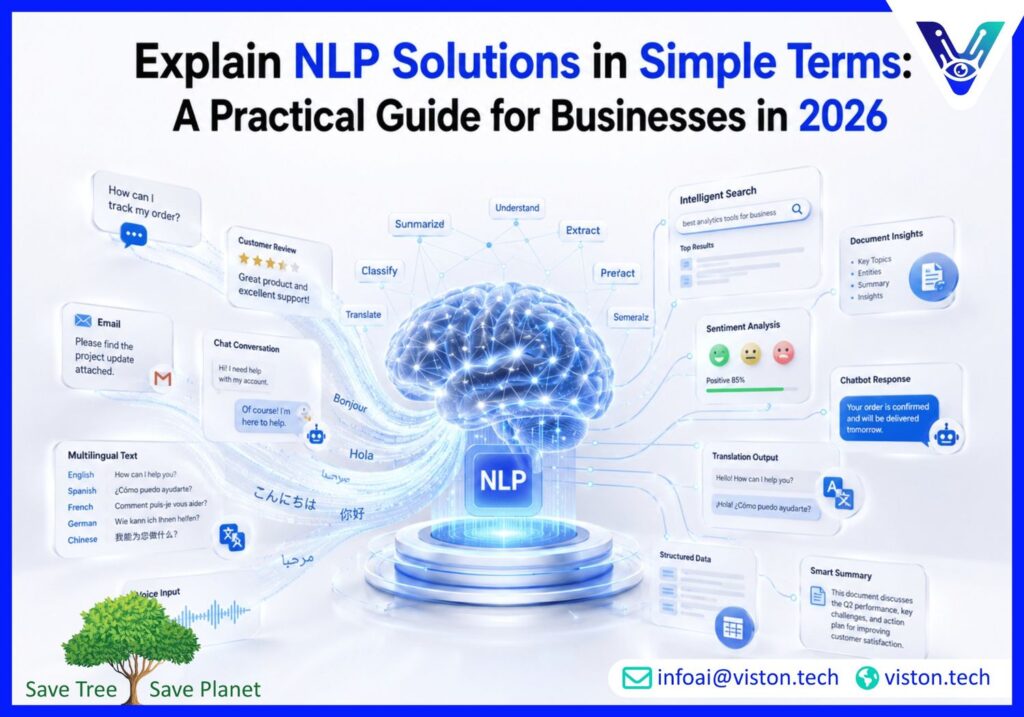 Businesses generate and receive huge amounts of text-based information every day through emails, customer support conversations, social media, surveys, documents, reviews, and internal communications. Natural Language Processing (NLP) solutions help organizations understand, analyze, and use this language data more efficiently. As AI adoption continues to grow in 2026, NLP has become an important technology for improving customer experiences, automating processes, and making better business decisions.