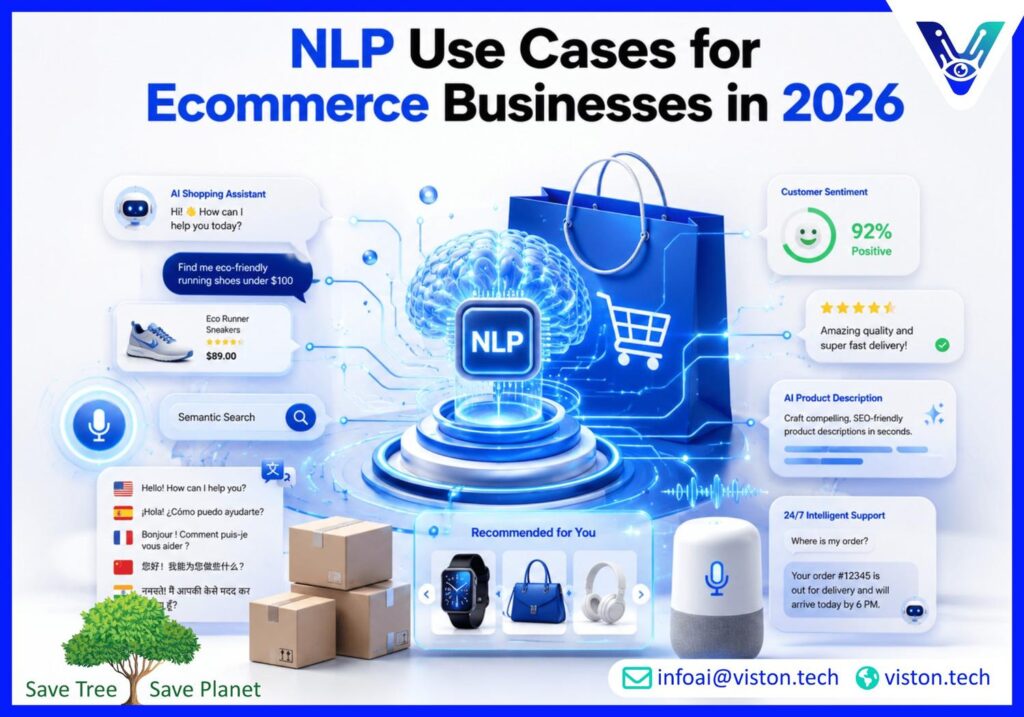
Customer expectations in ecommerce continue to evolve, with shoppers demanding faster responses, personalized experiences, and seamless interactions across digital channels. Natural Language Processing (NLP) has become a critical technology for ecommerce businesses looking to improve customer engagement, automate operations, and gain deeper insights from customer data. In 2026, NLP solutions are helping ecommerce companies transform how they communicate with customers, manage content, and drive revenue growth.
How NLP Is Transforming Ecommerce Operations
Natural Language Processing is a branch of artificial intelligence that enables computers to understand, interpret, and generate human language. For ecommerce businesses, this capability creates opportunities to automate communication, analyze customer feedback, and deliver more personalized shopping experiences.Modern NLP solutions can process large volumes of text from customer reviews, support tickets, chat conversations, emails, social media comments, and product descriptions. By extracting meaningful insights from this data, ecommerce companies can make faster and more informed business decisions.As AI technologies continue to mature, NLP has become an essential component of digital commerce strategies focused on scalability, efficiency, and customer satisfaction.
Key NLP Use Cases for Ecommerce Businesses
Intelligent Customer Support Chatbots
One of the most common NLP applications in ecommerce is AI-powered customer support. NLP-driven chatbots can understand customer questions, identify intent, and provide relevant responses without human intervention.These systems can handle tasks such as:
Order status inquiries
Shipping updates
Product recommendations
Return and refund requests
Frequently asked questions
Account management support
By automating routine interactions, businesses can reduce support costs while providing customers with immediate assistance 24/7.
Personalized Product Recommendations
NLP helps ecommerce platforms understand customer preferences by analyzing search queries, browsing behavior, reviews, and previous interactions.Instead of relying solely on purchase history, NLP systems can identify customer intent through natural language inputs and recommend products that closely match individual needs.This creates a more personalized shopping experience that can improve conversion rates, average order value, and customer retention.
Advanced Ecommerce Search
Traditional keyword-based search often struggles with spelling errors, conversational queries, and customer intent.NLP-powered search engines can understand context and semantic meaning, allowing customers to find products more accurately.Examples include:
“Affordable running shoes for beginners”
“Gift ideas for tech lovers”
“Waterproof backpack for travel”
Rather than matching exact keywords, NLP interprets the meaning behind the search, delivering more relevant results and reducing search abandonment.
Sentiment Analysis for Customer Feedback
Ecommerce businesses receive valuable feedback through reviews, surveys, social media, and support interactions.NLP-powered sentiment analysis can automatically classify customer opinions as positive, negative, or neutral while identifying recurring themes and concerns.Benefits include:
Understanding customer satisfaction levels
Detecting product issues early
Monitoring brand reputation
Improving customer experience initiatives
Supporting product development decisions
This enables businesses to act proactively based on real customer sentiment.
Revenue-Driving NLP Applications
Automated Product Description Generation
Managing large product catalogs can be resource-intensive. NLP-powered content generation can help create consistent, informative, and SEO-friendly product descriptions at scale.Benefits include:
Faster catalog expansion
Improved content consistency
Reduced manual workload
Enhanced search visibility
Better customer understanding of products
Human review remains important, but NLP significantly accelerates content production workflows.
Voice Commerce Optimization
As voice assistants and voice-enabled shopping continue to grow, NLP enables ecommerce businesses to support conversational purchasing experiences.Customers can search, compare, and purchase products using natural speech rather than traditional text-based interactions.Ecommerce businesses that optimize for voice search can improve accessibility while expanding customer engagement channels.
Review Analysis and Product Improvement
NLP systems can analyze thousands of customer reviews to identify common praise points, complaints, and feature requests.Instead of manually reviewing feedback, businesses can automatically discover:
Product quality issues
Frequently requested features
Customer pain points
Competitive advantages
Emerging market trends
This information supports data-driven product and merchandising decisions.
Operational Benefits of NLP in Ecommerce
Email Classification and Automation
Ecommerce businesses often manage large volumes of customer emails. NLP can automatically categorize incoming messages and route them to the appropriate department.Common categories include:
Order issues
Returns and refunds
Technical support
Product inquiries
Partnership requests
This improves response times and enhances customer service efficiency.
Fraud Detection and Risk Monitoring
NLP can support fraud prevention initiatives by analyzing customer communications, transaction notes, and behavioral patterns.Combined with machine learning models, NLP helps identify suspicious language patterns and anomalies that may indicate fraudulent activities.
Multilingual Customer Engagement
Global ecommerce businesses often serve customers across multiple countries and languages.NLP-powered language processing enables:
Automated translation
Multilingual customer support
Localized content generation
Cross-border customer communication
Improved international shopping experiences
This allows brands to scale internationally while maintaining consistent customer interactions.
What Ecommerce Businesses Should Consider Before Implementing NLP
Businesses should align NLP initiatives with specific operational goals rather than adopting technology for its own sake.A phased implementation approach often delivers better results by focusing first on high-impact areas such as customer support, search optimization, and sentiment analysis.
How Viston AI Helps Ecommerce Businesses Leverage NLP
As organizations increasingly seek intelligent automation and customer-centric digital experiences, NLP has become a strategic capability rather than an experimental technology.Viston AI specializes in Natural Language Processing solutions that help ecommerce businesses unlock value from customer conversations, reviews, support interactions, and content workflows. By combining advanced language models, automation capabilities, and business-focused implementation strategies, Viston AI helps organizations improve customer engagement, operational efficiency, and decision-making.For ecommerce companies, NLP solutions can support conversational AI, intelligent search, sentiment analysis, content generation, multilingual communication, and customer experience optimization. The focus is not simply on deploying AI models but on creating practical solutions that align with business objectives, customer expectations, and scalable growth strategies.As ecommerce competition continues to intensify, organizations that effectively leverage NLP are better positioned to deliver personalized experiences, streamline operations, and respond quickly to evolving customer needs.
Frequently Asked Questions
What is NLP in ecommerce?
NLP, or Natural Language Processing, is an AI technology that enables computers to understand and process human language. In ecommerce, it is used for chatbots, search optimization, sentiment analysis, and customer support automation.
How can NLP improve ecommerce customer service?
NLP-powered chatbots and virtual assistants can provide instant responses, automate routine inquiries, and improve support availability while reducing operational costs.
Can NLP help increase ecommerce sales?
Yes. NLP can improve product discovery, personalize recommendations, optimize search functionality, and enhance customer experiences, all of which can contribute to higher conversion rates.
Is NLP useful for analyzing customer reviews?
Absolutely. NLP can automatically analyze large volumes of reviews to identify customer sentiment, recurring issues, and opportunities for product improvement.
What ecommerce processes can be automated using NLP?
NLP can automate customer support, email classification, product content creation, review analysis, multilingual communication, and various customer engagement workflows.
Why choose Viston AI for NLP solutions?
Viston AI provides business-focused NLP solutions designed to help ecommerce companies improve customer experiences, automate operations, and gain actionable insights from language-based data.
Conclusion
NLP use cases for ecommerce businesses extend far beyond chatbots and customer support. From intelligent search and personalized recommendations to sentiment analysis and multilingual engagement, Natural Language Processing is helping ecommerce companies operate more efficiently and deliver better customer experiences. As digital commerce continues to evolve in 2026, businesses that strategically adopt NLP solutions can improve scalability, strengthen customer relationships, and create competitive advantages. For organizations seeking practical and business-focused Natural Language Processing solutions, Viston AI offers expertise that supports meaningful ecommerce growth and operational excellence.