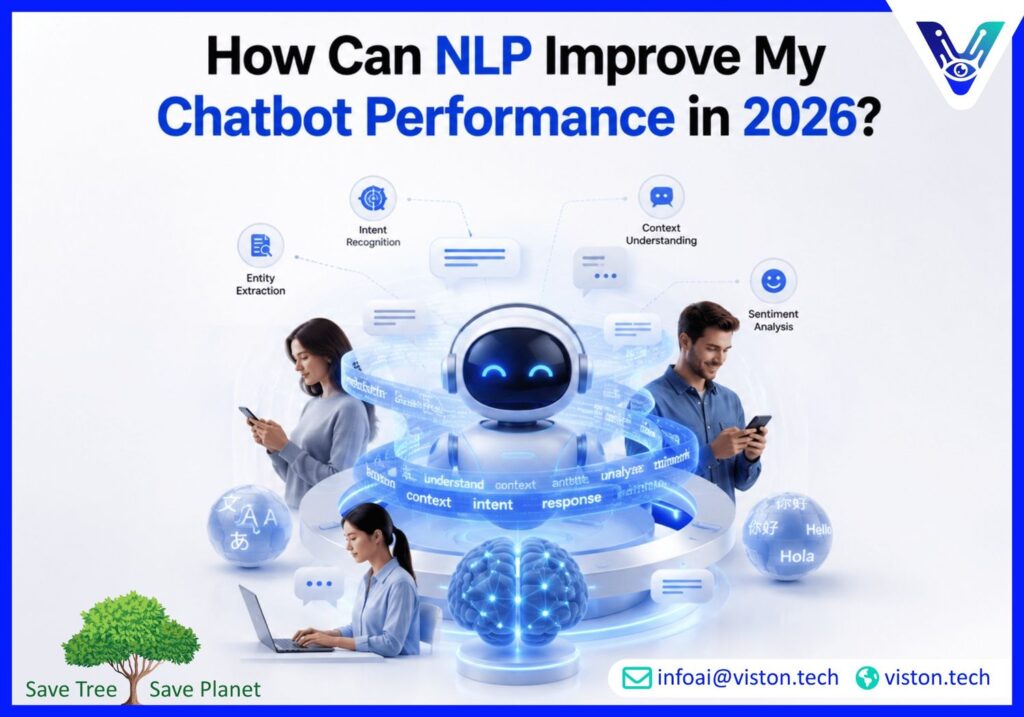
How Can NLP Improve My Chatbot Performance in 2026?
Businesses increasingly rely on chatbots to handle customer interactions, automate support, generate leads, and improve operational efficiency. However, a chatbot is only as effective as its ability to understand and respond to human language accurately. This is where Natural Language Processing (NLP) plays a critical role. Modern NLP solutions enable chatbots to deliver more natural, contextual, and intelligent conversations that improve customer experiences and business outcomes.
What NLP Means for Chatbot Performance
Natural Language Processing is a branch of artificial intelligence that enables computers to understand, interpret, process, and generate human language. In chatbot applications, NLP serves as the engine that helps systems understand user intent, recognize context, and provide relevant responses.Without NLP, chatbots typically rely on rigid keyword matching and predefined conversation paths. While this approach can work for simple queries, it often fails when users phrase questions differently or introduce complex requests.Advanced NLP-powered chatbots can:
Understand natural language variations
Identify customer intent accurately
Recognize entities such as names, locations, and products
Maintain conversational context
Support multilingual interactions
Deliver more human-like responses
Reduce misunderstandings and customer frustration
As customer expectations continue to rise in 2026, NLP has become a foundational technology for businesses seeking scalable and effective chatbot solutions.
Key Ways NLP Improves Chatbot Performance
Better Intent Recognition
One of the most important chatbot functions is identifying what a user wants. NLP models analyze sentence structure, language patterns, and contextual clues to determine user intent more accurately.For example, the following requests all express the same need:
“I want to track my order.”
“Where is my package?”
“Can you check my shipment status?”
A traditional rule-based chatbot may struggle to connect these variations. An NLP-powered chatbot recognizes the underlying intent and provides the appropriate response regardless of phrasing.
Improved Context Awareness
Modern NLP systems can maintain conversational context across multiple exchanges. This allows users to ask follow-up questions without repeating information.For example:User: “I need information about your pricing plans.”User: “Which one includes premium support?”The chatbot understands that the second question refers to pricing plans discussed earlier, resulting in a smoother customer experience.
Enhanced Entity Recognition
Named Entity Recognition (NER) helps chatbots identify important information within conversations.Examples include:
Customer names
Product names
Locations
Dates
Order numbers
Account information
By extracting these entities automatically, chatbots can personalize interactions and streamline processes without requiring excessive user input.
More Natural Conversations
Advanced NLP models help chatbots understand language nuances, sentence structures, and conversational flow. This enables responses that sound more natural and relevant.Natural interactions increase user engagement and reduce abandonment rates, especially in customer support, sales, and onboarding workflows.
Business Benefits of NLP-Powered Chatbots
Organizations implementing NLP solutions within chatbot environments often experience measurable operational and customer service improvements.
Faster Customer Support
NLP enables chatbots to understand customer requests immediately and provide accurate answers without requiring human intervention for routine inquiries.This reduces:
Support ticket volumes
Response times
Operational costs
Agent workload
Higher Customer Satisfaction
Customers expect quick and accurate responses. NLP improves response quality, helping users receive relevant information without navigating complex menus or repeating questions.Better experiences often translate into stronger customer retention and loyalty.
Scalable Customer Engagement
As businesses grow, handling increasing customer interactions becomes challenging. NLP-powered chatbots can manage thousands of conversations simultaneously while maintaining consistent service quality.This scalability is particularly valuable for eCommerce, SaaS, healthcare, financial services, education, and customer service organizations.
Lead Qualification and Sales Support
NLP chatbots can collect information, qualify prospects, answer product questions, and guide users through buying journeys.By understanding intent and conversational signals, these systems help sales teams focus on high-quality opportunities.
Important NLP Capabilities for Modern Chatbots in 2026
Businesses evaluating chatbot technologies should look beyond basic automation and consider advanced NLP capabilities.
Sentiment Analysis
Sentiment analysis enables chatbots to identify customer emotions and adjust responses accordingly.For example, frustrated customers can be escalated to human agents faster, helping prevent negative experiences.
Multilingual Processing
Global businesses increasingly serve diverse customer bases. NLP models can support multiple languages while maintaining conversational quality.This capability improves accessibility and customer engagement across regions.
Intent Classification Models
Advanced machine learning models continuously improve intent recognition through training and optimization.The result is higher chatbot accuracy and reduced misunderstanding rates over time.
Knowledge Base Integration
NLP systems can connect with internal documentation, product databases, FAQs, and enterprise systems.This allows chatbots to provide dynamic and contextually accurate information rather than relying solely on static scripts.
Generative AI Integration
Many modern chatbot solutions combine NLP with large language models and generative AI technologies.This enables richer conversations, dynamic responses, and more sophisticated customer assistance while maintaining business-specific controls and governance.
Best Practices for Improving Chatbot Performance with NLP
Simply implementing NLP is not enough. Successful chatbot initiatives require ongoing optimization.
Train models using real customer conversations.
Continuously refine intent classifications.
Monitor chatbot analytics and performance metrics.
Maintain updated knowledge bases.
Implement human handoff mechanisms.
Use sentiment detection where appropriate.
Support multilingual customer interactions when needed.
Ensure data privacy and security compliance.
Organizations that treat NLP as an ongoing capability rather than a one-time implementation generally achieve better long-term performance.
How Viston AI Supports NLP-Powered Chatbot Solutions
As businesses seek smarter conversational experiences, NLP solutions have become a key component of customer engagement and automation strategies. Viston AI focuses on Natural Language Processing solutions that help organizations build intelligent systems capable of understanding, processing, and responding to human language effectively.For chatbot applications, NLP capabilities can improve intent recognition, contextual understanding, conversation accuracy, and customer satisfaction. Organizations often face challenges such as inconsistent responses, poor query understanding, limited scalability, and difficulty handling complex customer interactions. Effective NLP implementation addresses these challenges through advanced language processing, machine learning models, entity extraction, sentiment analysis, and conversational intelligence.By aligning NLP technologies with business objectives, companies can create chatbot experiences that support customer service, lead generation, knowledge management, and operational efficiency initiatives. Modern NLP solutions also enable integration with enterprise systems, CRM platforms, support tools, and knowledge repositories, creating more connected and intelligent customer experiences.As chatbot expectations continue to evolve in 2026, organizations increasingly require NLP expertise that combines technical capabilities with practical business applications, helping transform automated conversations into meaningful customer interactions.
Frequently Asked Questions
How does NLP make a chatbot smarter?
NLP helps chatbots understand user intent, context, and language variations, enabling more accurate and natural conversations.
Can NLP improve chatbot customer satisfaction?
Yes. NLP reduces misunderstandings, provides more relevant responses, and creates smoother customer interactions, which can improve satisfaction levels.
Is NLP necessary for enterprise chatbots?
For most enterprise applications, NLP is essential because it enables scalability, contextual understanding, personalization, and efficient handling of diverse customer inquiries.
What NLP features are most important for chatbots?
Intent recognition, entity extraction, sentiment analysis, contextual understanding, multilingual support, and knowledge base integration are among the most valuable NLP capabilities.
Can NLP-powered chatbots support multiple languages?
Yes. Modern NLP solutions can process and respond in multiple languages, helping businesses serve international customers more effectively.
How can Viston AI help with chatbot NLP solutions?
Viston AI provides Natural Language Processing solutions that can help organizations improve chatbot understanding, conversational accuracy, automation capabilities, and overall customer engagement outcomes.
Conclusion
Natural Language Processing has become one of the most important technologies for improving chatbot performance in 2026. From intent recognition and contextual understanding to sentiment analysis and multilingual support, NLP enables chatbots to deliver more intelligent, accurate, and customer-friendly interactions. Businesses that invest in robust Natural Language Processing solutions can improve customer service efficiency, enhance user experiences, and scale conversational automation more effectively. For organizations exploring advanced chatbot capabilities, NLP remains a critical foundation for achieving meaningful and measurable business results.