What Is LLM Chatbot Development? A Business Guide for 2026
Large Language Models (LLMs) have transformed how businesses use conversational AI. Unlike traditional rule-based chatbots that follow predefined scripts, LLM-powered chatbots can understand context, generate human-like responses, and support more complex interactions. As organizations increasingly adopt AI-driven customer engagement and automation strategies, understanding LLM chatbot development has become essential for business leaders evaluating modern chatbot solutions.
Understanding LLM Chatbot Development
LLM chatbot development refers to the process of designing, building, integrating, and deploying chatbots powered by Large Language Models. These models are trained on vast amounts of text data and can understand natural language, interpret intent, generate responses, and perform a wide range of conversational tasks.Unlike traditional chatbots that rely on fixed decision trees and predefined responses, LLM chatbots can:
Understand complex user queries
Maintain conversational context
Generate dynamic responses
Support multi-turn conversations
Interpret natural language variations
Access external knowledge sources
Handle diverse business use cases
As a result, businesses can provide more natural, personalized, and efficient user experiences across customer-facing and internal operations.
Why LLM Chatbots Matter for Businesses in 2026
The expectations of customers and employees have changed significantly. Users increasingly expect instant, accurate, and conversational support regardless of the channel they use.LLM chatbot development enables businesses to address several operational challenges:
High customer support volumes
Slow response times
Inconsistent customer experiences
Limited support availability
Manual information retrieval processes
Lead qualification inefficiencies
Knowledge management challenges
Modern LLM chatbots help organizations improve accessibility to information while reducing repetitive workloads for support, sales, and operations teams.
Key Advantages of LLM-Powered Chatbots
More human-like conversations
Improved intent recognition
Better handling of complex questions
Continuous learning and optimization opportunities
Scalability across multiple channels
Enhanced personalization capabilities
Support for multilingual interactions
These capabilities make LLM chatbots valuable assets for businesses seeking to improve customer engagement and operational efficiency.
Core Components of LLM Chatbot Development
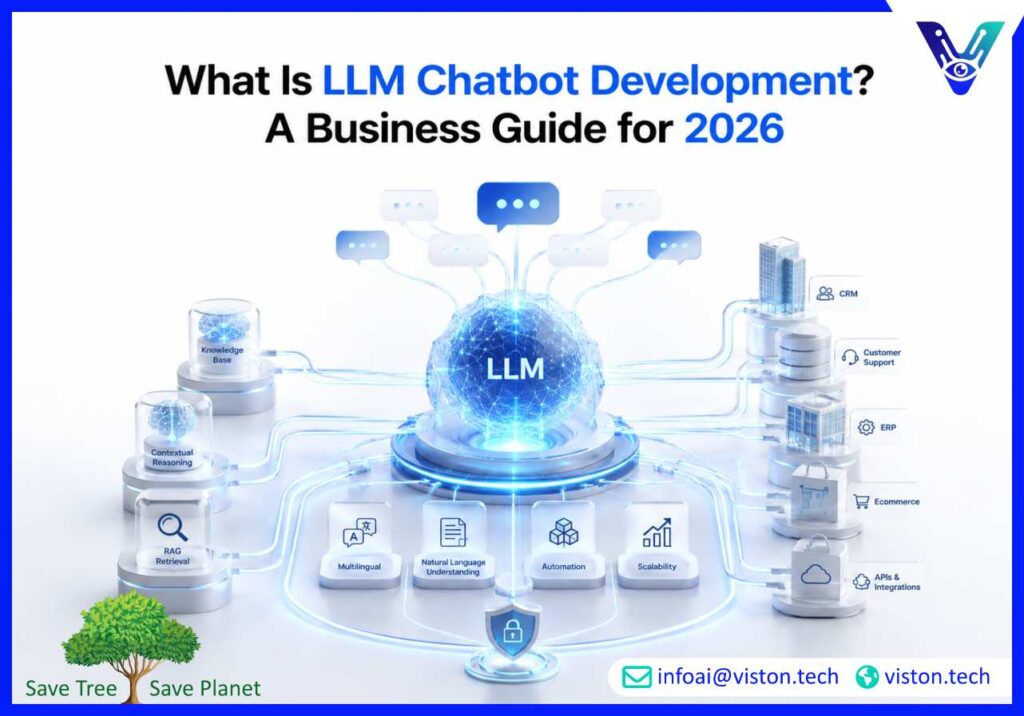
Successful LLM chatbot development involves more than selecting a language model. Businesses must design a complete ecosystem that supports reliable and secure interactions.
Language Model Selection
The chosen LLM serves as the foundation of the chatbot. Different models offer varying strengths in reasoning, response quality, customization, scalability, and deployment flexibility.
Knowledge Base Integration
Many business chatbots require access to company-specific information such as product documentation, support articles, policies, and operational procedures.Retrieval-Augmented Generation (RAG) architectures are increasingly used to connect LLMs with organizational knowledge sources, improving accuracy and reducing hallucinations.
System Integrations
Modern chatbots often connect with:
CRM platforms
Customer support systems
ERP solutions
Marketing automation tools
Ecommerce platforms
Scheduling applications
Internal databases
These integrations enable chatbots to provide real-time information and execute business workflows.
Conversation Design
Even advanced AI models require structured conversation planning. Effective chatbot design includes:
User journey mapping
Intent identification
Fallback handling
Human escalation workflows
Context management
Response quality controls
Common Business Use Cases for LLM Chatbots
LLM chatbot development supports a wide range of business applications across industries.
Customer Support Automation
Organizations use LLM chatbots to answer frequently asked questions, resolve common issues, provide troubleshooting guidance, and route complex cases to human agents.
Lead Generation and Qualification
Chatbots can engage website visitors, gather requirements, qualify prospects, and schedule consultations, helping sales teams focus on high-value opportunities.
Employee Self-Service
Internal chatbots assist employees with HR policies, IT support requests, onboarding resources, and company knowledge retrieval.
Ecommerce Assistance
Retail businesses use LLM chatbots to provide product recommendations, order tracking, shopping assistance, and personalized customer support.
Knowledge Management
Organizations can make internal documentation more accessible by enabling employees to ask questions conversationally rather than manually searching through large knowledge repositories.
Key Considerations Before Developing an LLM Chatbot
Businesses evaluating LLM chatbot development should consider several important factors before implementation.
Data Security and Privacy
Organizations must establish appropriate safeguards for customer data, internal information, and regulatory compliance requirements.
Response Accuracy
While LLMs are highly capable, they can occasionally generate inaccurate information. Validation mechanisms and knowledge retrieval systems help improve reliability.
Integration Requirements
The chatbot should integrate effectively with existing business systems to maximize operational value.
Scalability
Businesses should choose architectures capable of supporting future growth, increased usage volumes, and expanding use cases.
Governance and Monitoring
Continuous monitoring, analytics, testing, and optimization are essential for maintaining chatbot performance and user satisfaction.
How Viston AI Supports LLM Chatbot Integration for Businesses
As organizations adopt conversational AI technologies, successful implementation depends on more than simply deploying a language model. Effective solutions require integration with existing business systems, workflows, customer touchpoints, and operational processes.Viston AI specializes in AI Chatbot Integration, helping businesses connect advanced chatbot capabilities with CRM platforms, support systems, knowledge bases, communication channels, and other critical business applications. This integration-focused approach enables organizations to create connected conversational experiences that support customer engagement, automation, and operational efficiency.Businesses exploring LLM chatbot development often require scalable integration strategies, secure data access, workflow automation, performance monitoring, and user experience optimization. By focusing on practical implementation and system interoperability, Viston AI helps organizations transform AI capabilities into meaningful business outcomes.As LLM technologies continue to evolve throughout 2026, integration expertise remains a critical factor in achieving reliable, scalable, and business-ready chatbot deployments.
Frequently Asked Questions
What does LLM stand for in chatbot development?
LLM stands for Large Language Model. It is an AI model trained on large volumes of text data that enables chatbots to understand and generate natural language responses.
How is an LLM chatbot different from a traditional chatbot?
Traditional chatbots rely on predefined rules and scripted responses, while LLM chatbots can understand context, interpret complex questions, and generate dynamic conversational responses.
Can LLM chatbots integrate with business systems?
Yes. Modern LLM chatbots can integrate with CRM platforms, helpdesk systems, databases, ERP software, ecommerce platforms, and other business applications through APIs and integration frameworks.
Are LLM chatbots suitable for customer support?
Yes. LLM chatbots are widely used for customer support because they can handle a broad range of inquiries, provide contextual responses, and support self-service experiences.
How can Viston AI help with LLM chatbot projects?
Viston AI provides AI Chatbot Integration services that help businesses connect LLM-powered chatbots with existing systems, workflows, and operational processes to create scalable and effective conversational AI solutions.
Conclusion
LLM chatbot development represents a significant advancement in conversational AI, enabling businesses to deliver more intelligent, personalized, and scalable interactions. From customer support and lead generation to employee assistance and knowledge management, LLM-powered chatbots offer practical solutions to a wide range of business challenges. However, achieving meaningful results requires strong integration, governance, security, and optimization strategies. Organizations investing in AI Chatbot Integration can maximize the value of LLM technologies by ensuring their chatbot solutions are connected to the systems, data, and workflows that drive real business outcomes. For businesses pursuing this approach, Viston AI provides the integration expertise needed to support successful chatbot deployments in 2026.