
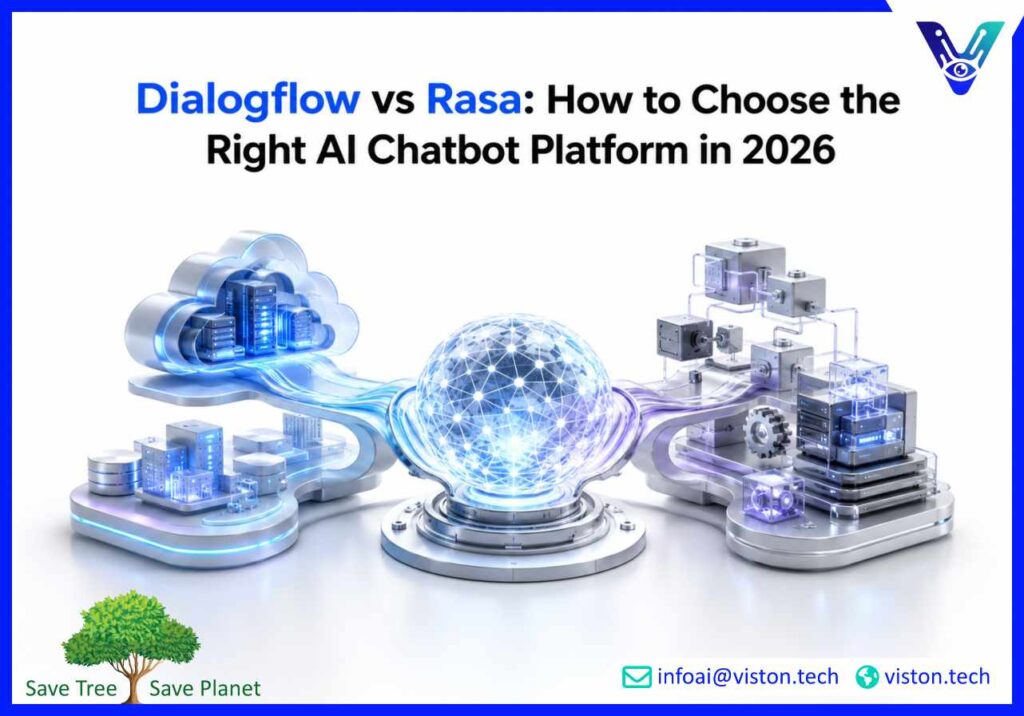
Choosing between Dialogflow and Rasa has become a key decision for businesses investing in conversational AI. Both platforms are widely used for building intelligent chatbots, but they differ significantly in architecture, flexibility, control, and deployment approach. For organizations planning scalable AI chatbot development strategies, understanding these differences is essential to avoid costly rework and ensure long-term success.
Dialogflow and Rasa are two leading frameworks used to build AI-powered conversational systems, but they follow fundamentally different philosophies in how chatbots are designed, trained, and deployed.
Dialogflow, developed by Google, is a cloud-based natural language understanding platform that allows developers to build conversational interfaces for websites, apps, and messaging platforms. It offers a managed environment where much of the infrastructure, scaling, and machine learning capabilities are handled by Google Cloud.
Rasa, on the other hand, is an open-source conversational AI framework designed for teams that want full control over their chatbot architecture. It allows businesses to build, train, and deploy chatbots on their own infrastructure, giving them complete ownership of data and conversational logic.
In 2026, businesses are no longer choosing chatbot platforms based only on ease of setup. They are evaluating factors such as data privacy, customization depth, integration flexibility, cost scalability, and long-term ownership of conversational intelligence systems.
For companies building serious AI chatbot development strategies, both tools offer strong capabilities—but serve very different business needs.
The most important difference between Dialogflow and Rasa lies in their underlying architecture and control model.
Dialogflow operates as a fully managed cloud service. It provides built-in natural language understanding (NLU), intent classification, entity recognition, and integration with Google Cloud services.
Key characteristics include:
This makes Dialogflow attractive for businesses that want faster time-to-market without managing infrastructure complexity.
Rasa follows a modular open-source architecture that gives developers full control over every layer of the chatbot stack.
Key characteristics include:
Rasa is often preferred by organizations that require high customization, strict data privacy, or industry-specific conversational logic.
While Dialogflow emphasizes simplicity and managed AI services, Rasa emphasizes flexibility and engineering control. This difference significantly impacts how each platform is used in real-world AI chatbot development projects.
When choosing between Dialogflow and Rasa, businesses must evaluate more than just features. The decision should align with long-term operational goals, technical capacity, and data governance requirements.
Dialogflow is generally easier for rapid chatbot deployment. Its visual interface and prebuilt models allow teams to build functional chatbots quickly, even with limited machine learning expertise.
Rasa requires more technical setup and development effort but offers deeper customization and control over conversational behavior.
Rasa provides significantly higher flexibility. Developers can modify machine learning pipelines, define custom actions, and integrate complex business logic.
Dialogflow offers customization within predefined limits, making it less flexible for highly specialized use cases.
Rasa is often preferred in industries where data control is critical, such as healthcare, finance, and government systems, because it can be deployed on-premise without sending data to external cloud services.
Dialogflow processes data within Google Cloud infrastructure, which may not meet strict regulatory requirements in certain enterprise environments.
Dialogflow uses a usage-based pricing model tied to Google Cloud services. This can be cost-effective for small to medium deployments but may become expensive at scale depending on usage volume.
Rasa is open-source, meaning there are no licensing costs, but businesses must invest in infrastructure, engineering resources, and maintenance.
In practice, Dialogflow reduces operational overhead, while Rasa shifts costs toward internal engineering and infrastructure management.
Both platforms support integrations with messaging channels, CRMs, APIs, and enterprise systems. However, Rasa provides more flexibility for custom integrations due to its open architecture.
Dialogflow offers faster plug-and-play integrations, especially within the Google ecosystem.
The right choice depends on the business model, technical resources, and long-term AI strategy.
In 2026, many organizations also adopt a hybrid approach—using Dialogflow for quick customer-facing bots and Rasa for complex internal or enterprise workflows requiring deeper customization.
Beyond platform selection, successful chatbot implementation depends on how well the system is designed, trained, and integrated into business operations.
Regardless of whether Dialogflow or Rasa is chosen, organizations must focus on several key implementation factors:
Another critical factor is conversational design. A chatbot is only as effective as its ability to guide users toward meaningful outcomes. Poorly designed conversation flows can lead to frustration, even if the underlying AI model is strong.
Businesses must also consider long-term maintenance. Chatbots are not static systems—they require continuous training, optimization, and updates as user behavior and business requirements evolve.
From an AI chatbot development perspective, both Dialogflow and Rasa can deliver strong outcomes when implemented with a clear strategy and strong operational alignment.
For businesses evaluating Dialogflow vs Rasa, the decision often comes down to balancing speed, control, scalability, and long-term ownership of conversational systems. Viston AI works with organizations to design and implement AI chatbot development strategies that align with their technical capabilities and business objectives.
Instead of focusing solely on platform features, successful chatbot adoption depends on understanding business workflows, integration requirements, data sensitivity, and user experience expectations. Viston AI helps organizations assess whether a managed solution like Dialogflow or a customizable framework like Rasa better fits their operational needs.
By aligning chatbot architecture with real business requirements, companies can avoid over-engineering or underutilizing their AI systems. This ensures that chatbot investments contribute directly to customer engagement, automation efficiency, and long-term scalability across digital channels.
Neither platform is universally better. Dialogflow is better for quick deployment and managed infrastructure, while Rasa is better for customization, control, and enterprise-grade flexibility.
Yes, Rasa is open-source, but businesses must account for infrastructure, development, and maintenance costs when deploying it at scale.
Dialogflow can handle moderately complex chatbots, but highly customized workflows may be easier to implement in Rasa due to its flexible architecture.
Enterprises that prioritize data control and customization often prefer Rasa, while those seeking faster deployment and managed services may choose Dialogflow.
Yes, but migration requires restructuring intents, training data, and conversation logic, so platform selection should be made carefully from the start.
Yes, Viston AI supports AI chatbot development across both platforms, helping businesses select, design, and deploy the most suitable conversational AI solution.
Choosing between Dialogflow and Rasa is ultimately a strategic decision that impacts scalability, control, and long-term AI capability. Dialogflow offers speed, simplicity, and managed infrastructure, making it ideal for businesses that want fast deployment. Rasa provides deep customization, data ownership, and architectural flexibility, making it suitable for complex or regulated environments. In 2026, organizations must evaluate not just features but long-term business alignment when selecting a chatbot platform. A well-informed decision ensures that AI chatbot development efforts deliver sustainable value, improved customer engagement, and operational efficiency.
