
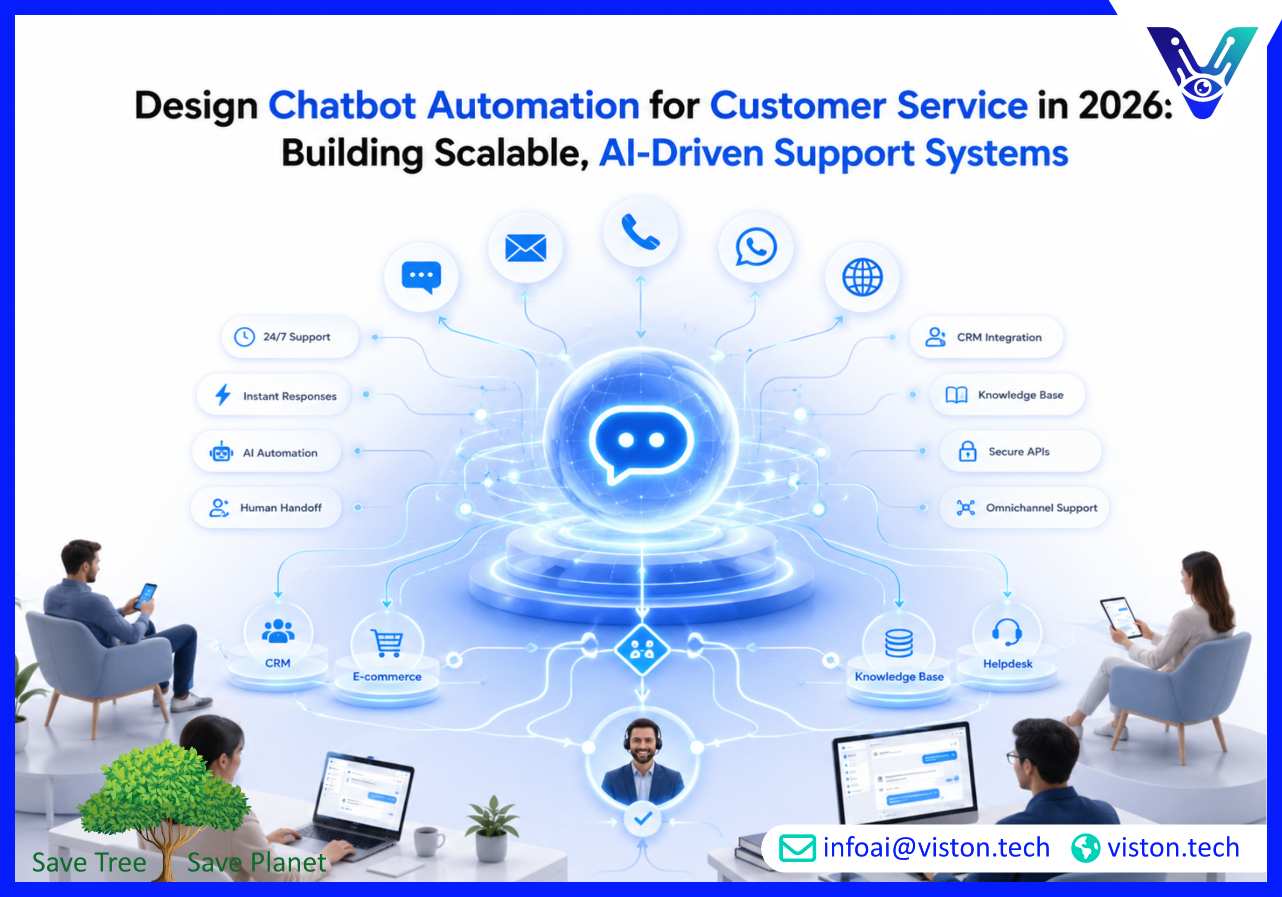
Designing chatbot automation for customer service has become a critical priority for businesses aiming to deliver faster, more consistent, and cost-efficient support experiences. In 2026, customer expectations are shaped by instant responses, personalized assistance, and seamless omnichannel interactions. Companies that invest in structured AI chatbot automation can significantly improve resolution times, reduce support workloads, and enhance overall customer satisfaction across global markets.
Customer service is no longer just a reactive function. It has become a key differentiator for brands competing in digital-first environments. Chatbot automation plays a central role in transforming support operations by handling repetitive queries, guiding users through processes, and escalating complex issues to human agents when needed.
Businesses across industries such as SaaS, ecommerce, healthcare, finance, and retail are increasingly adopting AI chatbot systems to meet rising demand for 24/7 support availability and instant resolution expectations.
Key drivers behind chatbot automation adoption include:
In this environment, chatbot automation is not just a tool—it is a strategic infrastructure layer for modern customer service operations.
At the core of chatbot automation is the ability to understand user intent. Natural Language Understanding (NLU) enables chatbots to interpret customer messages accurately, even when phrased informally or inconsistently.
Strong intent recognition systems allow chatbots to classify queries into categories such as billing issues, technical support, account management, order tracking, or general inquiries.
Customer service chatbots rely on structured workflows that guide users through predefined resolution paths.
Chatbot automation must integrate with core business systems for real-time support.
A seamless transition from chatbot to human agent is essential.
Analyze support data to find common issues such as password resets, order tracking, refunds, and troubleshooting.
Create structured flows that guide users toward resolution.
Determine which issues should be handled by AI and which require human support.
Reduce conversation steps to improve customer satisfaction.
Different phrasing makes intent detection challenging without strong training data.
Over-automation can reduce customer satisfaction if human access is limited.
Connecting multiple systems requires secure APIs and ongoing maintenance.
Chatbots require ongoing improvements based on conversation data.
Viston AI helps businesses design and implement AI chatbot development solutions focused on customer service automation.
Its approach emphasizes integration with CRM systems, helpdesk tools, ecommerce platforms, and internal knowledge bases to build fully connected automation ecosystems.
Instead of standalone bots, Viston AI builds structured conversational systems that improve response times, reduce support costs, and enhance customer experience.
In 2026, scalable chatbot automation is essential for global customer support operations, and Viston AI supports businesses in achieving this through practical, workflow-driven AI systems.
It is the use of AI chatbots to handle customer queries and automate support workflows without human intervention for every request.
They handle FAQs, order tracking, billing issues, account management, and basic troubleshooting.
No, they support human agents by handling repetitive tasks and escalating complex issues.
It improves speed, availability, consistency, and customer satisfaction.
Yes, including SaaS, ecommerce, healthcare, finance, and retail.
It builds AI chatbot systems that integrate with business tools and automate customer service workflows.
Designing chatbot automation for customer service is essential for modern businesses aiming to scale support efficiently. In 2026, organizations must balance automation and human interaction to meet rising customer expectations. Well-designed chatbot systems improve response time, reduce operational cost, and enhance overall customer experience. Businesses that adopt structured AI chatbot automation strategies will be better positioned for long-term growth and global scalability.
