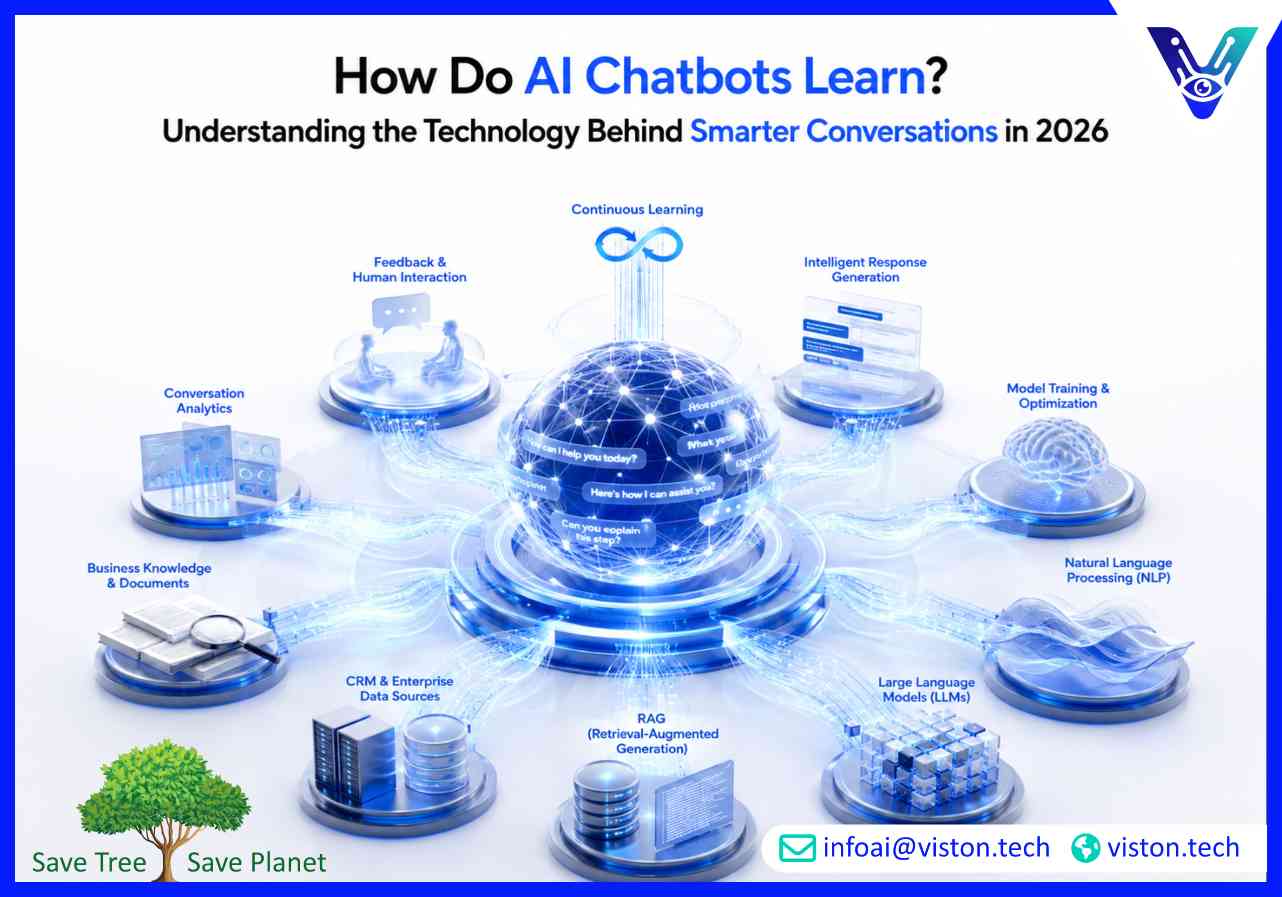
How Do AI Chatbots Learn? Understanding the Technology Behind Smarter Conversations in 2026
AI chatbots have become an essential part of modern business operations, helping organizations automate customer support, qualify leads, streamline workflows, and improve customer experiences. As adoption continues to grow in 2026, many business leaders ask an important question: how do AI chatbots learn? Understanding how chatbots develop and improve their responses helps businesses make informed decisions about AI chatbot integration and long-term automation strategies.
What Does It Mean for an AI Chatbot to Learn?
Unlike traditional rule-based chatbots that follow fixed scripts, AI chatbots use advanced technologies such as machine learning, natural language processing (NLP), and large language models (LLMs) to understand and respond to human conversations.When people say an AI chatbot “learns,” they generally mean the system becomes better at understanding user intent, recognizing patterns, retrieving relevant information, and generating more accurate responses over time.AI chatbots do not learn exactly like humans. Instead, they improve through training data, model updates, feedback mechanisms, performance monitoring, and integration with business knowledge sources.Modern AI chatbot learning typically involves:
Language model training
Natural language understanding
Pattern recognition
Intent classification
Knowledge retrieval
Feedback-based optimization
Conversation analytics
Continuous model refinement
How AI Chatbots Learn Before Deployment
Most of an AI chatbot’s learning happens before businesses deploy it.
Training on Large Datasets
Foundation AI models are trained using massive collections of publicly available text, books, websites, documentation, articles, and other language sources. This training helps the model understand grammar, sentence structure, context, relationships between concepts, and conversational patterns.During training, the AI identifies statistical patterns in language and develops the ability to predict meaningful responses based on user input.
Learning Language Patterns
Rather than memorizing every sentence, AI models learn relationships between words, phrases, concepts, and contexts.For example, a chatbot learns that phrases such as:
“I need help with my order”
“Where is my package?”
“Can I track my shipment?”
may all relate to a common customer service intent involving order tracking.This allows chatbots to understand requests even when users phrase them differently.
Natural Language Processing (NLP)
NLP enables chatbots to interpret human language in a way computers can process.NLP helps AI chatbots:
Understand user intent
Recognize entities and keywords
Interpret context
Handle spelling variations
Process conversational language
Identify sentiment
As NLP technology advances, chatbots become more capable of handling complex conversations and nuanced customer requests.
How AI Chatbots Learn After Integration
Once integrated into a business environment, AI chatbots can continue improving through controlled optimization processes.
Business Knowledge Integration
Many modern AI chatbots are connected to company-specific information sources such as:
Knowledge bases
CRM systems
Support documentation
Internal databases
Product catalogs
Policy documents
Training materials
Instead of relying solely on pre-trained knowledge, chatbots retrieve relevant information from these sources to provide accurate and business-specific responses.
Conversation Analytics
Organizations analyze chatbot interactions to identify:
Frequently asked questions
Conversation drop-off points
Failed responses
Escalation triggers
Customer satisfaction trends
Emerging support topics
These insights help businesses improve chatbot workflows and expand knowledge coverage.
Feedback Loops
Many AI chatbot systems collect user feedback through ratings, surveys, or support outcomes.Feedback helps organizations determine:
Which responses are effective
Which answers require improvement
Where additional training data is needed
What information users struggle to find
This creates a structured improvement process that increases chatbot effectiveness over time.
Key Technologies That Help AI Chatbots Learn
Machine Learning
Machine learning enables systems to identify patterns within data and improve performance based on observed outcomes.In chatbot environments, machine learning can help:
Improve intent recognition
Optimize recommendations
Enhance routing decisions
Personalize interactions
Improve response accuracy
Large Language Models (LLMs)
Large language models form the foundation of many advanced AI chatbots in 2026.These models allow chatbots to:
Generate natural responses
Understand context
Handle multi-turn conversations
Summarize information
Answer complex questions
Support multiple languages
LLMs significantly expand chatbot capabilities beyond traditional scripted automation.
Retrieval-Augmented Generation (RAG)
Many businesses now use Retrieval-Augmented Generation (RAG) architectures.Rather than depending entirely on model memory, RAG systems retrieve relevant information from approved business data sources before generating responses.This approach improves:
Accuracy
Data freshness
Compliance
Business relevance
Response consistency
RAG has become one of the most important technologies for enterprise AI chatbot integration.
What AI Chatbots Cannot Learn Automatically
A common misconception is that AI chatbots automatically improve themselves from every conversation.In reality, responsible AI deployments often restrict autonomous learning to protect accuracy, security, and compliance.Businesses generally control how chatbot updates occur to prevent:
Incorrect information adoption
Data privacy risks
Bias introduction
Compliance violations
Security vulnerabilities
Most enterprise AI chatbots learn through monitored training, curated knowledge updates, and controlled optimization processes rather than unrestricted self-learning.
Why Continuous Learning Matters for Business Success
Customer expectations, products, regulations, and business processes constantly evolve. A chatbot that remains static quickly becomes less effective.Continuous learning and optimization help businesses:
Maintain response accuracy
Support new products and services
Reduce support workload
Improve customer satisfaction
Increase automation efficiency
Adapt to changing business needs
Scale customer interactions
Organizations that actively manage chatbot improvement programs often achieve significantly better results than those treating chatbot deployment as a one-time project.
How Viston AI Supports AI Chatbot Learning Through Integration
Understanding how AI chatbots learn is essential when implementing business-focused AI solutions. Viston AI helps organizations integrate AI chatbots with the systems, knowledge sources, and workflows that enable meaningful and accurate conversational experiences.Effective AI chatbot integration goes beyond deployment. It requires connecting chatbots to business data, CRM platforms, support systems, documentation repositories, and operational workflows that provide relevant context for customer interactions. Through proper integration, monitoring, analytics, and optimization strategies, businesses can continuously improve chatbot performance while maintaining security, compliance, and reliability.As AI adoption accelerates in 2026, organizations increasingly benefit from chatbot integration approaches that support ongoing learning, knowledge management, personalization, and scalable automation across multiple customer touchpoints.
Frequently Asked Questions
Do AI chatbots learn from every conversation?
Not automatically. Most enterprise chatbots use controlled learning processes that review conversation data, feedback, and knowledge updates before implementing improvements.
What helps AI chatbots become more accurate?
Accurate training data, quality knowledge sources, effective AI chatbot integration, continuous monitoring, and regular optimization all contribute to better chatbot performance.
Can AI chatbots learn company-specific information?
Yes. Through integrations with knowledge bases, CRM systems, documents, and business databases, chatbots can access and utilize company-specific information.
What is the role of NLP in chatbot learning?
Natural Language Processing helps chatbots understand human language, identify intent, interpret context, and generate relevant responses during conversations.
How does Viston AI help businesses improve chatbot learning?
Viston AI supports AI chatbot integration by connecting conversational AI systems with business data, workflows, and knowledge sources that help improve accuracy, relevance, and operational value.
Conclusion
Understanding how AI chatbots learn helps businesses make smarter decisions about AI chatbot integration and long-term automation investments. Modern chatbots improve through a combination of machine learning, NLP, large language models, business knowledge integration, analytics, and structured optimization processes. While AI systems do not learn independently without oversight, they can become increasingly effective when supported by the right data, workflows, and governance frameworks. As organizations continue expanding AI initiatives in 2026, investing in robust AI chatbot integration strategies will play a critical role in maximizing chatbot accuracy, business value, and customer experience outcomes.