
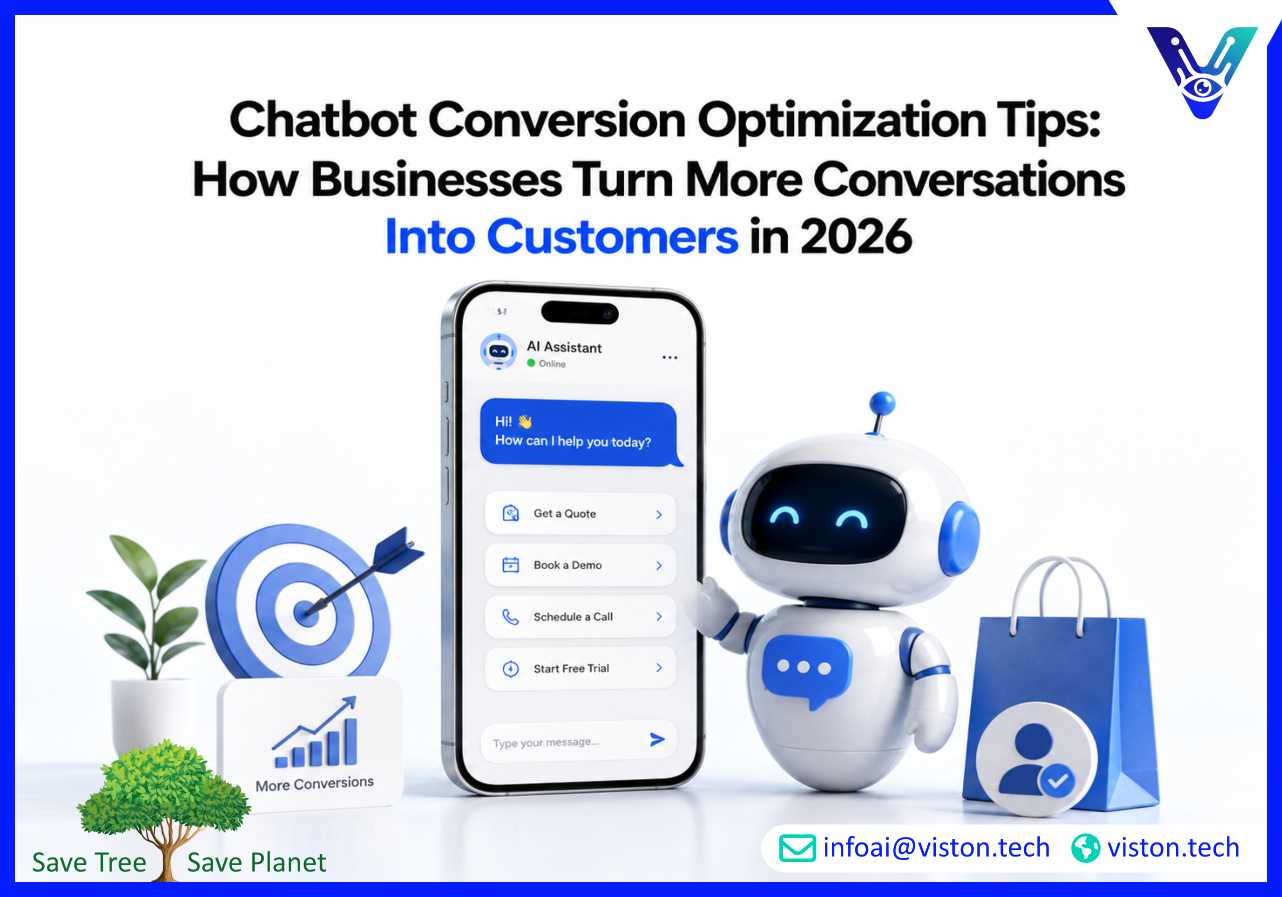
AI chatbots have become an important part of digital customer acquisition strategies. However, simply deploying a chatbot does not guarantee results. Businesses that achieve strong returns focus on chatbot conversion optimization to ensure conversations guide users toward meaningful actions. In 2026, organizations are increasingly refining chatbot experiences to improve lead generation, customer engagement, and revenue growth.
Modern customers expect fast, personalized, and frictionless interactions. A chatbot that answers questions but fails to move users toward a conversion opportunity can create engagement without delivering business value.
Conversion optimization focuses on improving how effectively a chatbot helps users complete desired actions such as:
As AI chatbot integration becomes more sophisticated, businesses are measuring chatbot performance based on outcomes rather than conversation volume alone.
Many businesses invest in chatbot technology but struggle to achieve strong conversion performance because of avoidable design and integration issues.
Users should quickly understand what the chatbot can help them achieve. When conversations lack direction, engagement often drops before conversion opportunities appear.
Long qualification sequences can create friction and increase abandonment rates. Collecting excessive information before providing value often discourages users from continuing.
Generic chatbot responses make interactions feel disconnected from user needs. Customers increasingly expect contextual and personalized experiences.
Without integration with CRM systems, support platforms, and customer databases, chatbots may struggle to provide relevant recommendations or accurate information.
Some users prefer assistance from a live representative before making important purchasing decisions. Missing escalation options can reduce trust and limit conversions.
Organizations that consistently improve chatbot conversion rates typically focus on both user experience and technical integration.
The opening interaction should immediately communicate how the chatbot can help. Users are more likely to engage when they understand the potential benefit.
Examples include:
Structured conversation paths reduce user effort and improve completion rates. Quick reply buttons, suggested actions, and guided workflows help users move through conversations efficiently.
Users are more willing to share information after receiving helpful guidance. Businesses should avoid treating every interaction like a lead capture form.
A balanced approach builds trust while still supporting qualification objectives.
Integrated chatbots can leverage customer history, previous interactions, location data, and behavioral signals to provide more relevant experiences.
Personalization can improve:
One advantage of chatbot technology is instant responsiveness. Delays caused by poor integrations, API performance issues, or workflow bottlenecks can negatively impact user experience.
Fast and reliable responses help maintain engagement momentum.
Every additional step creates the potential for abandonment. Businesses should continuously evaluate conversation flows and remove unnecessary questions or actions.
Simple conversations often outperform complex automation sequences.
High-value prospects may want reassurance before making a decision. Intelligent handoff workflows allow users to connect with sales or support teams when necessary.
This hybrid approach often improves conversion outcomes while maintaining automation efficiency.
Optimization requires ongoing measurement and analysis. Businesses should establish performance benchmarks and monitor key indicators.
Tracks how many chatbot interactions result in qualified leads or completed inquiries.
Measures how many users successfully reach the intended outcome.
Identifies stages where users abandon conversations.
User feedback helps determine whether the chatbot experience supports customer expectations.
Organizations increasingly connect chatbot activity with actual sales outcomes to evaluate return on investment.
These metrics help identify optimization opportunities and guide future improvements.
Conversion optimization is often influenced by the quality of chatbot integration across business systems.
Effective AI chatbot integration typically includes:
When chatbots can access real-time information and participate in broader business workflows, they become significantly more effective conversion tools.
Businesses should also conduct regular testing, monitor user behavior, and update conversation flows to reflect changing customer expectations.
For organizations investing in AI Chatbot Integration, conversion optimization requires more than chatbot deployment. Viston AI helps businesses connect conversational AI with operational systems, customer data, sales workflows, and engagement channels to support measurable business outcomes.
Effective chatbot conversion strategies depend on well-designed conversation flows, CRM integration, workflow automation, analytics, personalization, and ongoing performance optimization. By focusing on practical business objectives rather than isolated chatbot features, organizations can create conversational experiences that support lead generation, customer engagement, and revenue growth.
Viston AI’s AI Chatbot Integration services help businesses build scalable chatbot ecosystems that align customer interactions with broader operational goals. As AI adoption continues to expand in 2026, integrated and optimized chatbot experiences play an increasingly important role in digital growth strategies.
Chatbot conversion optimization is the process of improving chatbot interactions to increase the number of users who complete desired actions such as inquiries, purchases, bookings, or lead submissions.
Conversions directly connect chatbot activity to business outcomes, helping organizations generate measurable value from customer interactions and automation investments.
Businesses can improve performance through better conversation design, personalization, faster responses, CRM integration, reduced friction, and strategic human handoff options.
Key metrics include conversion rate, conversation completion rate, drop-off rate, customer satisfaction, lead quality, and revenue attribution.
Yes. Viston AI provides AI Chatbot Integration services that help businesses improve chatbot effectiveness through workflow integration, personalization, analytics, automation, and conversion-focused optimization strategies.
Chatbot conversion optimization is becoming a critical priority for businesses seeking stronger returns from AI Chatbot Integration initiatives. While chatbots can improve engagement and operational efficiency, their true value lies in helping users complete meaningful actions that support business objectives. By focusing on conversation design, personalization, integration quality, analytics, and continuous optimization, organizations can significantly improve conversion performance. Businesses that invest in conversion-focused chatbot strategies in 2026 will be better positioned to generate qualified leads, enhance customer experiences, and achieve sustainable digital growth. Viston AI supports these efforts through practical AI Chatbot Integration solutions designed around measurable business outcomes.
