What Are Alternatives to NLP Solutions? A Practical Guide for Businesses in 2026
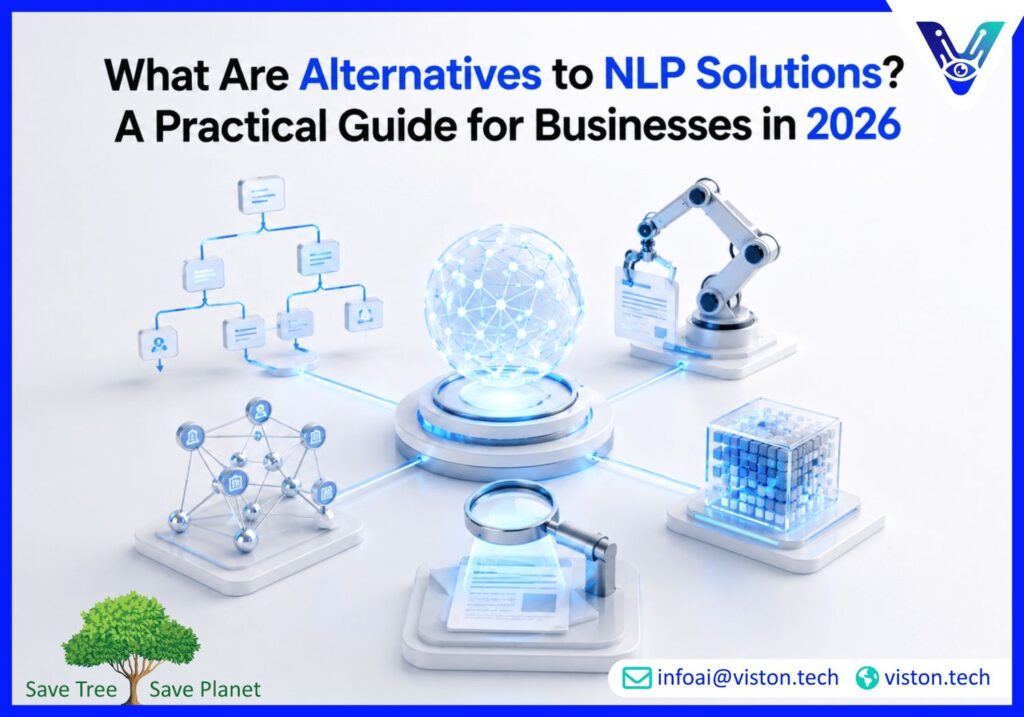
As businesses continue investing in automation, customer experience, data analysis, and operational efficiency, Natural Language Processing (NLP) solutions have become a popular choice for understanding and processing human language. However, NLP is not always the only or best option for every use case. Depending on business objectives, data availability, complexity, and budget, organizations may benefit from alternative technologies that address specific challenges more effectively.
Understanding the Role of NLP Solutions in Business
Natural Language Processing solutions enable computers to understand, interpret, generate, and analyze human language. Businesses commonly use NLP for chatbots, sentiment analysis, document processing, content classification, language translation, customer support automation, and search optimization.While NLP technologies have evolved significantly, they are not always necessary for every business process. Some organizations discover that alternative approaches can deliver faster implementation, lower costs, improved accuracy for structured workflows, or better alignment with specific operational requirements.Before evaluating alternatives, decision-makers should understand the problem they are trying to solve rather than focusing solely on the technology itself.
Why Businesses Look for Alternatives to NLP Solutions
Several factors may lead organizations to explore alternatives to NLP solutions:
Limited availability of quality language data
High implementation complexity
Industry-specific requirements that demand structured processing
Budget constraints
Regulatory and compliance concerns
Need for faster deployment
Requirement for deterministic outputs rather than language interpretation
Integration challenges with legacy systems
In many cases, organizations are not replacing NLP entirely but combining it with complementary technologies to achieve better business outcomes.
Alternative Technologies to NLP Solutions in 2026
Rule-Based Automation Systems
Rule-based systems remain highly effective for predictable and structured business processes. These solutions use predefined logic and decision trees to automate tasks without requiring language understanding capabilities.Common use cases include:
Workflow approvals
Compliance validation
Data routing
Customer service ticket categorization
Document verification
Organizations operating in highly regulated environments often prefer rule-based systems because their decision-making processes are transparent, auditable, and easier to control.
Robotic Process Automation (RPA)
Robotic Process Automation focuses on automating repetitive digital tasks. Unlike NLP solutions that interpret language, RPA automates interactions with software systems through predefined actions.Businesses frequently use RPA for:
Invoice processing
Data entry
Order management
Customer onboarding
Report generation
System integrations
For organizations dealing primarily with structured data, RPA can often provide faster returns on investment than complex NLP implementations.
Knowledge Graphs and Semantic Data Models
Knowledge graphs organize information through relationships between entities, concepts, and business data.Instead of relying heavily on language interpretation, these systems create structured representations of information that support:
Enterprise search
Recommendation engines
Data discovery
Customer intelligence
Decision support systems
Knowledge graphs are increasingly used alongside AI systems to improve contextual understanding and data retrieval accuracy.
Machine Learning Models for Structured Data
Many business challenges involve numerical, transactional, or operational data rather than natural language.In such cases, traditional machine learning approaches may provide better results than NLP solutions.Examples include:
Fraud detection
Demand forecasting
Predictive maintenance
Customer churn prediction
Risk assessment
Inventory optimization
Organizations should evaluate whether their problem truly requires language processing or whether structured data analytics can achieve the desired outcome more efficiently.
Computer Vision Solutions
When information is primarily visual rather than textual, computer vision technologies can be more appropriate than NLP.Common applications include:
Image recognition
Quality inspection
Medical imaging analysis
Identity verification
Document scanning
Manufacturing automation
Many modern business workflows combine computer vision and NLP technologies to handle both visual and textual information.
Choosing the Right Alternative for Your Business Needs
Selecting an alternative to NLP solutions requires a clear understanding of business objectives, operational workflows, and expected outcomes.
Assess the Nature of Your Data
If most business data is structured, technologies such as machine learning, RPA, or analytics platforms may provide greater value than language-focused solutions.
Define Business Outcomes First
Organizations should focus on solving business problems rather than implementing technology for its own sake.Questions to consider include:
What process needs improvement?
What outcomes are expected?
How will success be measured?
What systems require integration?
What compliance requirements apply?
Evaluate Scalability Requirements
Technology choices should support future growth. Businesses should consider transaction volumes, user adoption, geographic expansion, and integration complexity when selecting alternatives.
Consider Governance and Compliance
In industries with strict compliance obligations, explainability and auditability often become critical decision factors. Rule-based systems and structured automation solutions may provide advantages in such environments.
How Alternative Solutions Complement NLP Technologies
Businesses increasingly adopt hybrid architectures rather than choosing a single technology.For example:
NLP can extract information from customer emails.
RPA can automate downstream workflows.
Machine learning can generate predictions.
Knowledge graphs can organize enterprise knowledge.
Business intelligence tools can support decision-making.
This integrated approach often delivers better outcomes than relying on a standalone NLP solution.As AI ecosystems continue evolving in 2026, organizations are focusing on practical combinations of technologies that improve efficiency, accuracy, governance, and business value.
How Viston AI Helps Businesses Evaluate and Implement Intelligent Automation Solutions
Organizations exploring alternatives to Natural Language Processing solutions often face a broader challenge: determining which technologies best align with their operational goals, data environment, and growth strategy.Viston AI specializes in Natural Language Processing Solutions while helping businesses identify where NLP, automation, machine learning, intelligent document processing, conversational AI, and related technologies can deliver measurable value. Rather than treating NLP as a one-size-fits-all solution, the focus is on aligning technology decisions with actual business requirements.For organizations evaluating customer service automation, document processing, enterprise search, workflow optimization, knowledge management, or AI-driven decision support, a structured implementation approach is essential. This includes understanding data quality, integration requirements, scalability considerations, governance expectations, and long-term operational objectives.Businesses often benefit from combining NLP with complementary technologies such as robotic process automation, predictive analytics, semantic search, and AI-powered workflows. By taking a practical and business-focused approach, organizations can avoid unnecessary complexity while building solutions that support efficiency, accuracy, and sustainable growth.As enterprise AI adoption continues to accelerate globally, selecting the right combination of technologies becomes increasingly important for achieving meaningful and measurable outcomes.
Frequently Asked Questions
What is the most common alternative to NLP solutions?
Robotic Process Automation (RPA) is one of the most common alternatives, particularly for structured and repetitive business processes that do not require language understanding.
Can machine learning replace NLP?
Machine learning can replace NLP for problems involving structured data, predictions, classifications, or analytics. However, NLP remains necessary when understanding or generating human language is required.
Are rule-based systems still relevant in 2026?
Yes. Rule-based systems remain highly relevant for compliance-driven, predictable, and auditable workflows where transparency and control are important.
Should businesses completely replace NLP solutions?
Not necessarily. Many organizations achieve the best results by combining NLP with automation, analytics, machine learning, and knowledge management technologies.
How do I determine whether NLP is the right solution?
Evaluate the type of data involved, business objectives, implementation complexity, scalability requirements, and expected outcomes. If language understanding is central to the process, NLP may still be the most appropriate choice.
How can Viston AI support businesses evaluating NLP alternatives?
Viston AI helps organizations assess business requirements, identify suitable intelligent automation strategies, and determine where Natural Language Processing Solutions fit within broader operational and technology goals.
Conclusion
Exploring alternatives to NLP solutions does not necessarily mean moving away from artificial intelligence. Instead, it involves selecting the technologies that best align with specific business challenges, operational requirements, and expected outcomes. Depending on the use case, solutions such as RPA, machine learning, rule-based automation, knowledge graphs, and computer vision may provide significant value. For organizations evaluating intelligent automation strategies, understanding where Natural Language Processing Solutions fit within the broader technology landscape is essential. Viston AI helps businesses navigate these decisions with a practical approach focused on scalability, efficiency, and long-term business impact.

 As businesses continue investing in automation, customer experience, data analysis, and operational efficiency, Natural Language Processing (NLP) solutions have become a popular choice for understanding and processing human language. However, NLP is not always the only or best option for every use case. Depending on business objectives, data availability, complexity, and budget, organizations may benefit from alternative technologies that address specific challenges more effectively.