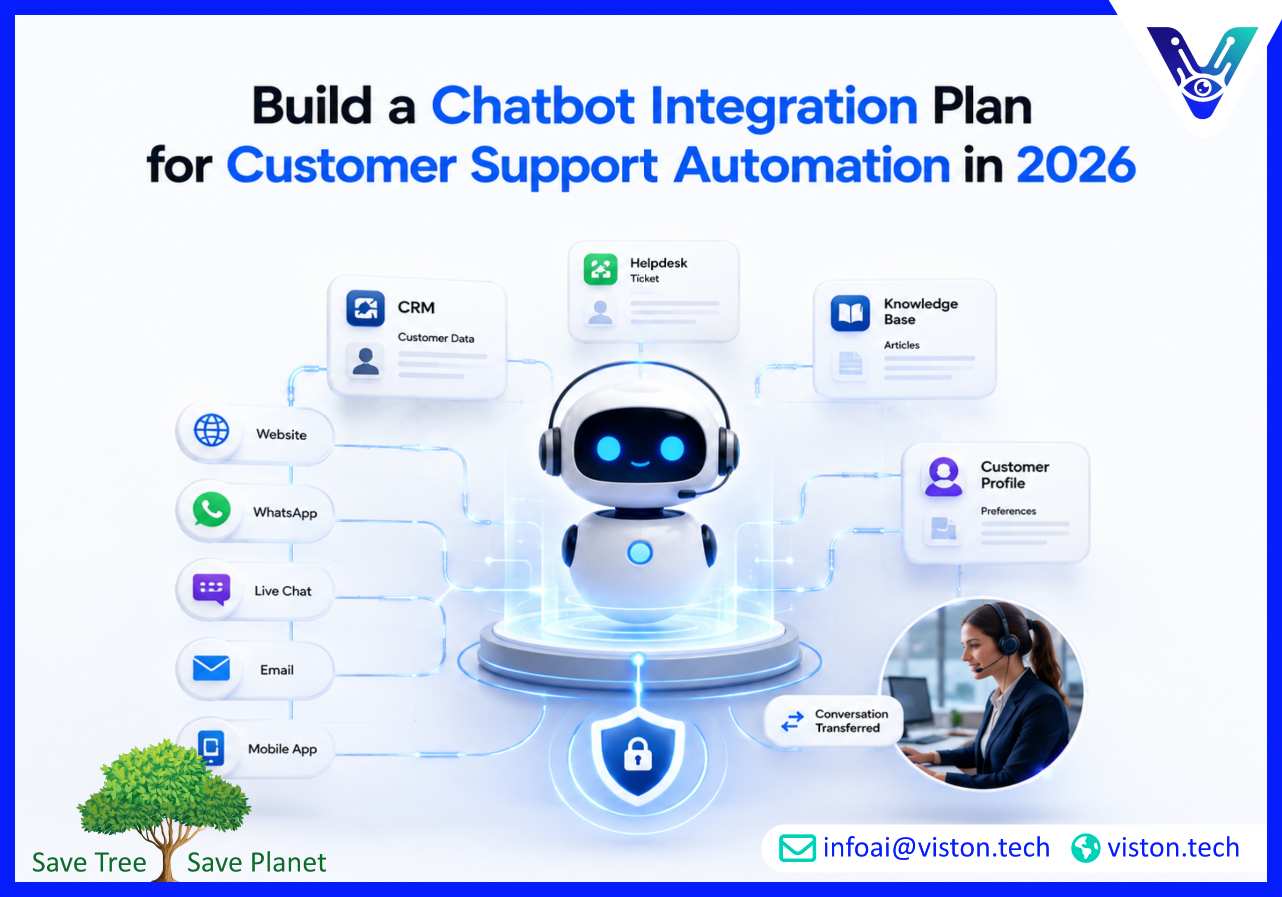
Build a Chatbot Integration Plan for Customer Support Automation in 2026
Customer support expectations continue to rise as businesses compete on speed, availability, and service quality. Organizations that rely solely on manual support processes often struggle to manage growing inquiry volumes efficiently. Building a structured chatbot integration plan helps businesses automate routine interactions, improve customer experiences, and create scalable support operations without compromising service quality.
Why Customer Support Automation Requires a Strategic Integration Plan
Customer support automation is no longer limited to answering basic FAQs. Modern AI-powered chatbots can access business systems, retrieve customer information, create support tickets, provide order updates, and assist customers across multiple communication channels.However, successful automation requires more than deploying a chatbot. Businesses need a well-defined chatbot integration plan that aligns customer support objectives with existing systems, workflows, and operational requirements.A structured integration plan helps organizations:
Reduce customer wait times
Improve support availability
Lower operational costs
Increase first-contact resolution rates
Provide consistent customer experiences
Scale support operations efficiently
Improve agent productivity
Gain actionable customer insights
Without proper integration, chatbots often become isolated tools that create more frustration than value.
Key Components of a Customer Support Chatbot Integration Plan
Define Support Objectives
The first step is identifying the specific support challenges the chatbot should address.Common objectives include:
Handling frequently asked questions
Reducing support ticket volume
Providing 24/7 customer assistance
Automating account-related inquiries
Supporting order tracking requests
Managing appointment scheduling
Collecting customer information before escalation
Improving customer satisfaction scores
Clearly defined objectives establish measurable success criteria for the integration project.
Identify Customer Interaction Channels
Customers engage with businesses across multiple touchpoints. The chatbot integration plan should determine where automation will be deployed.Typical channels include:
Business websites
Mobile applications
WhatsApp
Facebook Messenger
Instagram messaging
Email support workflows
Live chat platforms
Customer portals
An omnichannel approach ensures customers receive consistent support regardless of where they initiate conversations.
Map Customer Support Workflows
Before implementation, organizations should document common support journeys.This includes:
Issue reporting processes
Product inquiries
Billing questions
Technical troubleshooting
Returns and refunds
Account management requests
Escalation procedures
Well-designed workflows help chatbots guide customers toward resolutions efficiently while ensuring seamless handoffs when human assistance is required.
Systems That Should Be Connected to Support Chatbots
The effectiveness of customer support automation depends heavily on system integration.Modern AI chatbots perform best when connected to business-critical platforms.
Customer Relationship Management (CRM) Systems
CRM integration allows chatbots to access customer profiles, interaction histories, account information, and service records.This enables personalized and context-aware customer interactions.
Helpdesk and Ticketing Platforms
Integrating support software allows chatbots to:
Create tickets
Update ticket status
Assign issues to departments
Track resolution progress
Notify customers automatically
Knowledge Base Platforms
Connecting internal and external knowledge repositories enables chatbots to provide accurate answers based on approved company information.This significantly improves response quality and consistency.
Order Management Systems
For ecommerce and service-based businesses, chatbot access to order information allows customers to receive instant updates regarding purchases, shipments, invoices, and account activity.
Communication and Collaboration Tools
Platforms such as internal messaging systems and support collaboration tools help automate escalations and improve coordination between chatbot workflows and human agents.
Building an Effective Customer Support Automation Workflow
Automate High-Volume Requests First
Organizations should begin automation with repetitive, low-complexity inquiries.Examples include:
Password resets
Order status requests
Business hours inquiries
Shipping information
Appointment confirmations
Basic troubleshooting guidance
Automating these interactions delivers immediate operational benefits while minimizing implementation risk.
Implement Intelligent Escalation Paths
Not every customer issue can be resolved through automation.A successful chatbot integration plan includes clear escalation mechanisms that transfer conversations to support agents when:
Customer frustration is detected
Complex technical issues arise
Sensitive account actions are requested
Compliance requirements demand human review
Chatbot confidence levels fall below acceptable thresholds
Smooth escalation protects customer satisfaction and prevents unresolved issues.
Enable Context Retention
Customers should never need to repeat information multiple times.Integrated chatbots can retain conversation context, customer details, and interaction history to support efficient issue resolution and seamless agent transitions.
Performance Metrics for Customer Support Chatbot Integration
Organizations should continuously monitor chatbot performance after deployment.Key performance indicators often include:
How Viston AI Supports Customer Support Automation Through AI Chatbot Integration
As businesses increasingly invest in customer support automation, successful implementation depends on more than chatbot deployment alone. Effective solutions require secure integrations, intelligent workflows, system interoperability, and ongoing optimization.Viston AI specializes in AI Chatbot Integration solutions that help organizations connect conversational AI with customer support operations, CRM platforms, knowledge bases, helpdesk systems, communication channels, and business workflows. By focusing on practical integration strategies, businesses can create connected support ecosystems that improve responsiveness while maintaining service quality.Customer support automation initiatives often involve multiple technologies, data sources, and user journeys. Viston AI helps businesses design integration frameworks that support scalability, operational efficiency, customer engagement, and measurable business outcomes. Whether organizations are automating common support requests, enhancing omnichannel service delivery, or improving support team productivity, a structured integration approach helps maximize the value of conversational AI investments.As customer expectations continue to evolve in 2026, organizations that prioritize intelligent chatbot integration are better positioned to deliver faster, more efficient, and more personalized support experiences.
Frequently Asked Questions
What is a chatbot integration plan for customer support automation?
A chatbot integration plan is a structured strategy that outlines how a chatbot will connect with support systems, business applications, communication channels, and workflows to automate customer service processes effectively.
Which systems should be integrated with customer support chatbots?
Common integrations include CRM platforms, helpdesk software, knowledge bases, order management systems, customer portals, communication tools, and analytics platforms.
How long does customer support chatbot integration take?
Implementation timelines vary based on system complexity, workflow requirements, customization needs, and the number of integrations involved. Simple deployments may take days, while enterprise projects can take several weeks or months.
Can chatbot integration reduce support costs?
Yes. By automating repetitive inquiries and reducing ticket volumes, chatbot integration can help organizations lower operational costs while improving service availability and response times.
Can Viston AI help businesses automate customer support?
Yes. Viston AI provides AI Chatbot Integration services that help businesses connect conversational AI with customer support systems, workflows, and operational platforms to improve efficiency and customer experiences.
Conclusion
Building a chatbot integration plan for customer support automation is essential for businesses seeking scalable, efficient, and customer-centric service operations in 2026. A successful strategy combines well-defined objectives, intelligent workflows, seamless system integrations, security considerations, and continuous performance optimization. When implemented effectively, AI Chatbot Integration helps organizations reduce support workloads, improve customer satisfaction, and create more responsive service experiences. Businesses looking to maximize the value of customer support automation can benefit from working with experienced specialists such as Viston AI to develop a practical and scalable chatbot integration framework.