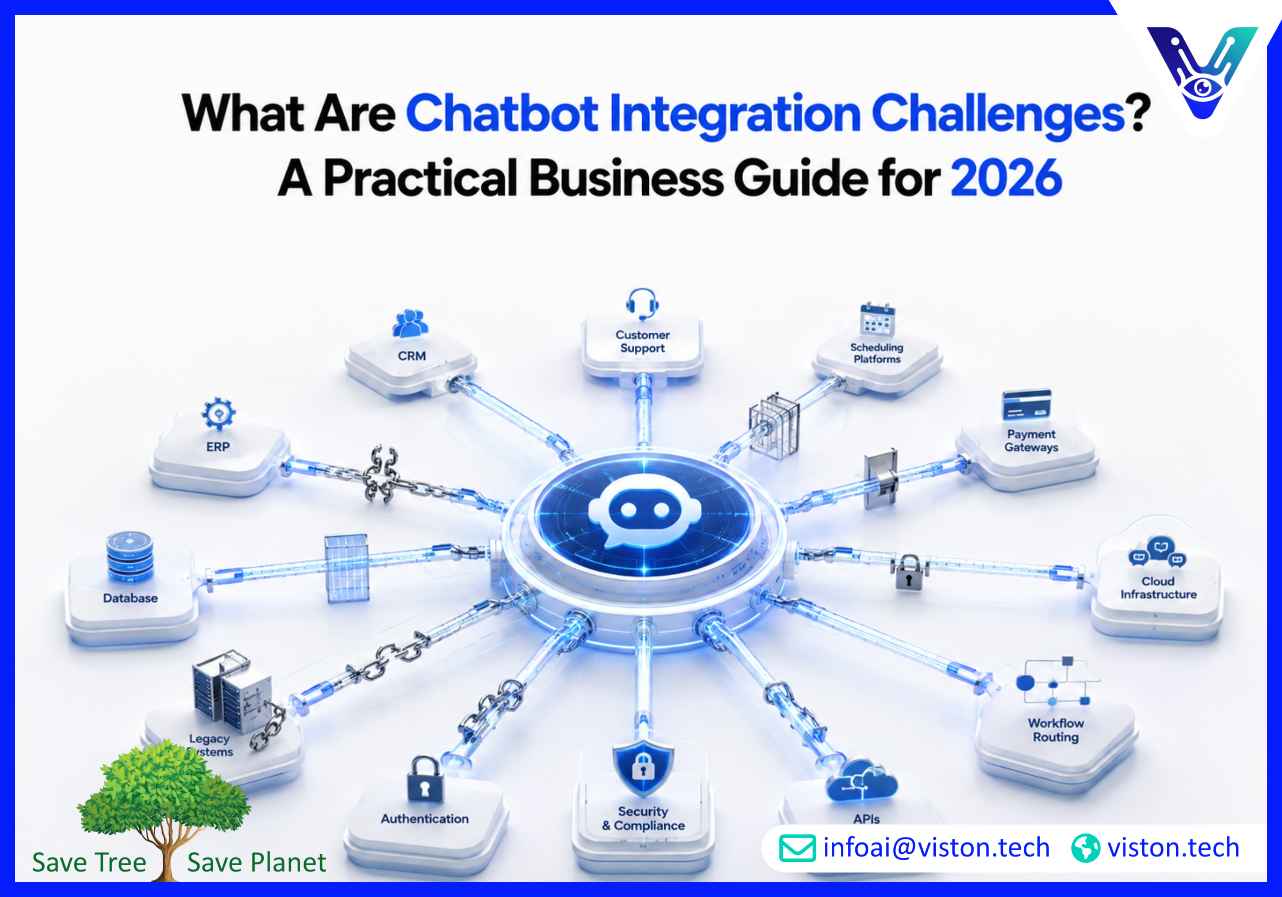
What Are Chatbot Integration Challenges? A Practical Business Guide for 2026
As businesses increasingly adopt AI-powered customer interactions, chatbot integration has become a strategic priority rather than a technology experiment. While modern chatbot platforms offer powerful automation capabilities, successful implementation often depends on overcoming integration challenges that can impact performance, user experience, security, and business outcomes. Understanding these challenges helps organizations plan more effectively and maximize the value of AI chatbot integration.
Why Chatbot Integration Can Be Challenging
Chatbot integration involves connecting an AI chatbot with existing business systems, applications, databases, communication channels, and workflows. Although chatbot technology has advanced significantly, integration projects often require careful planning across technical, operational, and business functions.The complexity increases when organizations need chatbots to interact with multiple systems such as CRM platforms, customer support software, ERP solutions, appointment scheduling tools, payment gateways, and communication platforms.Without proper integration planning, businesses may experience data inconsistencies, limited chatbot functionality, poor customer experiences, and operational inefficiencies.
Common Chatbot Integration Challenges Businesses Face
Legacy System Compatibility
Many organizations still operate legacy software systems that were not designed for modern AI integrations. Older systems may lack APIs or provide limited connectivity options.This can create challenges when attempting to:
Access customer information
Retrieve transaction data
Update records automatically
Synchronize real-time information
Support omnichannel customer interactions
Custom middleware or integration layers are often required to bridge the gap between legacy systems and AI chatbot platforms.
Data Quality and Consistency Issues
Chatbots rely heavily on accurate and accessible data. If business data is fragmented across multiple systems or contains inaccuracies, chatbot performance can suffer.Common problems include:
Duplicate customer records
Outdated information
Missing data fields
Conflicting records across systems
Inconsistent formatting standards
Poor data quality can result in inaccurate chatbot responses and reduced customer trust.
API Limitations and Connectivity Problems
Most chatbot integrations depend on APIs to communicate with external systems. However, not all APIs offer the same level of functionality or reliability.Challenges may include:
Rate limits on API requests
Authentication complexities
Incomplete documentation
Version compatibility issues
Unexpected service interruptions
Businesses must ensure their integration architecture can handle these limitations while maintaining consistent chatbot performance.
Security and Privacy Requirements
Security remains one of the most important concerns in chatbot integration projects. Chatbots often process sensitive customer information, including personal details, payment information, account data, and support records.Key security challenges include:
Secure data transmission
Access control management
User authentication
Data encryption
Regulatory compliance requirements
Audit trail maintenance
Organizations must ensure chatbot integrations align with their cybersecurity policies and applicable privacy regulations.
Operational Challenges During Chatbot Integration
Workflow Alignment
Successful chatbot deployment requires alignment with existing business processes. Many organizations underestimate the effort needed to redesign workflows around conversational automation.Questions businesses often face include:
When should conversations be escalated to human agents?
Which processes should remain manual?
How should chatbot-generated tasks be assigned?
What service-level expectations should be maintained?
Poor workflow alignment can create operational bottlenecks rather than efficiencies.
Coordinating requirements across departments can be challenging, particularly when business objectives differ.
Change Management and User Adoption
Even technically successful integrations can struggle if employees and customers are reluctant to adopt chatbot-driven processes.Organizations may encounter resistance due to:
Concerns about automation replacing jobs
Lack of training
Unclear operational procedures
Inconsistent chatbot performance
Poor user experience design
Effective change management is essential for long-term success.
Technical Challenges in Modern AI Chatbot Integration
Natural Language Understanding Accuracy
Modern AI chatbots are significantly more capable than earlier rule-based systems. However, understanding customer intent accurately remains a challenge.Integration complexity increases when chatbots must:
Interpret industry-specific terminology
Support multiple languages
Handle ambiguous requests
Process contextual conversations
Recognize customer-specific information
Training, testing, and continuous optimization are critical components of successful AI chatbot integration.
Multi-Platform Integration Requirements
Customers increasingly expect seamless interactions across multiple channels, including websites, mobile apps, WhatsApp, social media platforms, email, and customer portals.Ensuring consistent chatbot functionality across these environments presents challenges related to:
Data synchronization
Conversation continuity
Platform-specific limitations
User authentication consistency
Performance monitoring
Scalability Concerns
As chatbot usage grows, integration architecture must support increasing volumes of conversations and transactions.Businesses need to consider:
Infrastructure capacity
Database performance
API throughput
Response times
Disaster recovery planning
Scalability challenges often emerge after successful chatbot adoption, making proactive planning essential.
Best Practices for Overcoming Chatbot Integration Challenges
Start with Clear Business Objectives
Successful projects begin with clearly defined goals. Organizations should identify the specific outcomes they expect from chatbot integration, such as improving customer support efficiency, increasing lead generation, reducing operational costs, or enhancing customer experiences.
Conduct Integration Readiness Assessments
Before implementation, businesses should evaluate:
Existing technology infrastructure
Available APIs
Data quality standards
Security requirements
Workflow dependencies
Operational readiness
Prioritize Security from the Beginning
Security should not be treated as a post-deployment activity. Integration planning should incorporate authentication, encryption, access controls, monitoring, and compliance requirements from the earliest stages.
Implement Continuous Monitoring
Ongoing monitoring helps organizations identify performance issues, integration failures, customer experience gaps, and optimization opportunities before they affect business operations.
How Viston AI Supports Effective AI Chatbot Integration
For businesses implementing AI chatbot integration, success often depends on more than simply deploying a chatbot platform. Effective integration requires connecting conversational AI with business systems, workflows, customer data, and operational processes.Viston AI specializes in AI Chatbot Integration solutions designed to help organizations deploy chatbots that work seamlessly within existing business environments. This includes supporting integrations across websites, CRM platforms, customer service systems, communication channels, automation workflows, and enterprise applications.By focusing on practical implementation, scalable architecture, security considerations, workflow alignment, and long-term optimization, Viston AI helps businesses address many of the common challenges associated with chatbot integration projects. Whether organizations are implementing customer support automation, lead generation workflows, appointment booking systems, or omnichannel customer engagement solutions, a structured integration approach can significantly improve project outcomes and user experiences.
Frequently Asked Questions
What is the biggest challenge in chatbot integration?
One of the most common challenges is integrating chatbots with existing business systems while maintaining accurate, secure, and real-time data exchange.
Why do chatbot integrations fail?
Failures often result from poor planning, unclear business objectives, inadequate data quality, insufficient testing, or lack of workflow alignment.
How important are APIs in chatbot integration?
APIs are essential because they allow chatbots to communicate with CRM systems, databases, support platforms, payment systems, and other business applications.
Can chatbot integration create security risks?
Yes. Without proper security controls, chatbots may expose sensitive information. Secure authentication, encryption, access management, and compliance measures are critical.
How long does chatbot integration typically take?
Timelines vary depending on system complexity, integration requirements, customization needs, and the number of platforms involved. Simple integrations may take weeks, while enterprise implementations may require several months.
Why might businesses choose Viston AI for chatbot integration projects?
Organizations looking for AI Chatbot Integration support may consider Viston AI for its focus on system connectivity, workflow integration, scalability, security, and practical business implementation.
Conclusion
Understanding chatbot integration challenges is essential for businesses seeking to maximize the value of conversational AI investments in 2026. Technical complexity, security requirements, data quality concerns, workflow alignment, and scalability considerations all play important roles in successful implementation. By addressing these challenges proactively and adopting a structured AI Chatbot Integration strategy, organizations can improve customer experiences, streamline operations, and achieve more reliable business outcomes. For companies pursuing integrated AI solutions, experienced providers such as Viston AI can help navigate these complexities and support successful long-term deployment.