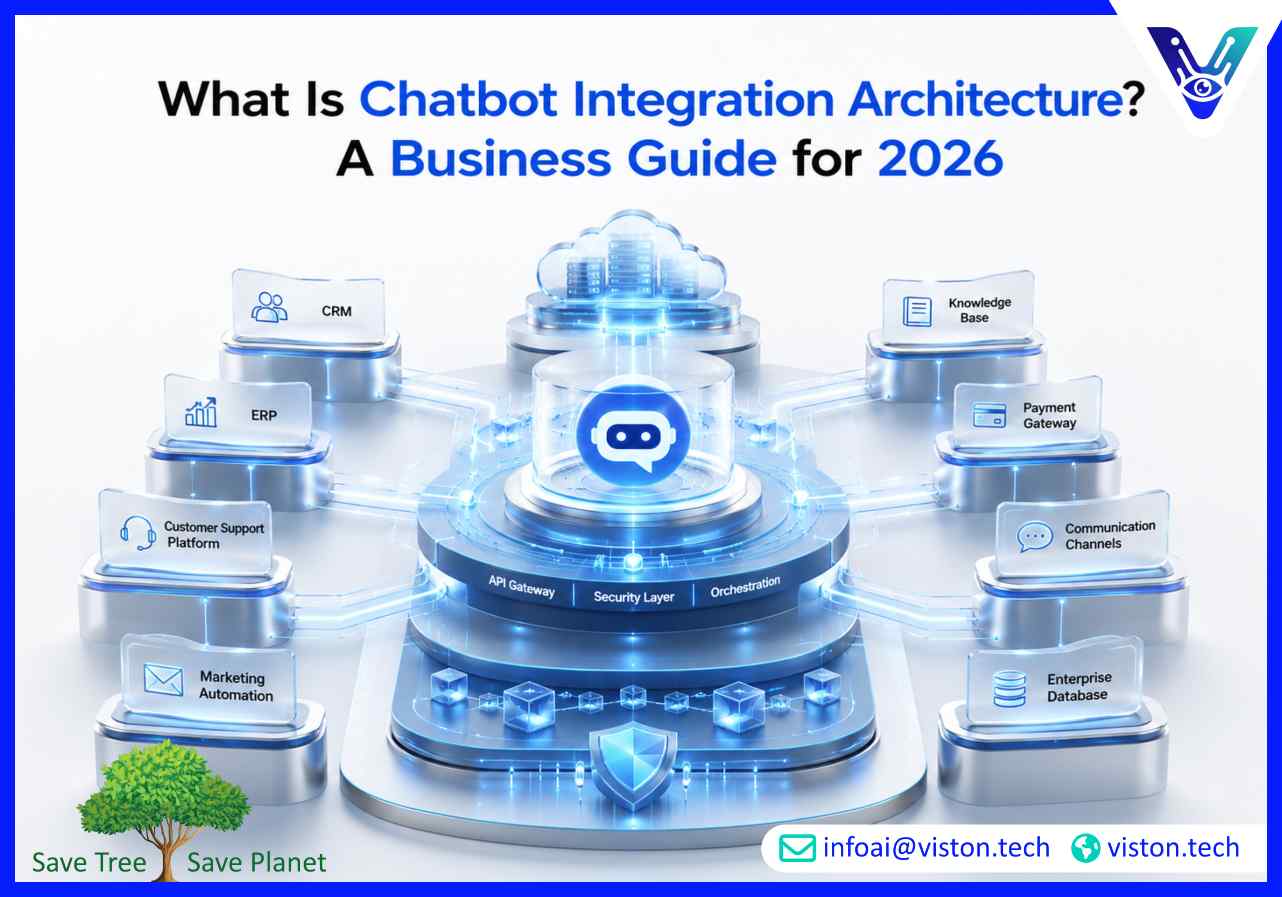
What Is Chatbot Integration Architecture? A Business Guide for 2026
As AI-powered customer engagement becomes a standard business requirement, organizations are investing heavily in AI chatbot integration across websites, CRM systems, communication channels, support platforms, and internal business applications. However, successful deployment depends on more than chatbot design alone. The foundation lies in chatbot integration architecture—the framework that determines how a chatbot connects, exchanges data, and interacts with other systems across the business ecosystem.
Understanding Chatbot Integration Architecture
Chatbot integration architecture refers to the technical structure that enables a chatbot to communicate with external platforms, databases, applications, and business systems. It defines how information flows between the chatbot and connected technologies to deliver accurate, contextual, and automated interactions.Rather than operating as a standalone tool, modern AI chatbots function as connected digital assistants that interact with multiple systems simultaneously. Integration architecture ensures that customer inquiries, support requests, lead information, appointment bookings, and business workflows can move seamlessly between the chatbot and enterprise systems.In 2026, businesses increasingly expect chatbots to access real-time information, trigger automated processes, and provide personalized responses. Achieving these capabilities requires a well-designed integration architecture.
Core Components of Chatbot Integration Architecture
Chatbot user interface layer
Natural language processing (NLP) engine
Integration middleware
API management layer
Business applications and databases
Security and authentication framework
Analytics and reporting systems
Workflow automation tools
Each component plays a critical role in ensuring reliable communication between systems while maintaining performance, scalability, and security.
Why Chatbot Integration Architecture Matters in 2026
Businesses now operate across multiple digital touchpoints, including websites, mobile applications, social media platforms, messaging channels, and customer service systems. Customers expect consistent experiences regardless of where interactions occur.Without a structured integration architecture, organizations often face challenges such as:
Disconnected customer data
Inconsistent responses across channels
Manual intervention requirements
Limited automation capabilities
Data synchronization issues
Security vulnerabilities
Scalability limitations
A strong architecture creates a unified ecosystem where chatbot interactions contribute directly to operational efficiency and customer experience goals.
Business Benefits of Proper Architecture
Faster response times
Improved customer experiences
Real-time access to business data
Automated workflows and processes
Higher lead conversion rates
Reduced support workloads
Enhanced reporting visibility
Scalable chatbot deployment
Key Layers of a Modern Chatbot Integration Architecture
Modern AI chatbot integration projects typically follow a layered architecture model that separates responsibilities and improves maintainability.
1. Presentation Layer
This layer includes customer-facing channels where users interact with the chatbot.Common channels include:
Business websites
Mobile applications
WhatsApp
Facebook Messenger
Slack
Microsoft Teams
Customer portals
The presentation layer captures user requests and forwards them to the AI processing layer.
2. AI and Conversation Layer
This layer handles natural language understanding, intent recognition, conversation management, and response generation.Functions include:
User intent detection
Entity extraction
Context management
Knowledge retrieval
Response generation
Conversation personalization
Advanced AI models increasingly support multilingual conversations, sentiment analysis, and contextual memory.
3. Integration Layer
The integration layer serves as the bridge between the chatbot and business systems.Responsibilities include:
API communication
Data transformation
System orchestration
Workflow triggering
Error handling
Event processing
This layer is often the most important part of chatbot integration architecture because it determines how effectively the chatbot interacts with enterprise applications.
4. Business Systems Layer
This layer includes the applications and databases that power business operations.Examples include:
CRM platforms
ERP systems
Customer support software
Inventory management systems
Appointment booking tools
Marketing automation platforms
Knowledge bases
Payment gateways
The chatbot retrieves and updates information through integrations with these systems.
Common Chatbot Integration Architecture Models
The ideal architecture depends on business objectives, technical complexity, and integration requirements.
Point-to-Point Architecture
In this model, the chatbot connects directly to individual systems through dedicated APIs.Advantages:
Simple implementation
Lower initial cost
Suitable for small projects
Limitations:
Difficult to scale
Higher maintenance complexity
Integration duplication
Middleware-Based Architecture
A middleware platform acts as an intermediary between the chatbot and business systems.Advantages:
Centralized integration management
Improved scalability
Simplified maintenance
Faster system expansion
This model is widely used in enterprise chatbot deployments.
Microservices Architecture
Microservices separate chatbot functions into independent services that communicate through APIs.Advantages:
High scalability
Flexible deployment
Independent updates
Improved reliability
Organizations with complex digital ecosystems increasingly adopt this approach.
Many modern AI chatbot integrations are built using cloud-native principles to support growing business demands.
How Viston AI Supports Effective AI Chatbot Integration
For businesses investing in AI Chatbot Integration, architecture planning is often the difference between a chatbot that simply answers questions and one that becomes an operational asset.Viston AI focuses on helping organizations connect AI chatbots with the systems that drive customer engagement, sales, support, and operational workflows. Rather than treating chatbot deployment as an isolated project, the integration approach emphasizes seamless communication between conversational interfaces and business applications.This includes connecting chatbots with CRM platforms, support systems, marketing automation tools, appointment scheduling software, databases, enterprise applications, and communication channels. By designing integration architectures around actual business processes, organizations can automate repetitive tasks, improve data accessibility, and create more personalized customer experiences.Businesses increasingly require chatbot solutions that are scalable, secure, and adaptable to future technology investments. Through structured AI chatbot integration strategies, organizations can build architectures that support growth, maintain performance, and deliver consistent user experiences across digital channels.For companies seeking long-term value from conversational AI, a well-designed integration architecture provides the foundation needed for automation, operational efficiency, and measurable business outcomes.
Frequently Asked Questions
What is chatbot integration architecture?
Chatbot integration architecture is the framework that enables a chatbot to connect with business systems, applications, databases, and communication channels to exchange data and automate workflows.
Why is chatbot integration architecture important?
It ensures reliable communication between systems, improves scalability, enhances customer experiences, and supports automation across business operations.
Which systems can be integrated into a chatbot architecture?
Common integrations include CRM platforms, ERP systems, customer support software, marketing automation tools, payment gateways, knowledge bases, and communication platforms.
What is the most scalable chatbot architecture model?
Microservices and cloud-native architectures are generally considered the most scalable because they support flexible deployment, independent updates, and rapid expansion.
How does AI chatbot integration improve business performance?
It enables automation, reduces manual work, provides real-time access to information, improves response quality, and supports more efficient customer interactions.
Can Viston AI help businesses implement chatbot integration architecture?
Organizations exploring AI chatbot integration can evaluate whether Viston AI’s integration-focused approach aligns with their requirements for connecting chatbots with business systems, workflows, and customer engagement platforms.
Conclusion
Understanding chatbot integration architecture is essential for organizations seeking to maximize the value of conversational AI in 2026. A chatbot’s effectiveness depends not only on its intelligence but also on how well it connects with the systems that support business operations. Through a structured AI Chatbot Integration strategy, businesses can create scalable, secure, and efficient digital experiences that improve customer engagement and streamline workflows. For organizations evaluating long-term chatbot initiatives, building the right architectural foundation is a critical step toward sustainable automation and business growth.