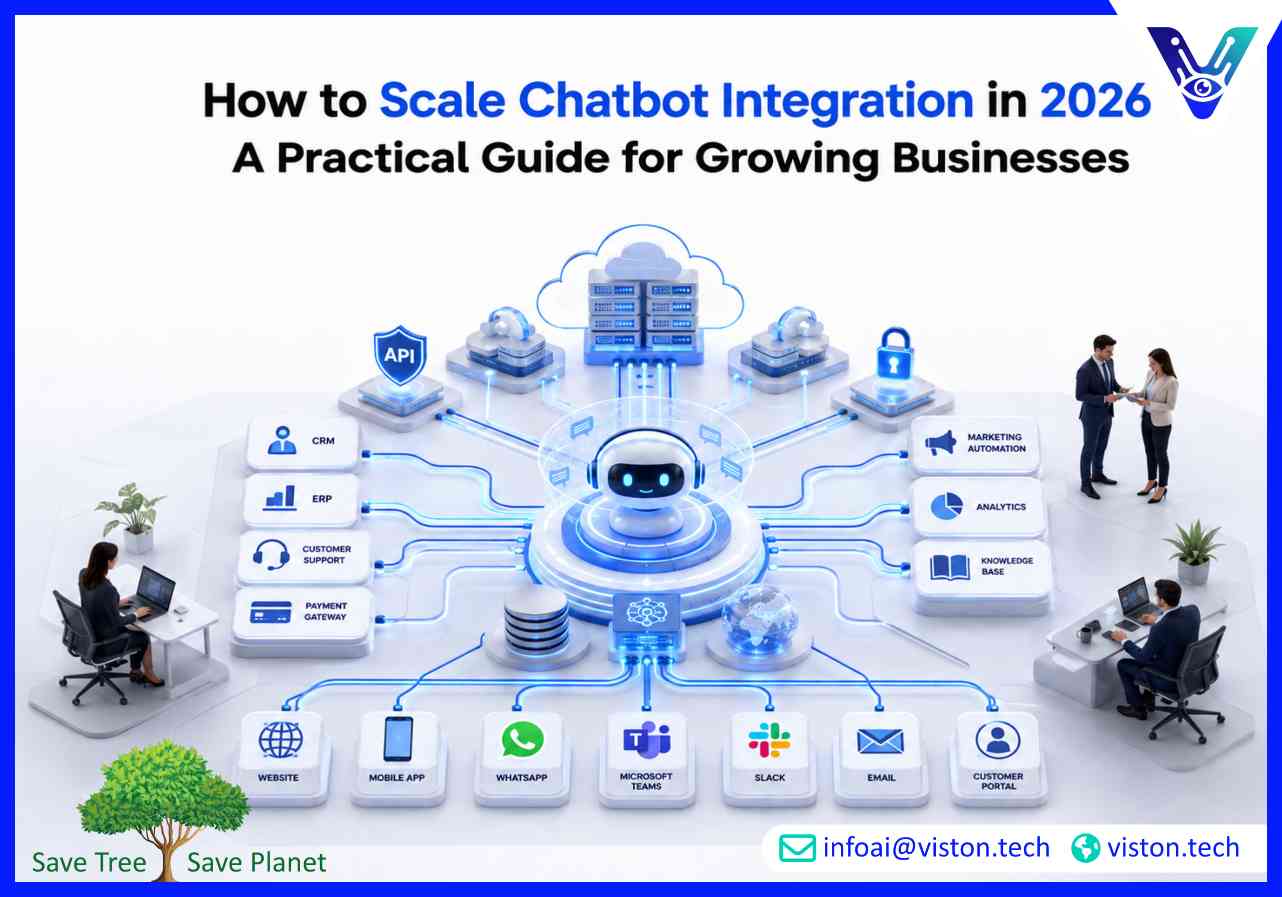
How to Scale Chatbot Integration in 2026: A Practical Guide for Growing Businesses
As businesses increasingly rely on AI-powered customer interactions, chatbot integration must evolve beyond simple automation. A chatbot that performs well for a few hundred users may struggle when supporting thousands of conversations, multiple channels, and complex workflows. Understanding how to scale chatbot integration is essential for organizations seeking sustainable growth, operational efficiency, and consistent customer experiences in 2026.
What Does Scaling Chatbot Integration Mean?
Scaling chatbot integration refers to expanding a chatbot ecosystem’s ability to handle growing user demand, business processes, communication channels, and data requirements without sacrificing performance or reliability.Modern chatbot deployments often begin with basic website support. As businesses grow, they frequently expand integrations across CRM platforms, ERP systems, customer service software, marketing automation tools, payment gateways, and messaging platforms.A scalable chatbot integration framework should support:
Increasing conversation volumes
Multiple communication channels
Business system integrations
Global user bases
Multilingual interactions
Advanced AI capabilities
Security and compliance requirements
Continuous optimization and monitoring
Successful scaling requires both technical infrastructure and operational planning.
Common Challenges When Scaling Chatbot Integration
Growing Conversation Volumes
As customer engagement increases, chatbot platforms must handle larger numbers of simultaneous interactions. Poorly designed integrations can lead to slower response times, failed workflows, and inconsistent user experiences.
Managing Multiple Data Sources
Scaling often requires connecting chatbots with multiple business systems. Customer data may exist across CRM platforms, ERP systems, support software, inventory databases, and analytics tools.Without a unified integration architecture, data synchronization becomes increasingly difficult.
Channel Expansion
Businesses rarely remain limited to a single communication channel. Customers expect support across:
Websites
WhatsApp
Slack
Microsoft Teams
Facebook Messenger
Mobile applications
Email workflows
Each additional channel introduces new integration, security, and maintenance requirements.
AI Performance Management
As chatbot knowledge bases grow, maintaining response accuracy becomes more challenging. Large-scale deployments require structured training processes, knowledge management practices, and performance monitoring.
Security and Compliance Risks
Handling larger volumes of customer information increases exposure to security risks. Organizations must implement strong authentication, encryption, access controls, and compliance frameworks.
Key Strategies for Scaling Chatbot Integration Successfully
Build an API-First Integration Architecture
An API-first approach allows chatbots to communicate efficiently with business applications while maintaining flexibility for future expansion.Instead of creating isolated integrations, businesses should establish standardized APIs that support:
Customer data access
Order management
Support ticket creation
Inventory updates
Appointment scheduling
Payment processing
This approach simplifies maintenance and supports future growth.
Use Cloud-Native Infrastructure
Cloud platforms provide elasticity that enables chatbot systems to automatically adjust resources based on demand.Benefits include:
Automatic scaling
High availability
Global accessibility
Disaster recovery support
Reduced infrastructure management
Cloud-native deployment models have become the preferred approach for large-scale chatbot ecosystems in 2026.
Implement Modular Integrations
Monolithic chatbot architectures become difficult to maintain as integrations grow.Modular integration frameworks allow organizations to:
Add new systems independently
Reduce deployment risks
Simplify troubleshooting
Accelerate updates
Improve scalability
Each business function can operate through dedicated integration services while maintaining centralized management.
Centralize Data Management
Scalable chatbot deployments require reliable access to consistent information.Organizations should establish centralized data management practices that:
Eliminate duplicate records
Maintain data quality
Improve reporting accuracy
Support real-time synchronization
Enhance customer experiences
A single source of truth reduces integration complexity and improves chatbot effectiveness.
Best Practices for Long-Term Chatbot Scalability
Monitor Performance Continuously
Scaling is not a one-time project. Businesses must continuously monitor chatbot performance indicators such as:
Response times
Conversation completion rates
User satisfaction scores
Integration failures
API response metrics
System uptime
Ongoing monitoring helps identify bottlenecks before they impact users.
Design for Omnichannel Experiences
Customers expect seamless interactions regardless of where conversations begin.Scalable chatbot integrations should preserve context across channels, allowing users to move between website chat, messaging apps, and support portals without repeating information.
Support Multilingual Growth
Businesses expanding internationally require chatbot systems capable of supporting multiple languages while maintaining consistent service quality.Modern AI chatbot platforms increasingly incorporate multilingual language models and localization capabilities.
Strengthen Security Frameworks
Security becomes increasingly important as chatbot ecosystems expand.Recommended measures include:
End-to-end encryption
Role-based access controls
API authentication
Audit logging
Data retention policies
Regular security assessments
Organizations should align chatbot security with broader enterprise governance requirements.
Automate Workflow Expansion
Scaling often involves automating additional business processes.Chatbots can support:
Lead qualification
Customer onboarding
Appointment scheduling
Order tracking
Internal employee support
Knowledge management
Service request handling
Automation helps organizations scale operations without proportional increases in staffing requirements.
Business Benefits of Scalable Chatbot Integration
Organizations that successfully scale chatbot integration often achieve measurable operational improvements.
Improved Customer Experience
Customers receive faster responses, consistent support, and better access to information across channels.
Operational Efficiency
Automation reduces repetitive workloads, allowing teams to focus on higher-value activities.
Greater Business Agility
Scalable architectures enable businesses to add new channels, services, and workflows more quickly.
Better Data Visibility
Integrated chatbot ecosystems provide valuable customer insights that support strategic decision-making.
Lower Long-Term Costs
Well-designed integrations reduce maintenance burdens and prevent costly system redesigns as businesses grow.
How Viston AI Supports Scalable AI Chatbot Integration
For organizations seeking to expand customer engagement and automation capabilities, scalable integration planning is as important as chatbot functionality itself.Viston AI specializes in AI Chatbot Integration solutions designed to connect conversational AI with critical business systems and workflows. As chatbot deployments evolve from basic customer support tools into enterprise-wide automation platforms, successful integration requires careful attention to architecture, scalability, security, and operational performance.By supporting integrations across websites, CRM platforms, communication channels, automation tools, and business applications, Viston AI helps organizations create chatbot ecosystems that can grow alongside changing business requirements. This includes enabling data connectivity, workflow automation, omnichannel experiences, and AI-powered customer interactions without creating unnecessary complexity.For businesses planning long-term digital transformation initiatives, scalable chatbot integration can help improve customer service, streamline operations, and support future innovation while maintaining reliability and governance standards.
Frequently Asked Questions
How do you scale chatbot integration effectively?
Scaling chatbot integration requires cloud infrastructure, API-first architecture, modular system design, centralized data management, and continuous performance monitoring.
When should a business scale its chatbot integration?
Businesses should consider scaling when conversation volumes increase, new channels are added, additional business systems require integration, or customer expectations become more complex.
Can scalable chatbot integrations support multiple platforms?
Yes. Modern chatbot architectures can integrate with websites, mobile apps, CRM systems, ERP platforms, messaging applications, and customer support software simultaneously.
What are the biggest risks when scaling chatbot integration?
Common risks include poor system architecture, data inconsistency, security vulnerabilities, performance bottlenecks, and insufficient monitoring capabilities.
Why is cloud infrastructure important for chatbot scalability?
Cloud platforms provide flexible resources, high availability, automatic scaling, and global accessibility, making them ideal for growing chatbot deployments.
How can Viston AI help with chatbot scalability?
Viston AI provides AI Chatbot Integration expertise that helps businesses connect chatbots with critical systems, automate workflows, support omnichannel engagement, and build scalable integration architectures.
Conclusion
Understanding how to scale chatbot integration is essential for organizations that want to maximize the long-term value of conversational AI. As businesses expand their digital ecosystems, chatbot integrations must support increasing demand, multiple channels, growing data volumes, and evolving customer expectations. By adopting scalable architectures, cloud-native infrastructure, strong security practices, and effective integration strategies, organizations can build chatbot ecosystems that remain reliable and effective well into the future. For businesses seeking specialized AI Chatbot Integration support, Viston AI offers practical expertise aligned with modern scalability requirements.