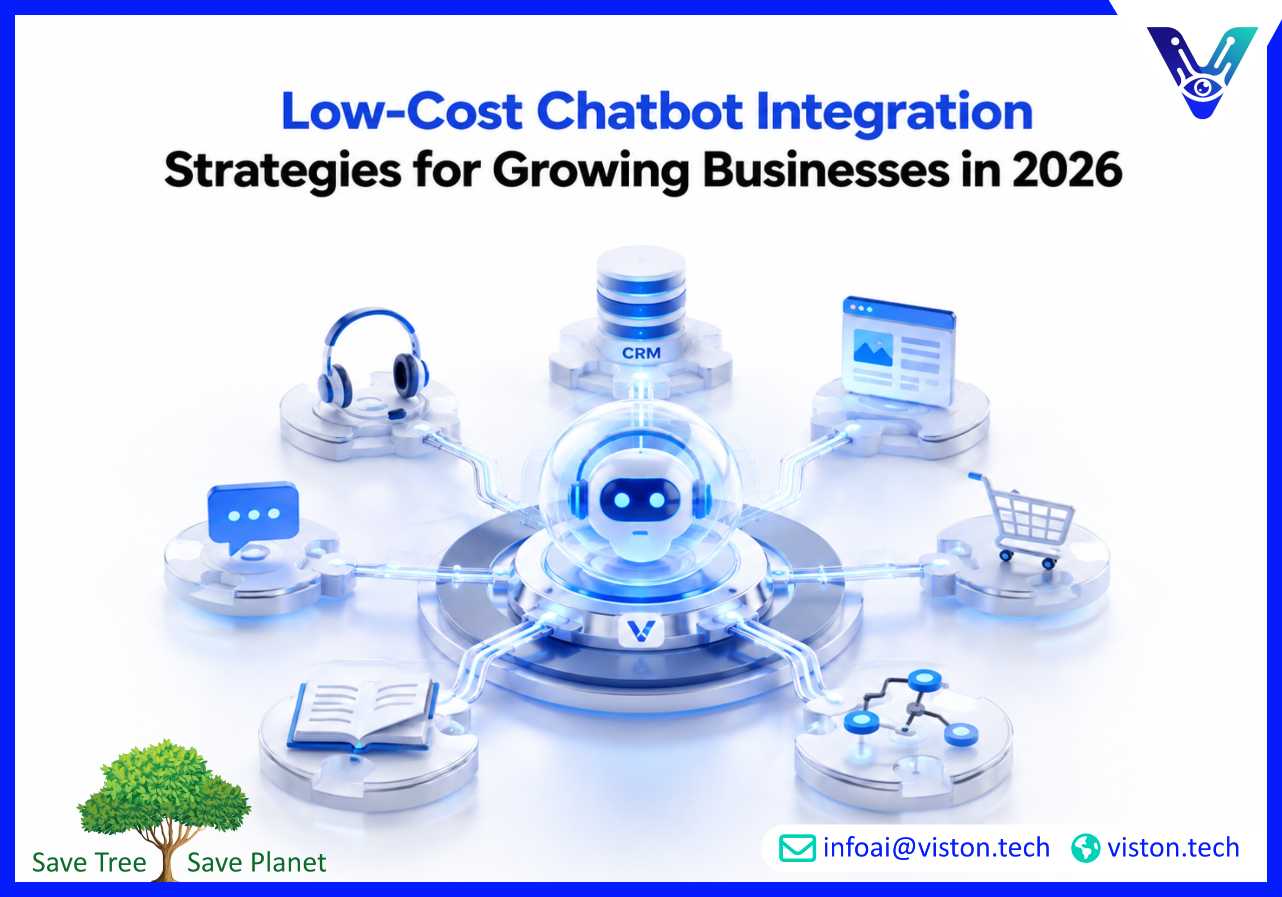
Low-Cost Chatbot Integration Strategies for Growing Businesses in 2026
As customer expectations continue to rise, businesses are under pressure to provide faster support, improve engagement, and streamline operations without increasing overhead costs. Low-cost chatbot integration strategies allow organizations to introduce automation, improve customer experiences, and support business growth while maintaining budget control. In 2026, successful chatbot adoption is less about spending more and more about integrating intelligently.
Why Low-Cost Chatbot Integration Matters in 2026
Businesses of all sizes are looking for practical ways to automate repetitive tasks while maintaining service quality. Chatbot technology has become more accessible than ever, enabling organizations to deploy intelligent customer interactions without enterprise-level budgets.Modern chatbot integration helps businesses:
Reduce customer service workload
Provide 24/7 support availability
Automate lead qualification
Improve response times
Support sales and marketing activities
Enhance customer engagement across channels
Scale support operations efficiently
The key challenge is implementing chatbot solutions cost-effectively while still achieving meaningful business outcomes.
Core Low-Cost Chatbot Integration Strategies
Start with High-Impact Use Cases
One of the most effective ways to control chatbot integration costs is focusing on high-volume, repetitive customer interactions first.Common examples include:
Frequently asked questions
Order status inquiries
Appointment scheduling
Lead capture forms
Basic technical support
Product information requests
By automating common inquiries, businesses can generate immediate operational efficiencies without investing in highly complex chatbot systems.
Leverage Existing Business Systems
Many organizations already use CRM platforms, helpdesk software, eCommerce systems, or communication tools that support chatbot integrations.Rather than building custom infrastructure, businesses can connect chatbots directly to existing platforms. This reduces development requirements, shortens implementation timelines, and minimizes maintenance costs.Popular integrations often include:
CRM systems
Customer support platforms
Marketing automation tools
Knowledge bases
Website chat widgets
Messaging applications
Use Modular Integration Approaches
Many businesses overspend by attempting large-scale chatbot deployments from day one. A phased implementation approach allows organizations to spread investment over time.A typical roadmap may include:
Website chatbot deployment
CRM integration
Lead qualification workflows
Customer support automation
Multi-channel expansion
Advanced AI enhancements
This strategy helps businesses validate ROI before committing to larger investments.
Focus on Knowledge-Driven Automation
Many customer conversations rely on information already available within existing business documentation.Integrating chatbots with:
FAQs
Support articles
Product documentation
Internal knowledge repositories
Training materials
can significantly improve automation capabilities without requiring extensive custom development.
Common Cost Drivers Businesses Should Avoid
Low-cost chatbot integration does not mean sacrificing quality. However, organizations should understand which factors commonly increase project costs.
Overengineering Initial Deployments
Many businesses attempt to automate every possible customer interaction immediately. This often leads to unnecessary complexity, longer implementation timelines, and increased development expenses.Starting with focused objectives typically delivers better results.
Excessive Custom Development
While custom chatbot features may be necessary in some situations, extensive bespoke development can significantly increase integration costs.Businesses should evaluate whether existing platform capabilities can satisfy requirements before investing in custom solutions.
Poor Data Preparation
Chatbot effectiveness depends heavily on data quality.Incomplete FAQs, outdated documentation, and inconsistent customer information can increase implementation effort and reduce chatbot performance.Preparing knowledge assets before integration often lowers long-term costs.
Ignoring Scalability Requirements
A low-cost solution that requires complete replacement after a year can become expensive.Organizations should select chatbot architectures that allow future expansion while maintaining affordability during initial deployment.
Best Practices for Maximizing ROI from Chatbot Integration
Define Clear Business Objectives
Every chatbot integration project should begin with measurable goals.Examples include:
Reducing support tickets
Increasing lead generation
Improving response times
Reducing operational costs
Enhancing customer satisfaction
Clear objectives help organizations prioritize investments and measure success accurately.
Prioritize User Experience
Low-cost implementation should not compromise customer experience.Effective chatbots provide:
Natural conversations
Accurate responses
Simple navigation
Clear escalation paths
Fast resolution times
Well-designed conversational experiences often outperform expensive but poorly structured chatbot deployments.
Maintain Human Escalation Options
Even advanced chatbots cannot resolve every customer issue.Providing seamless handoffs to support teams ensures customer satisfaction while allowing automation to handle routine interactions.
Monitor and Optimize Continuously
Successful chatbot integration is an ongoing process.Regular analysis of:
Conversation success rates
Customer feedback
Resolution metrics
Drop-off points
Lead conversion rates
helps organizations continuously improve chatbot performance and maximize return on investment.
How Low-Cost AI Chatbot Integration Supports Business Growth
Affordable chatbot integration is no longer limited to simple scripted interactions. Modern AI-powered solutions can support customer engagement, sales processes, operational efficiency, and service delivery while remaining cost-effective.Businesses that implement practical chatbot strategies often experience:
Lower support costs
Improved operational efficiency
Higher customer satisfaction
Better lead management
Increased scalability
Enhanced digital experiences
As AI technologies mature, businesses that adopt strategic chatbot integration approaches can gain meaningful competitive advantages without significant infrastructure investments.
How Viston AI Supports Cost-Effective AI Chatbot Integration
For organizations exploring AI chatbot integration, selecting the right implementation partner can significantly influence both project costs and long-term outcomes.Viston AI specializes in AI Chatbot Integration solutions designed to help businesses deploy intelligent conversational experiences efficiently and practically. Rather than focusing solely on chatbot deployment, the emphasis is placed on creating integrations that align with existing business workflows, customer service processes, operational goals, and digital transformation initiatives.Through strategic chatbot integration, businesses can connect conversational AI with customer support platforms, CRM systems, business applications, knowledge repositories, and communication channels. This approach helps reduce implementation complexity while supporting scalability and future growth requirements.Organizations often seek chatbot integration partners that understand both technical implementation and business objectives. Effective AI chatbot integration requires consideration of automation workflows, system compatibility, user experience design, data management, security requirements, reporting capabilities, and ongoing optimization.By focusing on practical deployment strategies, operational efficiency, and business-focused integration models, Viston AI helps organizations evaluate opportunities to automate customer interactions, improve engagement, and support digital operations while maintaining cost-conscious implementation approaches.
Frequently Asked Questions
What is the most affordable way to integrate a chatbot?
The most cost-effective approach is typically starting with a focused use case such as FAQs, lead capture, or customer support automation and integrating the chatbot with existing business systems rather than building custom infrastructure.
Can small businesses benefit from AI chatbot integration?
Yes. Modern chatbot platforms offer scalable options that allow small businesses to automate routine interactions, improve customer service, and increase efficiency without requiring large technology budgets.
How long does chatbot integration usually take?
Implementation timelines vary depending on complexity. Basic integrations may be completed in weeks, while enterprise-level deployments involving multiple systems and workflows can take several months.
What systems can be integrated with chatbots?
Chatbots can commonly integrate with CRM platforms, customer support software, websites, eCommerce systems, marketing automation tools, knowledge bases, and communication channels.
How can businesses measure chatbot ROI?
Key metrics often include support cost reduction, response time improvements, customer satisfaction scores, lead conversion rates, ticket deflection rates, and operational efficiency gains.
Why choose a specialist such as Viston AI for chatbot integration?
Businesses often benefit from working with specialists who understand AI chatbot integration, workflow automation, system connectivity, scalability requirements, and practical implementation considerations that support long-term business objectives.
Conclusion
Low-cost chatbot integration strategies allow businesses to improve customer engagement, automate routine processes, and enhance operational efficiency without excessive investment. By focusing on high-impact use cases, leveraging existing systems, implementing phased deployment strategies, and continuously optimizing performance, organizations can achieve meaningful results while controlling costs. As AI adoption continues to expand in 2026, AI Chatbot Integration remains a practical and scalable solution for businesses seeking smarter customer interactions. For organizations evaluating implementation options, Viston AI provides specialized expertise that aligns chatbot technology with real business requirements and growth objectives.