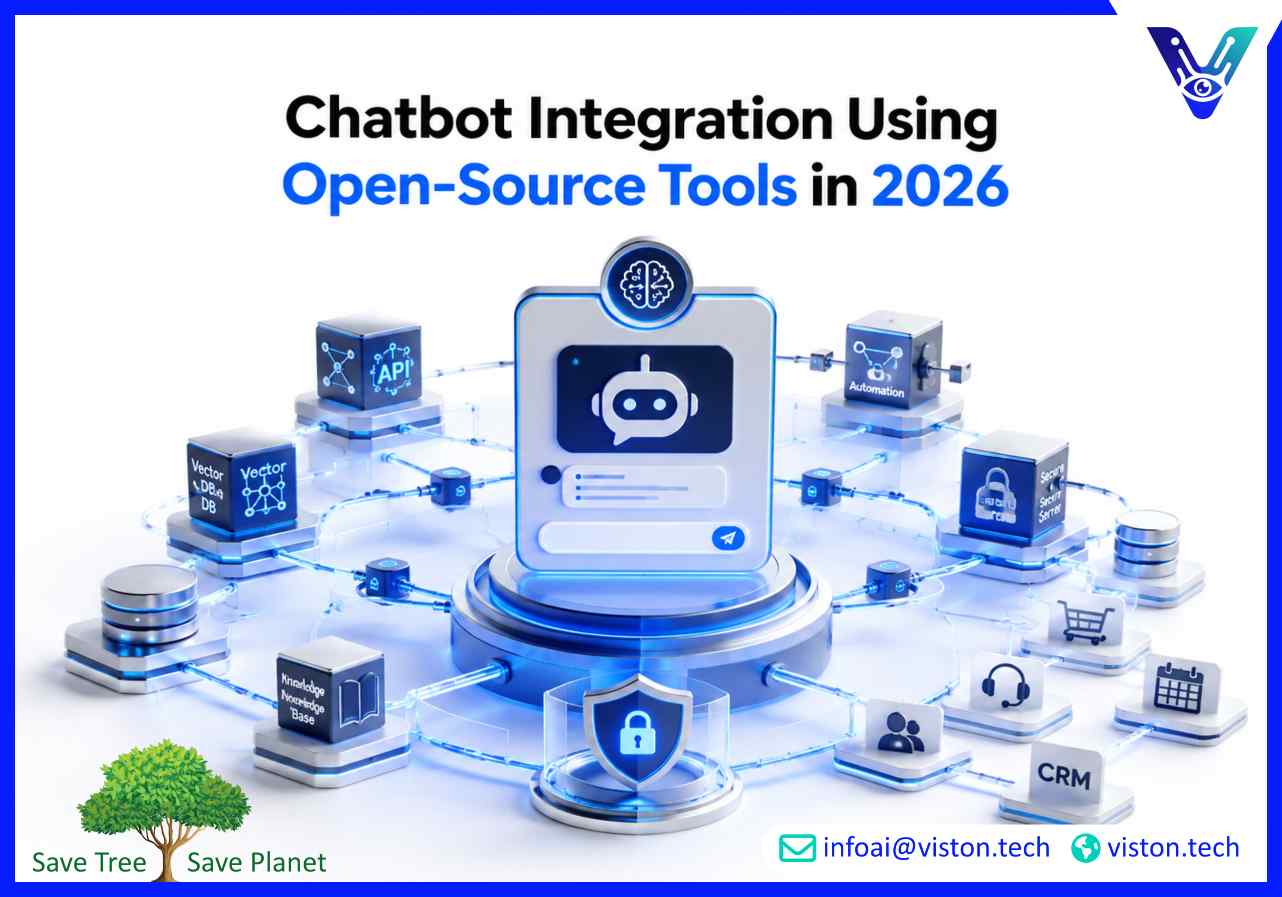
Chatbot Integration Using Open-Source Tools in 2026
Chatbot integration using open-source tools gives businesses more control over automation, data, workflows, and customer experience. In 2026, companies are looking beyond basic chat widgets and focusing on secure, scalable AI chatbot integration that connects with real business systems.
What Chatbot Integration Using Open-Source Tools Means
Chatbot integration using open-source tools means building or connecting conversational AI systems with business platforms through technologies that offer source-level flexibility, customization, and deployment control. Instead of relying only on closed SaaS chatbot platforms, businesses can use open-source frameworks, automation tools, APIs, vector databases, language models, and integration layers to create chatbot systems that fit their workflows.This approach is especially useful when a business needs more control over customer data, conversation flows, integrations, hosting, security, and long-term costs. Open-source chatbot integration can support customer support, lead qualification, internal helpdesks, appointment booking, product guidance, knowledge base search, CRM updates, ticket creation, and workflow automation.The goal is not simply to install a chatbot. The goal is to connect the chatbot to useful systems such as CRM software, helpdesk platforms, ecommerce stores, databases, calendars, payment systems, analytics tools, and internal knowledge repositories.
Why Open-Source Chatbot Integration Matters in 2026
Businesses in 2026 expect chatbots to do more than answer simple FAQs. Buyers now look for AI assistants that understand context, retrieve accurate information, escalate complex issues, respect privacy requirements, and work across multiple channels.Open-source tools help businesses meet these expectations by offering flexibility in how the chatbot is designed, trained, deployed, and improved. This can be valuable for companies that need custom workflows, industry-specific logic, multilingual support, private infrastructure, or deeper integration with existing software.Common open-source chatbot and AI integration components include:
Conversational AI frameworks for dialogue management
LLM orchestration tools for retrieval and workflow execution
Vector databases for knowledge search
Open-source automation platforms for system connections
APIs for CRM, helpdesk, ecommerce, and ERP integration
Self-hosted analytics and monitoring tools
For many organizations, the real advantage is ownership. Open-source integration allows teams to avoid rigid platform limitations, reduce vendor lock-in, and adapt the chatbot as business needs change.
Key Business Benefits of Open-Source AI Chatbot Integration
Greater Customization
Open-source tools allow businesses to design chatbot behavior around actual customer journeys, service processes, and internal rules. This is useful when standard chatbot templates cannot handle complex product questions, approval workflows, or industry-specific support requirements.
Better Data Control
Many businesses prefer open-source chatbot integration because it can support self-hosted or private-cloud deployment. This gives teams more control over customer conversations, business data, logs, and knowledge sources.
Lower Long-Term Platform Dependency
Open-source tools can reduce reliance on a single proprietary chatbot vendor. While implementation still requires technical expertise, businesses gain more freedom to modify, extend, and migrate their chatbot stack over time.
Deeper Integration with Business Systems
A chatbot becomes more valuable when it can take action. Open-source integration can connect the chatbot with CRM records, support tickets, order data, lead forms, internal databases, and workflow automation tools.
Scalable Knowledge Automation
Modern chatbot systems can use retrieval-augmented generation to answer questions from approved business content. This helps companies provide more accurate responses while reducing repetitive support work.
How to Approach Chatbot Integration Using Open-Source Tools
Start with the Use Case
Before choosing tools, define what the chatbot must achieve. A customer support bot, sales qualification bot, HR assistant, and technical documentation assistant all require different workflows, integrations, and quality controls.Useful questions include:
Who will use the chatbot?
What problems should it solve?
Which systems must it connect with?
What information can it access?
When should it escalate to a human?
How will success be measured?
Choose the Right Open-Source Stack
The right stack depends on the business goal. Some organizations need a structured chatbot framework with controlled conversation flows. Others need an LLM-powered assistant connected to a knowledge base and internal systems.A practical chatbot integration stack may include a conversation layer, natural language processing, an API layer, a database, a knowledge retrieval system, analytics, security controls, and human handoff logic.
Plan System Integrations Early
Integration is where most chatbot projects succeed or fail. A chatbot that cannot access the right data or trigger the right actions will remain limited. Businesses should map required integrations before development begins.Common integrations include:
CRM systems for lead capture and customer records
Helpdesk platforms for ticket creation and escalation
Ecommerce platforms for order and product queries
Calendars for booking and scheduling
Knowledge bases for accurate support answers
Analytics tools for performance tracking
Build Guardrails and Human Escalation
Open-source AI chatbot integration should include clear controls. The chatbot must know when to answer, when to ask clarifying questions, and when to hand off to a human agent. This is especially important for support, legal, healthcare, finance, and technical service environments.
Measure and Improve Continuously
Chatbot integration is not a one-time deployment. Businesses should review failed conversations, unanswered questions, escalation rates, user satisfaction, lead quality, containment rate, and response accuracy. These insights help improve prompts, flows, integrations, and knowledge content.
Choosing an AI Chatbot Integration Partner
Open-source tools offer flexibility, but they also require careful implementation. Businesses should evaluate providers based on technical capability, integration experience, security awareness, business understanding, and post-launch support.A reliable AI chatbot integration partner should be able to:
Translate business requirements into chatbot workflows
Select suitable open-source tools without overengineering
Connect the chatbot with existing business systems
Design safe escalation and fallback processes
Support testing, deployment, monitoring, and optimization
Balance automation with customer experience quality
The best chatbot integration projects focus on measurable outcomes, not novelty. A well-integrated chatbot should reduce manual work, improve response speed, support customer journeys, and create cleaner operational workflows.
Frequently Asked Questions
What is chatbot integration using open-source tools?
It is the process of building and connecting chatbot systems with business platforms using open-source frameworks, APIs, automation tools, databases, and AI components.
Is open-source chatbot integration suitable for businesses?
Yes. It can be suitable for businesses that need customization, data control, flexible deployment, and deeper integration with CRM, helpdesk, ecommerce, or internal systems.
What are the main risks of open-source chatbot integration?
The main risks include poor tool selection, weak security, inaccurate responses, limited maintenance, poor system integration, and lack of human escalation planning.
Can open-source chatbots integrate with CRM and helpdesk tools?
Yes. With proper API integration, open-source chatbot systems can create leads, update CRM records, open tickets, route requests, and support service workflows.
Do open-source chatbot tools reduce costs?
They can reduce licensing dependency, but businesses should still budget for development, hosting, integration, monitoring, security, and ongoing optimization.
Conclusion
Chatbot integration using open-source tools is a practical option for businesses that want flexible, secure, and customizable AI chatbot integration in 2026. The strongest results come from clear use cases, reliable system connections, strong data controls, and continuous improvement. Open-source tools can give businesses more ownership, but successful delivery depends on thoughtful architecture, integration expertise, and a clear focus on business outcomes.