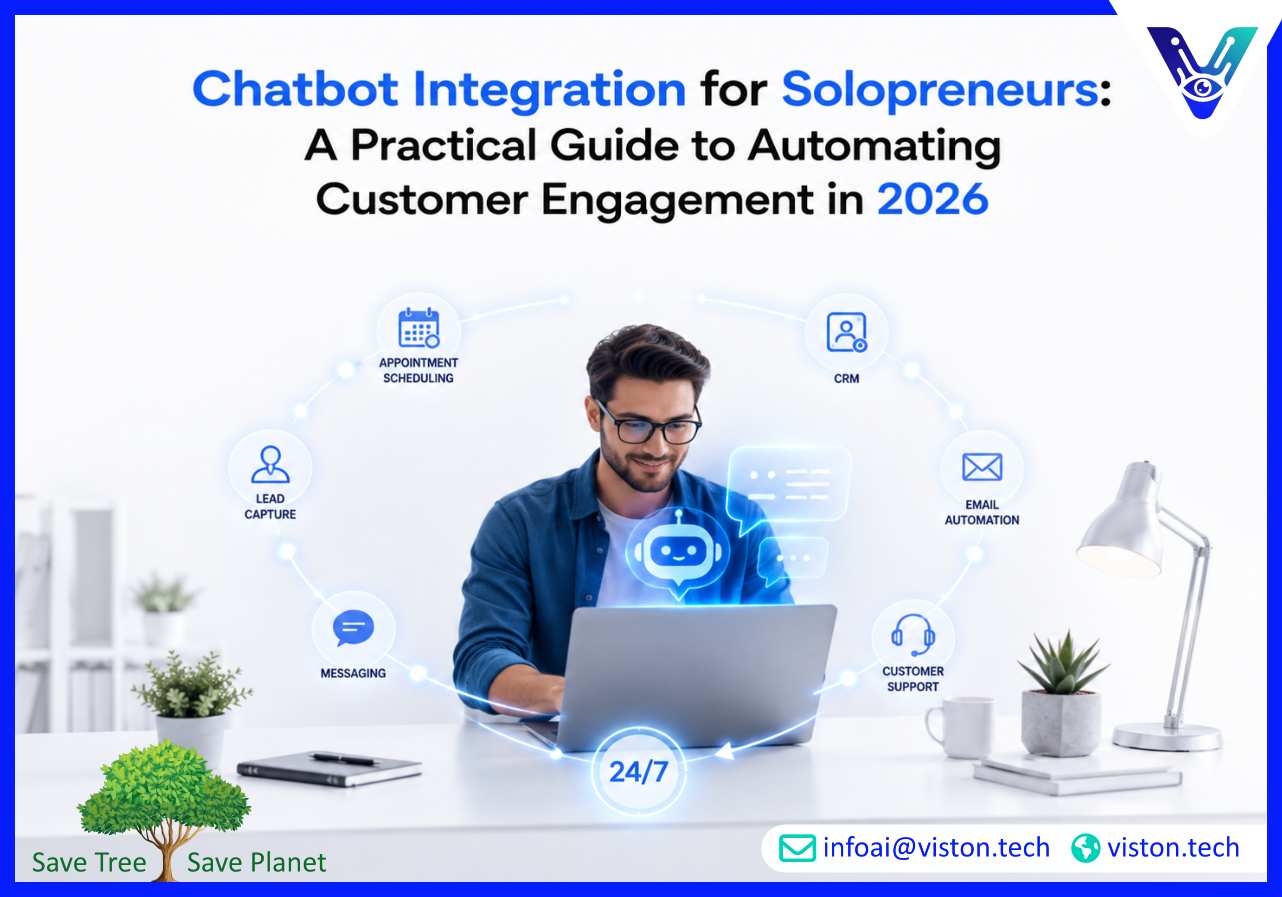
Chatbot Integration for Solopreneurs: A Practical Guide to Automating Customer Engagement in 2026
For solopreneurs, time is often the most limited resource. Managing customer inquiries, qualifying leads, scheduling appointments, and providing support can quickly consume valuable hours. In 2026, chatbot integration has become one of the most practical ways for solo business owners to automate repetitive interactions while maintaining responsive customer experiences. With the right implementation, chatbots can help solopreneurs scale operations without expanding headcount.
Why Chatbot Integration Matters for Solopreneurs in 2026
Solopreneurs are expected to wear multiple hats. They often handle marketing, sales, customer support, operations, and administration independently. As customer expectations continue to rise, responding quickly and consistently across digital channels becomes increasingly challenging.AI chatbot integration helps address these challenges by providing automated conversational experiences across websites, social media platforms, messaging applications, and customer portals.Modern chatbot solutions can:
Answer frequently asked questions instantly
Capture and qualify leads
Book appointments automatically
Provide product or service recommendations
Route inquiries to appropriate systems
Collect customer information
Support customers outside business hours
Reduce repetitive manual communication
For solopreneurs, these capabilities can create significant operational efficiencies while improving customer satisfaction.
Common Business Challenges Solopreneurs Face
Limited Availability
Potential customers often visit websites outside working hours. Without automated engagement, many opportunities are lost before a conversation begins.
High Volume of Repetitive Questions
Questions about pricing, services, availability, delivery times, and business policies consume valuable time that could be spent on revenue-generating activities.
Lead Management Difficulties
Capturing and organizing leads manually can result in delayed follow-ups and missed opportunities.
Scaling Customer Support
As a business grows, customer inquiries increase. Hiring dedicated support staff may not be financially viable for many solo business owners.
Inconsistent Customer Experience
When managing multiple communication channels manually, maintaining consistent messaging and response quality becomes difficult.AI chatbot integration helps address these issues by creating structured, automated workflows that operate continuously.
How AI Chatbot Integration Supports Solopreneur Growth
24/7 Customer Engagement
Integrated chatbots provide immediate responses regardless of business hours. This ensures website visitors receive assistance when they are most interested in making purchasing decisions.
Automated Lead Qualification
Rather than collecting only contact details, modern chatbots can ask qualifying questions and identify high-intent prospects.Examples include:
Budget requirements
Project timelines
Service interests
Business size
Location requirements
This allows solopreneurs to prioritize conversations with the highest-value opportunities.
Appointment Scheduling
Many chatbot integrations connect directly with calendar systems, enabling customers to book meetings without manual coordination.
CRM Integration
Chatbots can automatically transfer collected data into customer relationship management platforms, helping maintain organized sales pipelines.
Marketing Automation Support
Integrated chatbot workflows can trigger follow-up emails, newsletters, promotional campaigns, and customer nurturing sequences.
Reduced Administrative Work
Automating repetitive conversations frees up time for strategic business development, service delivery, and client management.
Best Practices for Successful Chatbot Integration
Start with Clear Business Objectives
Before selecting a chatbot platform, identify specific goals such as:
Increasing lead generation
Reducing support workload
Improving customer response times
Automating appointment booking
Enhancing customer onboarding
Clear objectives help determine integration requirements and success metrics.
Map Customer Journeys
Understanding how customers interact with the business helps create meaningful chatbot conversations.Key touchpoints may include:
Website visits
Contact form submissions
Product inquiries
Support requests
Appointment scheduling
Integrate Existing Business Systems
The most effective chatbot implementations connect with existing business tools rather than operating independently.Common integrations include:
CRM platforms
Email marketing systems
Calendar applications
Helpdesk software
E-commerce platforms
Knowledge bases
Customer databases
Maintain Human Escalation Options
While automation is valuable, certain conversations require human attention. Effective chatbot integrations include clear escalation paths for complex inquiries.
Continuously Optimize Conversations
Customer questions evolve over time. Regularly reviewing chatbot performance helps improve response quality, conversion rates, and customer satisfaction.
Key Features Solopreneurs Should Prioritize
Not all chatbot platforms offer the same capabilities. Solopreneurs should focus on practical business value rather than excessive feature lists.
Natural Language Understanding
AI-powered chatbots should understand customer intent rather than relying solely on scripted responses.
Solopreneurs need systems that are simple to update without requiring extensive technical expertise.
Analytics and Reporting
Performance tracking helps identify opportunities for optimization.Useful metrics include:
Conversation volume
Lead generation rates
Customer satisfaction indicators
Conversion rates
Response effectiveness
Scalability
The solution should support future business growth without requiring complete system replacement.
How Viston AI Supports AI Chatbot Integration for Solopreneurs
As businesses increasingly adopt conversational automation, successful chatbot implementation depends on more than simply deploying software. Effective AI chatbot integration requires strategic planning, workflow design, platform connectivity, customer journey mapping, and ongoing optimization.Viston AI specializes in AI chatbot integration services designed to help businesses implement intelligent conversational experiences that align with operational objectives. By focusing on integration rather than standalone chatbot deployment, the company helps organizations connect chatbots with existing business systems, customer data sources, CRM platforms, communication channels, and automation workflows.For solopreneurs, this approach can be particularly valuable because it allows automation to become part of a broader business process rather than an isolated tool. Proper integration helps streamline lead capture, customer support, appointment scheduling, information delivery, and customer engagement activities while reducing manual workload.Modern chatbot implementations increasingly require reliable integrations, scalable architecture, data management practices, security considerations, and performance monitoring. Through AI chatbot integration expertise, Viston AI supports businesses seeking practical automation solutions that improve customer experiences and operational efficiency while remaining adaptable as business requirements evolve.
Frequently Asked Questions
What is chatbot integration for solopreneurs?
Chatbot integration involves connecting AI-powered chatbots with business systems such as websites, CRM platforms, calendars, email tools, and customer support applications to automate customer interactions and business processes.
Can a chatbot help generate more leads?
Yes. Chatbots can engage visitors immediately, collect contact information, ask qualifying questions, and route high-intent prospects into sales workflows, helping improve lead generation efficiency.
Do solopreneurs need technical expertise to use chatbots?
Many chatbot platforms offer user-friendly interfaces, but professional integration services can help ensure optimal performance, system connectivity, workflow automation, and long-term scalability.
What systems can be integrated with a chatbot?
Common integrations include CRM platforms, calendars, email marketing systems, customer support software, e-commerce platforms, databases, payment systems, and analytics tools.
How long does chatbot integration typically take?
Implementation timelines vary based on complexity, required integrations, workflows, and customization requirements. Simple deployments may take days, while advanced integrations can require several weeks.
Why choose a specialist such as Viston AI for chatbot integration?
Organizations seeking AI chatbot integration support often benefit from specialist expertise in workflow design, platform connectivity, automation strategy, system integration, and performance optimization to maximize business value.
Conclusion
Chatbot integration for solopreneurs is no longer simply a customer support enhancement. In 2026, it has become a practical business automation strategy that helps solo business owners improve responsiveness, capture more leads, streamline operations, and deliver better customer experiences. Successful AI chatbot integration requires thoughtful planning, effective system connectivity, and continuous optimization. Businesses that implement chatbot automation strategically can reduce administrative workload while creating scalable customer engagement processes. For organizations seeking expert support, specialists such as Viston AI can help ensure chatbot integrations align with broader business goals and operational requirements.