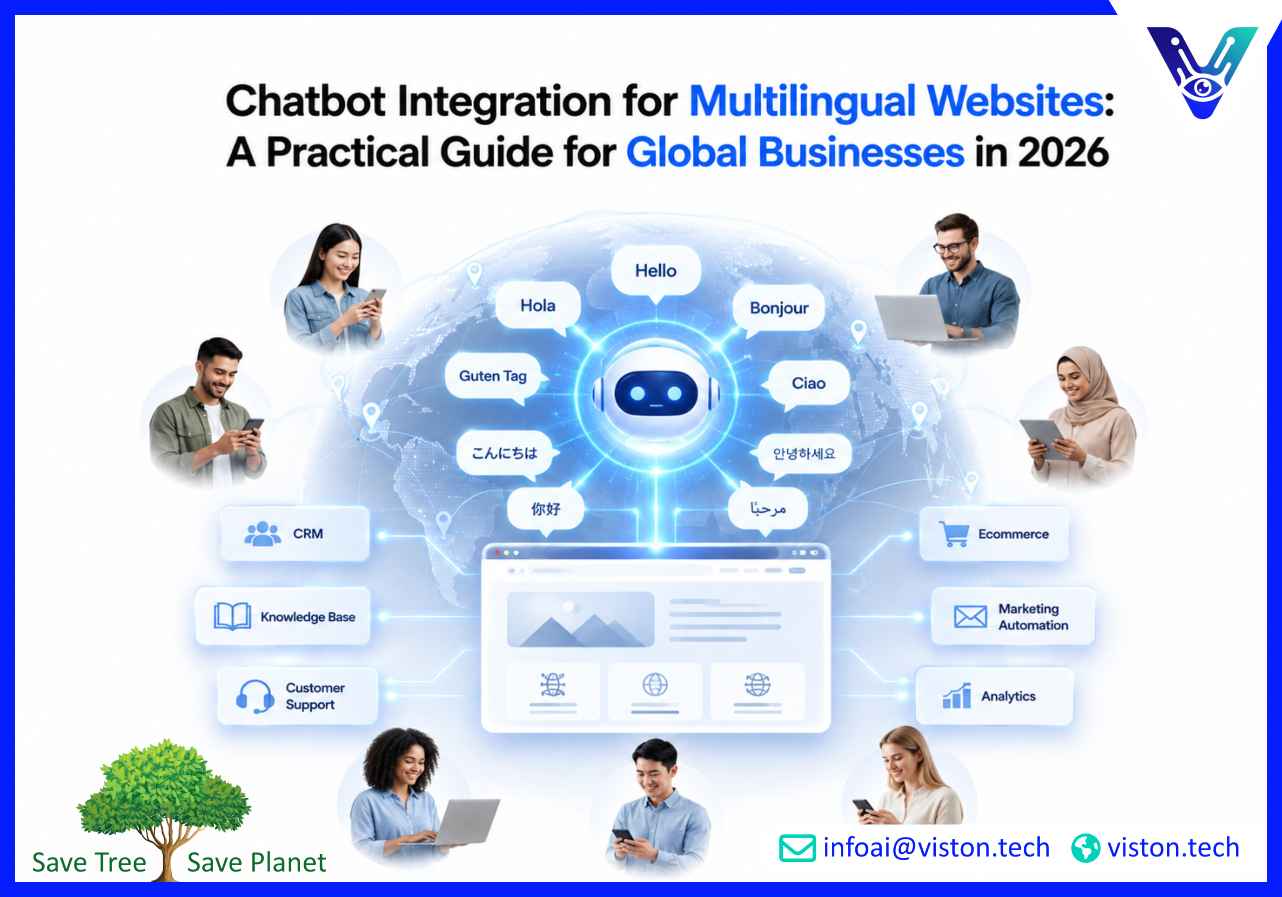
Chatbot Integration for Multilingual Websites: A Practical Guide for Global Businesses in 2026
As businesses expand across international markets, multilingual customer engagement has become a necessity rather than a competitive advantage. Customers expect support, product information, and assistance in their preferred language. Chatbot integration for multilingual websites helps organizations deliver consistent customer experiences, improve response times, and support global audiences without significantly increasing operational costs.
Understanding Chatbot Integration for Multilingual Websites
Chatbot integration for multilingual websites involves deploying AI-powered conversational systems that can understand, process, and respond to users in multiple languages across a website. These chatbots are integrated with websites, customer support systems, CRM platforms, knowledge bases, and business applications to provide seamless multilingual interactions.Modern AI chatbots can support dozens of languages while maintaining contextual understanding, intent recognition, and personalized customer experiences.For businesses serving international audiences, multilingual chatbot integration can support:
Customer service automation
Lead generation and qualification
Product recommendations
Appointment scheduling
Order tracking and support
Technical assistance
Knowledge base access
Sales inquiries across regions
Rather than building separate support teams for every market, organizations can use AI-powered chatbots to deliver scalable multilingual communication around the clock.
Why Multilingual Chatbots Matter in 2026
Global customers increasingly expect businesses to communicate in their native language. Language barriers often lead to abandoned purchases, lower customer satisfaction, and missed sales opportunities.In 2026, multilingual chatbot integration supports business growth by helping companies:
Expand into new international markets
Improve customer engagement
Reduce support costs
Increase website conversions
Provide 24/7 assistance
Maintain consistent brand communication
Support geographically distributed customers
Advances in large language models, multilingual natural language processing, and AI translation technologies have significantly improved chatbot accuracy across multiple languages.
Common Business Challenges
Organizations often face several challenges when serving multilingual audiences:
High costs of multilingual support teams
Inconsistent customer experiences across regions
Slow response times
Translation inaccuracies
Knowledge management complexity
Difficulty scaling customer support globally
A properly integrated multilingual chatbot can address many of these challenges while maintaining service quality.
Key Features Businesses Should Look for in Multilingual Chatbot Integration
Not all chatbot solutions are designed for multilingual environments. Businesses should evaluate chatbot integration capabilities carefully before implementation.
Automatic Language Detection
Advanced chatbots can automatically identify a visitor’s language based on browser settings, location signals, or conversation input, creating a smoother user experience.
Multilingual Natural Language Understanding
Effective chatbot systems must accurately understand customer intent across supported languages rather than simply translating responses.
Knowledge Base Integration
Connecting chatbots with multilingual knowledge repositories ensures consistent answers regardless of the language being used.
CRM and Customer Data Integration
Integration with CRM platforms allows chatbots to personalize conversations using customer history, preferences, and previous interactions.
Human Agent Escalation
Complex issues may require human support. A multilingual chatbot should seamlessly transfer conversations to the appropriate language-speaking support agent.
Analytics and Reporting
Businesses need visibility into performance metrics such as:
Conversation completion rates
Customer satisfaction
Language-specific engagement
Lead generation performance
Resolution rates
Support cost reductions
Best Practices for Successful Multilingual Chatbot Integration
Successful implementation requires more than enabling multiple languages. Organizations should adopt a structured integration strategy.
Start with Priority Languages
Focus initially on the languages that generate the highest website traffic, customer inquiries, or revenue opportunities.
Use Native Content Instead of Direct Translation
Customer interactions often include cultural nuances, regional terminology, and local expectations. Localized content generally performs better than direct machine translations.
Maintain Consistent Brand Voice
Regardless of language, chatbot responses should align with brand messaging, customer service standards, and organizational communication guidelines.
Integrate Across Business Systems
Chatbots deliver greater value when connected to:
CRM platforms
Helpdesk systems
Marketing automation tools
Ecommerce platforms
Customer databases
Knowledge management systems
Continuously Optimize Performance
Regular monitoring helps identify language-specific issues, misunderstood intents, and opportunities for improving customer experiences.Continuous training and optimization remain critical for maintaining chatbot effectiveness as customer expectations evolve.
Business Benefits of Multilingual AI Chatbot Integration
Organizations implementing multilingual chatbot solutions often experience benefits that extend beyond customer support automation.
Improved Customer Experience
Customers can communicate naturally in their preferred language, reducing friction and increasing satisfaction.
Global Market Accessibility
Businesses can engage international visitors more effectively without immediately expanding multilingual support teams.
Operational Efficiency
Automating routine inquiries reduces workload for support teams, allowing human agents to focus on more complex cases.
Higher Conversion Rates
Multilingual assistance can help guide prospects through purchasing decisions, product selection, and onboarding processes.
Scalable Customer Support
As businesses expand into additional markets, chatbot infrastructure can often scale more efficiently than traditional support models.
Better Data Collection
Multilingual conversations provide valuable insights into customer preferences, regional requirements, and emerging market opportunities.
How Viston AI Supports Multilingual Website Chatbot Integration
For organizations seeking to improve customer engagement across diverse markets, AI chatbot integration requires more than simply deploying a conversational interface. Effective implementation involves integration planning, language support strategies, business system connectivity, workflow automation, user experience optimization, and ongoing performance management.Viston AI specializes in AI Chatbot Integration services designed to help businesses implement intelligent conversational experiences across websites and digital customer touchpoints. For multilingual websites, chatbot integration can support customer service automation, lead generation, customer onboarding, knowledge base access, and multilingual engagement workflows.A structured integration approach typically includes chatbot deployment, language configuration, CRM connectivity, knowledge source integration, analytics setup, security considerations, and ongoing optimization. This helps organizations create scalable chatbot ecosystems that can support growing customer demands while maintaining consistent service quality.Whether supporting global audiences, expanding into new markets, or improving multilingual customer experiences, specialized AI chatbot integration services can help businesses align conversational AI capabilities with operational goals and customer expectations.
Frequently Asked Questions
What is chatbot integration for multilingual websites?
It involves implementing AI-powered chatbots that can communicate with website visitors in multiple languages while integrating with business systems such as CRM, support platforms, and knowledge bases.
How many languages can a multilingual chatbot support?
The number varies by platform, but many modern AI chatbot solutions can support dozens of languages with varying levels of conversational sophistication.
Can multilingual chatbots improve website conversion rates?
Yes. Providing assistance in a visitor’s preferred language can improve engagement, reduce friction, and increase the likelihood of completing desired actions.
Do multilingual chatbots require human support agents?
Yes, in many cases. While chatbots can automate routine interactions, complex inquiries often benefit from escalation to human agents.
How long does chatbot integration typically take?
Implementation timelines depend on complexity, integrations, supported languages, workflows, and business requirements. Projects can range from a few weeks to several months.
How can Viston AI help with multilingual chatbot integration?
Viston AI provides AI Chatbot Integration services that can support chatbot deployment, system integrations, workflow automation, multilingual customer engagement strategies, and ongoing optimization initiatives.
Conclusion
Chatbot integration for multilingual websites has become an important capability for businesses serving international audiences in 2026. Beyond improving customer support efficiency, multilingual AI chatbots help organizations deliver better customer experiences, support global expansion, and maintain consistent engagement across languages and markets. When implemented strategically, AI Chatbot Integration can create scalable communication channels that align with customer expectations and business growth objectives. For organizations exploring multilingual conversational solutions, experienced providers such as Viston AI can help design and implement integrations that support long-term operational and customer experience goals.