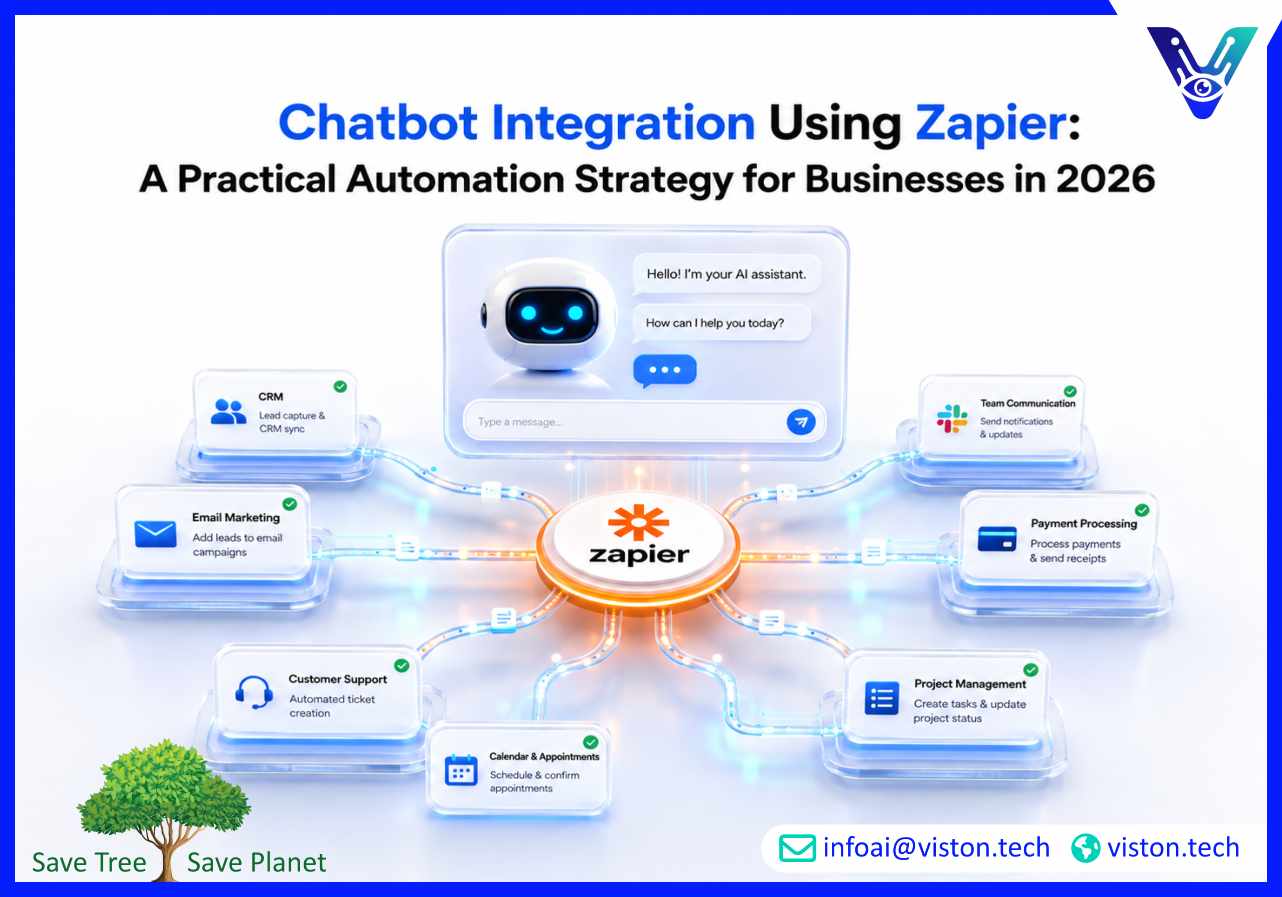
Chatbot Integration Using Zapier: A Practical Automation Strategy for Businesses in 2026
Businesses increasingly rely on chatbots to handle customer inquiries, capture leads, automate support, and improve operational efficiency. However, the real value of a chatbot comes from its ability to connect with the systems a business already uses. Chatbot integration using Zapier has become a practical way to automate workflows without extensive development resources, helping organizations streamline processes and improve customer experiences in 2026.
What Is Chatbot Integration Using Zapier?
Chatbot integration using Zapier refers to connecting a chatbot platform with other business applications through Zapier’s automation platform. Instead of manually transferring information between systems, businesses can create automated workflows that move data between chatbots and tools such as CRMs, email marketing platforms, helpdesk software, project management systems, payment platforms, and communication applications.Zapier acts as a bridge between applications. When a chatbot captures customer information or triggers a specific event, Zapier can automatically initiate actions in connected systems.Common chatbot automation workflows include:
Sending chatbot-generated leads to CRM platforms
Creating support tickets from chatbot conversations
Adding users to email marketing campaigns
Sending notifications to sales teams
Updating customer records automatically
Triggering appointment booking workflows
Creating tasks in project management systems
This approach allows businesses to build connected customer journeys without requiring custom software development for every integration.
Why Chatbot and Zapier Integrations Matter in 2026
Customer expectations continue to evolve. Users expect immediate responses, seamless experiences, and personalized interactions regardless of the communication channel they use.Without integration, chatbots often become isolated tools that collect information but fail to drive meaningful business actions. Teams may still need to manually enter data into CRM systems, create support tickets, or follow up with prospects.Modern businesses are increasingly focused on:
Reducing manual data entry
Improving response times
Enhancing customer experiences
Maintaining accurate customer records
Supporting scalable growth
Increasing operational efficiency
Connecting customer-facing systems with internal workflows
Zapier enables these objectives by automating repetitive processes that occur after a chatbot interaction.As organizations adopt more SaaS applications, integration flexibility becomes increasingly important. Zapier’s extensive application ecosystem allows businesses to connect chatbot workflows with hundreds of commonly used business tools.
Key Business Use Cases for Chatbot Integration Using Zapier
Lead Capture and CRM Automation
One of the most common chatbot use cases involves collecting lead information from website visitors.When a visitor provides contact details through a chatbot, Zapier can automatically:
Create a new CRM record
Assign the lead to a sales representative
Trigger lead qualification workflows
Send internal notifications
Initiate follow-up sequences
This reduces delays between lead capture and sales engagement while minimizing manual work.
Customer Support Automation
Support teams can use chatbot integrations to streamline ticket management processes.When a chatbot identifies a complex customer issue, Zapier can automatically:
Create a support ticket
Assign priority levels
Notify relevant support teams
Log conversation details
Update customer support databases
This helps ensure customer issues are handled efficiently without requiring manual intervention.
Appointment Scheduling Workflows
Businesses offering consultations, demos, or service appointments often use chatbots to collect booking requests.Zapier can automate scheduling-related actions such as:
Creating calendar events
Sending booking confirmations
Updating CRM records
Triggering reminder sequences
Notifying internal teams
These automations help reduce scheduling errors while improving customer convenience.
E-commerce and Order Management
Online retailers increasingly use chatbots to support product inquiries, order tracking, and customer engagement.Integrated workflows can:
Update customer databases
Trigger order notifications
Create support requests
Manage loyalty program enrollment
Collect customer feedback
This creates a more connected customer experience across sales and support functions.
Best Practices for Successful Chatbot Integration Using Zapier
Define Business Objectives First
Successful integrations begin with clear business goals.Before building workflows, organizations should identify:
The customer journey being automated
Required business outcomes
Data collection requirements
Operational bottlenecks
Performance metrics
Technology should support business objectives rather than drive them.
Map Data Flows Carefully
Data consistency is critical for effective automation.Businesses should determine:
What information the chatbot collects
Where the data needs to be sent
Which systems act as the source of truth
How duplicate records will be managed
How updates will be synchronized
Careful planning helps prevent reporting inaccuracies and operational inefficiencies.
Prioritize Security and Compliance
Many chatbot interactions involve customer information.Organizations should evaluate:
Data privacy requirements
Access controls
User permissions
Data retention policies
Regulatory obligations
Security considerations should be integrated into automation design from the beginning.
Monitor and Optimize Workflows
Automation is not a one-time implementation.Businesses should regularly review:
Workflow success rates
Error logs
Customer experience metrics
Lead conversion performance
Operational efficiency improvements
Continuous optimization ensures integrations continue delivering value as business requirements evolve.
Common Challenges Businesses Face with Zapier-Based Chatbot Integrations
Although Zapier simplifies integration projects, organizations often encounter challenges during implementation.
Complex Workflow Requirements
Basic automations are relatively straightforward, but larger organizations frequently require multi-step workflows involving numerous applications and decision points.Designing these workflows requires expertise in automation architecture and business process mapping.
Data Quality Issues
Automation can amplify data quality problems if validation processes are not established.Incomplete, duplicate, or inaccurate chatbot data can affect CRM records, reporting accuracy, and downstream workflows.
Scalability Considerations
As chatbot adoption grows, workflow volumes increase.Businesses must ensure integrations can handle growing transaction volumes while maintaining performance and reliability.
Platform Compatibility
Not every chatbot platform offers the same integration capabilities.Organizations should assess API availability, webhook support, data structures, and workflow flexibility before implementing automation strategies.
How Viston AI Supports Chatbot Integration Using Zapier
For businesses looking to automate customer interactions and operational workflows, chatbot implementation often extends beyond simply deploying a conversational interface. Effective chatbot integration requires aligning automation with business processes, customer journeys, data management requirements, and operational goals.Viston AI specializes in AI Chatbot Integration solutions that help organizations connect chatbot platforms with the systems that drive everyday business operations. When chatbot integration using Zapier is part of a broader automation strategy, businesses often require expertise in workflow design, CRM connectivity, lead management automation, customer support processes, appointment scheduling, and cross-platform data synchronization.Rather than focusing solely on chatbot deployment, Viston AI helps businesses create connected ecosystems where chatbot interactions trigger meaningful business actions. This includes designing scalable workflows, improving operational efficiency, ensuring data consistency, and supporting seamless integrations across sales, marketing, customer service, and business management platforms.As automation expectations continue to increase in 2026, businesses benefit from integration strategies that balance customer experience, operational reliability, security considerations, and long-term scalability. A structured integration approach helps organizations maximize the value of both chatbot technology and their existing software investments.
Frequently Asked Questions
Can Zapier connect with most chatbot platforms?
Many modern chatbot platforms offer direct Zapier integrations or support webhooks and APIs that can be connected through Zapier workflows. Compatibility should always be verified before implementation.
Is Zapier suitable for enterprise chatbot integrations?
Zapier can support many enterprise automation requirements, particularly for connecting SaaS applications. However, highly complex enterprise environments may also require custom integrations and advanced workflow solutions.
What business systems are commonly integrated with chatbots using Zapier?
Common integrations include CRM systems, email marketing platforms, helpdesk software, project management tools, calendars, communication platforms, and customer data systems.
How does chatbot integration improve lead management?
Integration automates lead capture, CRM updates, sales notifications, qualification workflows, and follow-up actions, reducing delays and improving sales responsiveness.
What are the biggest risks during chatbot integration projects?
Common risks include poor workflow design, inconsistent data mapping, security oversights, inadequate testing, and scalability limitations as automation volumes increase.
Can Viston AI help with chatbot integration using Zapier?
Yes. Viston AI provides AI Chatbot Integration expertise that can support businesses in designing, implementing, and optimizing chatbot automation workflows that align with operational and customer engagement objectives.
Conclusion
Chatbot integration using Zapier offers businesses a practical way to automate customer interactions, streamline workflows, and connect critical systems without extensive development effort. As organizations continue investing in automation in 2026, integrated chatbot ecosystems can improve lead management, customer support, operational efficiency, and data accuracy. By combining well-designed automation workflows with professional AI Chatbot Integration expertise, businesses can create scalable solutions that deliver measurable business value while supporting long-term growth and customer experience objectives.