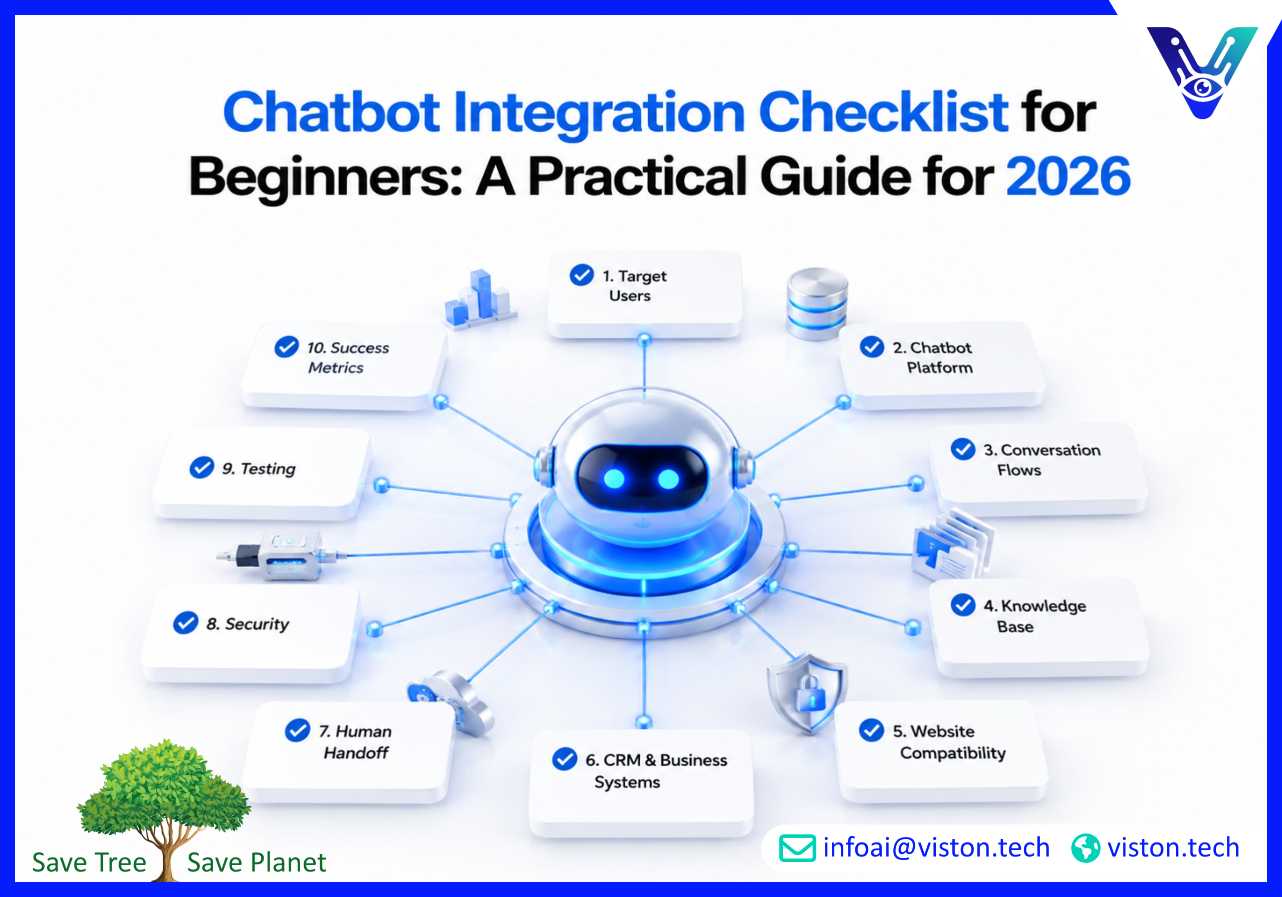
Chatbot Integration Checklist for Beginners: A Practical Guide for 2026
Businesses of all sizes are adopting AI-powered chatbots to improve customer engagement, automate support, generate leads, and streamline operations. However, successful chatbot deployment requires more than simply installing a chatbot on a website. This chatbot integration checklist for beginners provides a structured approach to help organizations implement chatbot solutions effectively and avoid common mistakes.
Understand Your Chatbot Integration Goals
Before selecting tools or platforms, businesses should define the purpose of the chatbot. A clear objective helps determine the required features, integrations, workflows, and success metrics.
Common Business Objectives
Lead generation and qualification
Customer support automation
Appointment booking
Product recommendations
Customer onboarding
Order tracking and status updates
Internal employee assistance
Without a defined objective, chatbot implementation can become fragmented and fail to deliver measurable business value.
The Essential Chatbot Integration Checklist for Beginners
Businesses new to AI chatbot implementation should review the following checklist before launching their solution.
1. Identify Target Users
Understand who will interact with the chatbot. Customer expectations differ depending on whether the audience consists of consumers, enterprise buyers, support clients, or internal employees.
Define primary user groups
Identify common questions
Map customer journeys
Understand user pain points
2. Select the Right Chatbot Platform
Not every chatbot platform is designed for the same business requirements. Evaluate solutions based on:
AI capabilities
Natural language processing accuracy
Integration flexibility
Scalability
Security standards
Analytics and reporting
Multi-channel support
The chosen platform should align with current needs while supporting future growth.
3. Define Conversation Flows
Successful chatbot experiences depend on thoughtful conversation design.
Create welcome messages
Build FAQ workflows
Design escalation paths
Define fallback responses
Map lead qualification questions
Well-structured conversations improve user satisfaction and increase completion rates.
4. Prepare Knowledge Sources
AI chatbots perform better when they have access to accurate and organized information.
Product documentation
Service information
FAQs
Help center content
Policies and procedures
Review content quality before connecting knowledge sources to the chatbot.
5. Verify Website Compatibility
For website chatbot deployment, confirm compatibility with:
Content management systems
Ecommerce platforms
Landing pages
Mobile websites
Custom web applications
Integration issues often arise when technical requirements are not assessed early in the project.
6. Connect Business Systems
One of the most important steps in chatbot integration is connecting the chatbot to existing business systems.
CRM platforms
Customer support software
Email marketing systems
Booking platforms
ERP solutions
Knowledge bases
Connected systems enable the chatbot to provide more useful and personalized interactions.
7. Configure Human Handoff Workflows
AI chatbots should not attempt to handle every interaction independently.Create clear escalation rules for:
Complex inquiries
Technical issues
Billing concerns
Complaints
Sales opportunities
Human handoff capabilities improve customer experience and prevent user frustration.
8. Implement Security Controls
Security remains a critical consideration for chatbot deployments in 2026.
Data encryption
Role-based access controls
Secure API connections
User authentication mechanisms
Data retention policies
Organizations handling customer information should ensure compliance with applicable privacy and security requirements.
9. Test Before Launch
Comprehensive testing helps identify issues before users encounter them.
Functional testing
Conversation testing
Integration testing
Load testing
Mobile testing
Error handling validation
Testing should involve both technical teams and business stakeholders.
10. Define Success Metrics
Measure chatbot performance using meaningful business KPIs.
Lead conversion rate
Customer satisfaction scores
Resolution rates
Average response time
Conversation completion rates
Support ticket reduction
Tracking these metrics helps organizations optimize chatbot performance over time.
Common Chatbot Integration Mistakes Beginners Should Avoid
Many first-time chatbot implementations fail to meet expectations because of avoidable mistakes.
Launching without clear objectives
Ignoring user experience design
Using incomplete knowledge bases
Failing to connect business systems
Over-automating complex processes
Neglecting security considerations
Skipping testing phases
Not monitoring chatbot performance after launch
Addressing these risks early significantly improves implementation outcomes.
Why Chatbot Integration Matters More in 2026
Customer expectations continue to evolve. Businesses are increasingly expected to provide immediate responses, personalized interactions, and seamless digital experiences.Modern chatbot integration is no longer limited to answering simple questions. AI-powered solutions now support:
Advanced lead qualification
Conversational commerce
Multilingual support
Customer onboarding automation
Workflow automation
Data collection and analysis
Omnichannel engagement
Organizations that implement chatbot solutions strategically can improve operational efficiency while enhancing customer experience.
How Viston AI Supports Effective AI Chatbot Integration
For businesses exploring AI chatbot integration, successful deployment often depends on proper planning, system connectivity, workflow design, and ongoing optimization. Viston AI specializes in AI Chatbot Integration solutions that help organizations implement chatbots aligned with real business objectives rather than treating them as standalone tools.The company focuses on connecting chatbot systems with websites, CRM platforms, customer support environments, lead management processes, and business workflows to create practical automation experiences. This approach helps businesses improve response times, streamline customer interactions, and support scalable growth initiatives.Rather than relying solely on pre-built chatbot functionality, effective integration requires careful attention to conversation design, data flow management, security requirements, analytics, and user experience. These factors become increasingly important as organizations expand chatbot usage across customer service, sales, onboarding, and operational processes.By supporting structured implementation strategies and business-focused chatbot deployments, Viston AI helps organizations build solutions that deliver measurable value while remaining adaptable to changing customer expectations and technological advancements.
Frequently Asked Questions
What is chatbot integration?
Chatbot integration is the process of connecting a chatbot with websites, applications, databases, CRM systems, support platforms, and other business tools to automate interactions and improve operational efficiency.
How long does chatbot integration take?
Implementation timelines vary depending on complexity. Basic website chatbot deployments may take days, while enterprise integrations involving multiple systems can require several weeks.
Do beginners need coding skills for chatbot integration?
Many modern chatbot platforms offer low-code or no-code capabilities. However, complex integrations often benefit from technical expertise, especially when connecting business systems and APIs.
What systems should a chatbot connect to?
Common integrations include CRM software, help desk platforms, booking systems, ecommerce platforms, email marketing tools, and internal knowledge bases.
How can businesses measure chatbot success?
Key metrics include customer satisfaction, response time, lead generation performance, resolution rates, conversation completion rates, and operational efficiency improvements.
Why choose Viston AI for AI Chatbot Integration?
Viston AI focuses on business-oriented AI Chatbot Integration strategies that connect chatbot technology with operational workflows, customer engagement goals, and scalable automation requirements.
Conclusion
A successful chatbot integration checklist for beginners goes beyond selecting a chatbot platform. Businesses must consider user needs, system integrations, conversation design, security, testing, and long-term optimization. As AI-driven customer engagement continues to evolve in 2026, organizations that approach AI Chatbot Integration strategically are better positioned to improve customer experiences and operational efficiency. For businesses seeking practical implementation support, Viston AI provides specialized expertise in building chatbot solutions that align with real business objectives and scalable growth requirements.