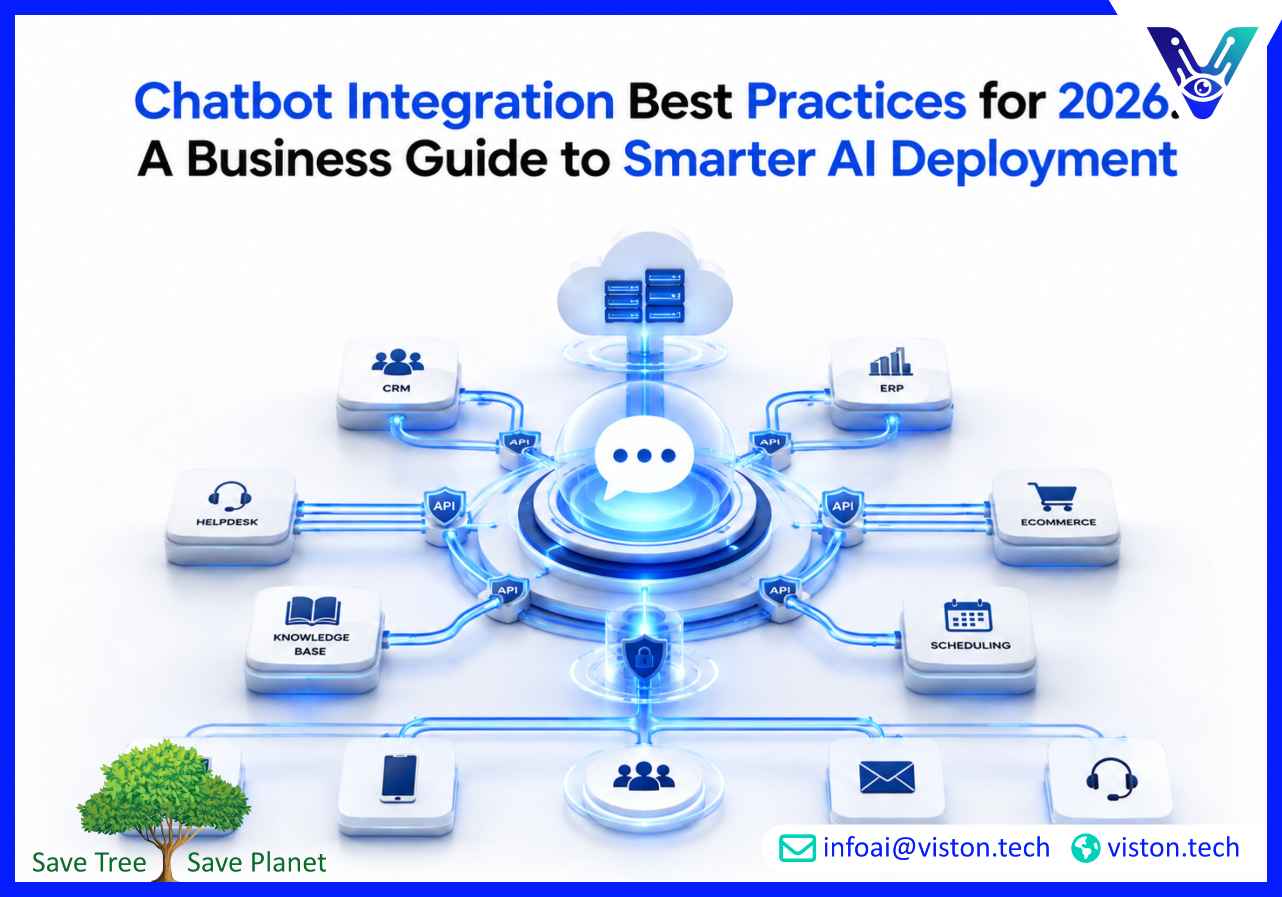
Chatbot Integration Best Practices for 2026: A Business Guide to Smarter AI Deployment
As AI-powered customer interactions become a standard business expectation, chatbot implementation is no longer just about deploying conversational technology. Organizations now need integrated, secure, scalable, and data-driven chatbot ecosystems. Understanding chatbot integration best practices helps businesses maximize automation, improve customer experiences, and achieve measurable returns from AI investments in 2026.
Why Chatbot Integration Matters More Than Ever in 2026
Modern chatbots have evolved beyond simple question-and-answer tools. Businesses increasingly rely on conversational AI to support customer service, sales, operations, employee assistance, and workflow automation.However, the effectiveness of a chatbot depends largely on its ability to connect with existing business systems. A chatbot that cannot access customer records, process transactions, retrieve information, or trigger workflows often creates more friction than value.Effective AI chatbot integration enables businesses to:
Deliver personalized customer experiences
Reduce manual workloads
Provide faster response times
Improve operational efficiency
Support omnichannel communication
Increase data accessibility
Scale customer engagement without proportional staffing increases
As organizations adopt increasingly sophisticated AI solutions, integration quality has become a key factor separating successful chatbot deployments from underperforming ones.
Best Practices for Successful Chatbot Integration in 2026
Start with Clear Business Objectives
The most successful chatbot projects begin with well-defined business goals rather than technology selection.Before integration begins, organizations should determine what outcomes they want to achieve, such as:
Customer support automation
Lead generation and qualification
Appointment scheduling
Employee self-service
Order tracking
Knowledge management
Customer onboarding
Clearly defined objectives help prioritize integrations, allocate resources effectively, and establish meaningful success metrics.
Prioritize Integration with Core Business Systems
A chatbot becomes significantly more valuable when connected to operational systems that contain real business data.Common integrations include:
Customer Relationship Management (CRM) platforms
Enterprise Resource Planning (ERP) systems
Helpdesk and ticketing platforms
Marketing automation tools
Ecommerce systems
Knowledge bases
Scheduling applications
Internal databases
Real-time access to accurate information allows chatbots to provide more relevant, personalized, and actionable responses.
Adopt an API-First Integration Strategy
Modern chatbot ecosystems depend heavily on APIs for secure and scalable communication between platforms.An API-first approach offers several advantages:
Faster integration development
Greater flexibility
Improved scalability
Easier maintenance
Better interoperability
Future-proof system architecture
Businesses planning long-term AI adoption should evaluate software platforms based on API maturity and integration capabilities.
Building a Scalable Chatbot Integration Framework
Design for Omnichannel Experiences
Customers increasingly interact with businesses across multiple digital touchpoints.In 2026, chatbot integration strategies should support channels such as:
Company websites
Mobile applications
WhatsApp
Slack
Microsoft Teams
Facebook Messenger
Email support systems
Customer portals
Maintaining conversation continuity across channels creates a more seamless customer experience while improving engagement and satisfaction.
Implement Strong Data Governance
Chatbots often process customer information, business records, and operational data.Organizations should establish governance frameworks that address:
Data ownership
Access permissions
Data quality standards
Retention policies
Audit trails
Compliance requirements
Strong governance improves reliability while reducing operational and regulatory risks.
Plan for Human Escalation
Even the most advanced AI systems cannot resolve every customer inquiry.Businesses should create structured escalation workflows that allow users to transition smoothly from chatbot interactions to human support when needed.Effective escalation processes reduce customer frustration and improve overall service quality.
Security and Compliance Best Practices for AI Chatbot Integration
Protect Sensitive Information
Security remains a top priority for chatbot deployments in 2026.Organizations should implement:
End-to-end encryption
Secure API authentication
Role-based access controls
Multi-factor authentication where appropriate
Data masking procedures
Continuous monitoring systems
These measures help protect customer information while maintaining trust.
Align with Regulatory Requirements
Compliance considerations vary based on industry and geography.Businesses should ensure chatbot integrations support relevant privacy, security, and industry regulations while maintaining transparency around AI usage and data processing practices.Compliance should be integrated into project planning rather than treated as a post-deployment activity.
Monitor AI Outputs and Performance
Responsible AI deployment requires ongoing oversight.Organizations should regularly evaluate:
Response accuracy
Bias risks
Conversation quality
User satisfaction
Security incidents
Escalation effectiveness
Business outcomes
Continuous monitoring helps maintain performance standards and supports long-term optimization.
Optimizing Chatbot Integration for Long-Term Business Value
Measure Business Impact
Successful chatbot integration extends beyond technical implementation.Organizations should track metrics such as:
Customer satisfaction scores
First-contact resolution rates
Response times
Lead conversion rates
Support cost reductions
Automation rates
Return on investment
These insights help justify continued investment and guide future improvements.
Continuously Improve Conversation Workflows
Customer expectations evolve quickly.Businesses should regularly analyze interaction data to identify new user needs, improve workflows, expand integrations, and refine chatbot responses.Continuous optimization often delivers greater long-term value than the initial deployment itself.
Build for Scalability from Day One
Many chatbot initiatives begin with a single use case but later expand across departments.Scalable integration architecture allows businesses to extend chatbot capabilities into customer service, sales, HR, operations, IT support, and other functions without requiring major redevelopment.Organizations that plan for growth early typically experience lower integration costs and faster expansion opportunities.
How Viston AI Helps Businesses Implement Chatbot Integration Best Practices
As organizations seek to improve automation and customer engagement, successful chatbot deployment increasingly depends on reliable integration strategies rather than standalone chatbot functionality.Viston AI specializes in AI Chatbot Integration solutions that help businesses connect conversational AI with operational systems, customer data platforms, support tools, and digital communication channels. Effective integration requires more than technical connectivity—it involves workflow design, scalability planning, security controls, performance optimization, and business alignment.By focusing on practical implementation requirements, Viston AI helps organizations build chatbot ecosystems that support real business objectives. Whether integrating CRM platforms, customer service systems, knowledge bases, or enterprise applications, a structured integration approach enables businesses to create more responsive, efficient, and personalized user experiences.As AI adoption continues to accelerate in 2026, businesses increasingly benefit from chatbot integration strategies that emphasize long-term scalability, data accessibility, governance, and measurable business outcomes.
Frequently Asked Questions
What are the most important chatbot integration best practices for 2026?
Key best practices include setting clear business objectives, integrating with core systems, adopting API-first architecture, implementing strong security controls, supporting omnichannel experiences, and continuously optimizing performance.
Why is chatbot integration more important than chatbot deployment?
Deployment provides access to chatbot functionality, while integration enables the chatbot to access business data, automate workflows, and deliver meaningful value across business operations.
Which systems should businesses integrate with chatbots first?
Most organizations prioritize CRM platforms, helpdesk systems, knowledge bases, marketing automation tools, and ecommerce platforms because these systems directly support customer interactions.
How can businesses improve chatbot security?
Organizations should implement encryption, secure APIs, authentication controls, monitoring systems, access management policies, and governance frameworks to protect sensitive information.
Can Viston AI help businesses implement chatbot integration best practices?
Yes. Viston AI provides AI Chatbot Integration expertise focused on connecting conversational AI with business systems, workflows, and customer engagement processes while supporting scalability and operational efficiency.
Conclusion
Following chatbot integration best practices is essential for businesses seeking meaningful results from conversational AI in 2026. Successful integration requires more than connecting software systems—it involves aligning business goals, data access, security requirements, user experiences, and operational workflows. Organizations that prioritize scalable architecture, governance, optimization, and customer-focused design are better positioned to achieve long-term value from AI chatbot integration. For businesses looking to build reliable and future-ready chatbot ecosystems, partnering with experienced specialists such as Viston AI can help ensure integrations support both immediate objectives and long-term growth.