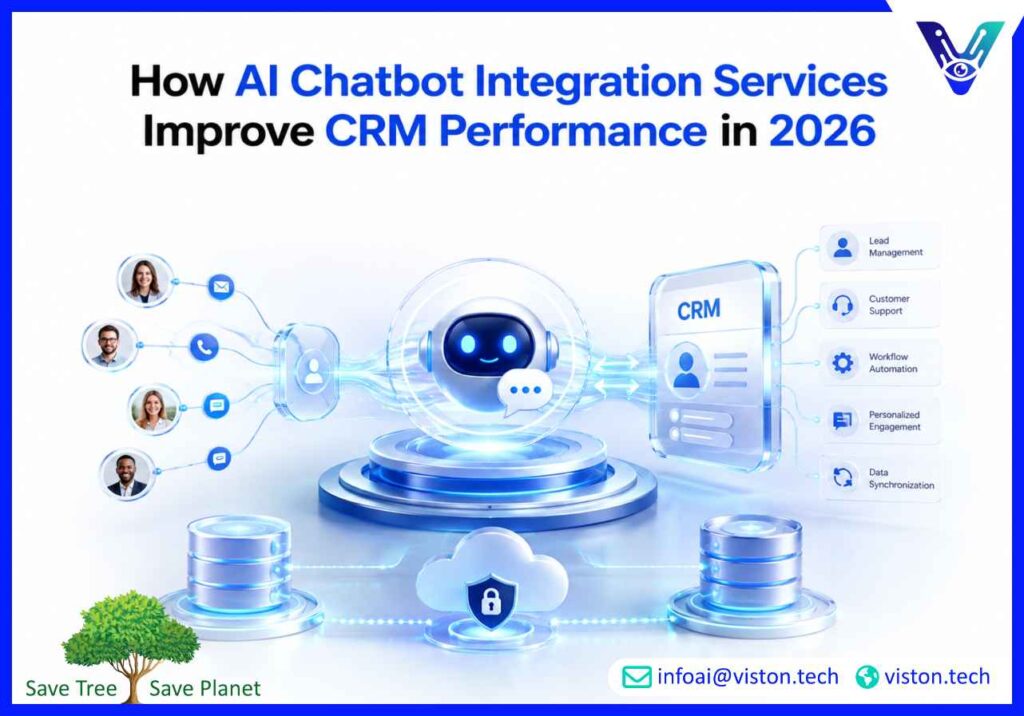
How AI Chatbot Integration Services Improve CRM Performance in 2026
Customer relationship management systems have become central to modern business operations, but their effectiveness depends on the quality, accuracy, and accessibility of customer data. As organizations seek faster response times, personalized engagement, and scalable customer support, AI chatbot integration services are increasingly being used to enhance CRM performance. By connecting conversational AI with CRM platforms, businesses can automate interactions, improve data collection, and create more efficient customer journeys.
Why CRM Integration Matters for AI Chatbots
A chatbot can answer questions and automate conversations, but its value increases significantly when connected to a CRM system. CRM integration allows chatbots to access customer information, update records, trigger workflows, and provide personalized responses based on real-time data.Without CRM integration, chatbots often operate as standalone tools with limited business value. With integration, they become part of a connected customer engagement ecosystem.Key benefits of CRM-connected chatbots include:
Centralized customer information management
Automated lead capture and qualification
Personalized customer interactions
Improved sales and support workflows
Real-time customer data updates
Faster response and resolution times
Enhanced reporting and analytics
In 2026, businesses increasingly view CRM-integrated chatbots as a strategic component of customer experience and operational efficiency initiatives.
How AI Chatbot Integration Services Connect with CRM Platforms
AI chatbot integration services focus on creating seamless communication between chatbot systems and customer relationship management platforms.
API-Based CRM Integration
Most modern CRM systems provide APIs that enable secure data exchange between applications. Integration services use these APIs to connect chatbots with customer records, lead databases, ticketing systems, and workflow automation tools.This enables chatbots to retrieve and update information without requiring manual intervention.
Lead Management Automation
When potential customers interact with a chatbot, information such as contact details, preferences, and inquiry history can be automatically captured and stored in the CRM.This reduces manual data entry while ensuring sales teams receive complete and accurate lead information.
Customer Support Synchronization
Integrated chatbots can access support histories, ticket statuses, and customer profiles directly from CRM systems.As a result, customers receive more relevant responses while support teams gain better visibility into ongoing interactions.
Workflow Triggering
CRM-integrated chatbots can initiate automated workflows such as:
Lead assignment
Follow-up scheduling
Email nurturing campaigns
Support ticket creation
Appointment booking
Customer onboarding processes
This helps organizations streamline operations while reducing repetitive administrative tasks.
Business Benefits of AI Chatbot CRM Integration
Organizations investing in AI chatbot integration services often pursue measurable business outcomes rather than simple automation.
Improved Lead Conversion
Chatbots can engage visitors immediately, qualify prospects through predefined criteria, and transfer high-intent leads directly into CRM pipelines.This reduces lead leakage and helps sales teams focus on qualified opportunities.
Enhanced Customer Experience
Access to CRM data allows chatbots to personalize interactions based on customer history, purchases, support requests, and preferences.Personalized experiences often lead to higher customer satisfaction and stronger engagement.
Greater Operational Efficiency
Automation reduces manual tasks associated with data entry, customer routing, and repetitive support inquiries.Teams can spend more time addressing complex issues and strategic initiatives.
Better Data Accuracy
Automated synchronization between chatbots and CRM systems helps reduce duplicate records, missing information, and inconsistent customer data.Accurate CRM records support better decision-making across sales, marketing, and customer service functions.
Scalable Customer Engagement
Businesses can handle large volumes of customer interactions without proportionally increasing staffing requirements.This scalability becomes particularly valuable during periods of growth or seasonal demand spikes.
Key Considerations Before Integrating Chatbots with CRM Systems
Successful chatbot integration requires more than simply connecting software platforms.
Data Security and Privacy
Organizations must ensure customer information is protected through encryption, access controls, authentication protocols, and secure API connections.Security requirements become especially important when handling sensitive customer or business data.
Integration Compatibility
Businesses should evaluate whether their CRM platform supports the necessary APIs, automation capabilities, and third-party integrations required for chatbot deployment.Compatibility assessments help avoid unexpected implementation challenges.
Conversation Design
Even with strong CRM integration, chatbot performance depends on effective conversation flows and user experience design.Organizations should map customer journeys carefully to ensure interactions remain intuitive and productive.
Human Escalation Processes
Not every inquiry can be handled through automation.Well-designed chatbot integrations include escalation paths that transfer complex requests to human agents while maintaining conversation context within the CRM.
Reporting and Analytics
Businesses should establish performance metrics before deployment.Common KPIs include:
CRM Platforms Commonly Integrated with AI Chatbots
Modern AI chatbot integration services frequently support a wide range of CRM solutions.Examples include:
Salesforce
HubSpot CRM
Microsoft Dynamics 365
Zoho CRM
Pipedrive
Freshsales
SugarCRM
Oracle CX platforms
The choice of CRM platform often influences integration architecture, workflow design, reporting capabilities, and scalability requirements.Businesses should select integration strategies that align with both current operational needs and future growth objectives.
How Viston AI Supports AI Chatbot Integration for CRM Environments
As organizations increasingly rely on connected customer engagement ecosystems, effective AI chatbot integration requires more than deploying conversational technology. It involves creating reliable connections between chatbots, CRM platforms, business workflows, customer data sources, and operational systems.Viston AI specializes in AI Chatbot Integration services that help businesses build intelligent, connected customer experiences. By integrating chatbots with CRM platforms and related business applications, organizations can automate lead management, streamline support operations, improve customer engagement, and enhance workflow efficiency.For businesses seeking scalable automation strategies, CRM-connected chatbot solutions can support both customer-facing and internal operational processes. A successful integration approach focuses on interoperability, security, data accessibility, user experience, and measurable business outcomes.As CRM ecosystems continue evolving in 2026, organizations benefit most from chatbot integrations that support long-term scalability, operational visibility, and personalized customer interactions across multiple digital channels.
Frequently Asked Questions
What is AI chatbot CRM integration?
AI chatbot CRM integration connects conversational AI platforms with customer relationship management systems, enabling automated data exchange, customer support, lead management, and workflow automation.
Can chatbots automatically create CRM records?
Yes. Integrated chatbots can capture customer information during conversations and automatically create or update CRM records based on predefined workflows.
Which CRM platforms work best with AI chatbots?
Most modern CRM platforms support chatbot integration through APIs, including Salesforce, HubSpot, Microsoft Dynamics 365, Zoho CRM, and Pipedrive.
How does CRM integration improve chatbot performance?
CRM integration provides access to customer data, enabling personalized responses, improved support experiences, accurate lead qualification, and more effective automation workflows.
Can Viston AI help integrate chatbots with CRM systems?
Yes. Viston AI provides AI Chatbot Integration services that help businesses connect conversational AI with CRM platforms, operational systems, and customer engagement workflows.
Conclusion
AI chatbot integration services play an increasingly important role in helping businesses maximize the value of their CRM investments. By connecting conversational AI with customer data, workflows, and operational processes, organizations can improve customer experiences, automate repetitive tasks, and create more efficient engagement strategies. As customer expectations continue to evolve in 2026, businesses that invest in effective AI Chatbot Integration solutions can build stronger relationships, improve operational performance, and scale customer interactions more effectively. For organizations seeking a reliable integration approach, Viston AI offers specialized expertise in connecting chatbots with CRM-driven business environments.