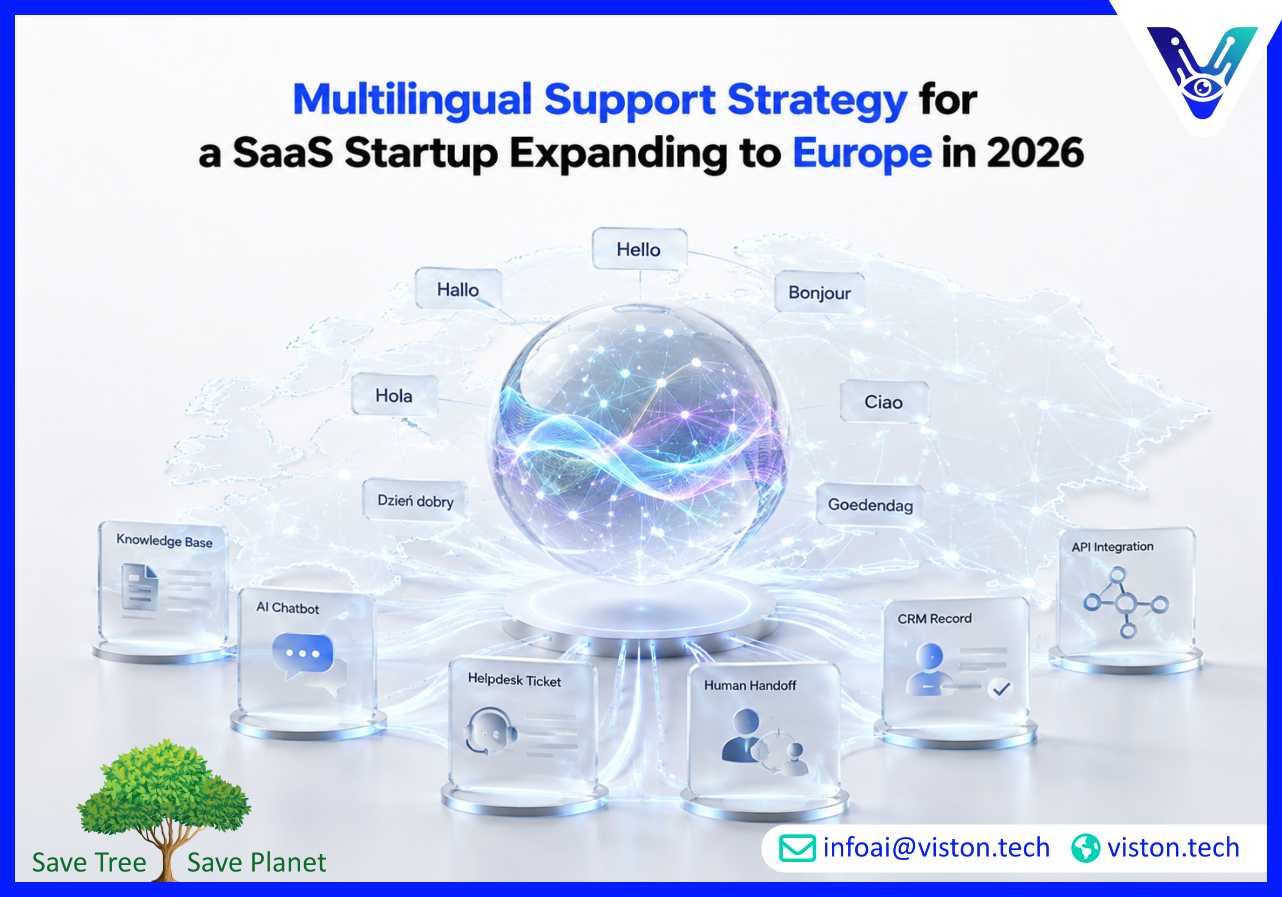
Multilingual Support Strategy for a SaaS Startup Expanding to Europe in 2026
A multilingual support strategy for a SaaS startup expanding to Europe must do more than translate replies. It should help customers activate the product, understand billing, resolve technical issues, protect their data, and receive consistent service across languages without creating an unsustainable support operation.
What a European Multilingual Support Strategy Must Achieve
Europe should not be treated as one English-speaking market. The European Union alone has 24 official languages, while customer expectations, terminology, communication styles, payment preferences, and purchasing processes vary between countries. A SaaS startup therefore needs a market-led strategy rather than an immediate commitment to supporting every European language.The objective is to provide dependable support in the languages that matter most to product adoption and revenue. Customers do not necessarily expect every support channel to be fully staffed in their language from the first day. They do expect critical information to be understandable, common questions to be answered accurately, and complex problems to reach a capable person without unnecessary repetition.A strong strategy should support the complete SaaS customer journey:
Pre-sale questions about features, security, integrations, plans, and contracts
Account registration and product onboarding
Configuration, API, integration, and troubleshooting guidance
Subscription, invoicing, renewal, cancellation, and refund enquiries
Incident communication and service-status updates
Data protection, account access, and privacy-related requests
Customer success conversations involving adoption, retention, or expansion
The startup should also define what multilingual support does not cover. For example, a company may offer automated help and translated ticket support in five languages while providing live technical specialists only in English, German, and French. Clear service boundaries prevent customers from expecting capabilities the business cannot deliver reliably.
Support must be connected to product adoption
For a SaaS company, language problems often appear before a formal support ticket is opened. Users may abandon onboarding because setup instructions are unclear, misunderstand a feature name, fail to connect an integration, or select the wrong billing option.Multilingual support should therefore include in-product guidance, knowledge-base articles, chatbot conversations, transactional emails, error explanations, and agent responses. Translating only the marketing website may attract European users without giving them enough support to reach value after registration.
Prioritize European Markets and Languages Using Real Demand
A startup should not select languages based only on population size or assumptions about market opportunity. Language priorities should reflect commercial activity, product usage, support demand, deal value, and operational readiness.
Build a language demand score
Review available data for each European market, including:
Website traffic and browser-language settings
Trial registrations and paid accounts by country
Sales opportunities and pipeline value
Support tickets submitted by non-English-speaking users
Onboarding completion and activation rates
Customer churn and failed-payment enquiries
Product usage, expansion potential, and account value
Availability of internal reviewers or regional partners
Each language can then be scored according to demand, revenue opportunity, support volume, complexity, and delivery cost. A B2B SaaS startup targeting larger organisations may prioritize German and French because of active enterprise opportunities. A product-led platform may discover stronger demand from Spanish, Italian, Dutch, Polish, or Nordic-language users.
Use tiered language coverage
A tiered model allows the startup to expand support without promising the same service level everywhere.Tier one languages receive localized onboarding, approved knowledge content, chatbot coverage, ticket support, and defined access to human specialists. These should be the startup’s most commercially important markets.Tier two languages receive translated self-service content, AI-assisted support, and human escalation through translated agent workspaces. Response times may be longer when native-language review is required.Tier three languages receive language detection, machine-assisted translation, and English-language specialist support. The business should clearly explain the level of support available.Begin with three to five priority languages rather than launching broad but shallow coverage. Expansion should follow measured demand and demonstrated service quality.
Define terminology before translating content
SaaS products contain technical and commercial terms that must remain consistent. Create a multilingual terminology glossary covering feature names, navigation labels, integrations, account roles, subscription plans, security terminology, and common troubleshooting instructions.Decide which product names should remain in English and which terms require localized explanations. A controlled glossary reduces confusion between the application interface, help centre, chatbot, support agents, sales material, and customer success communication.
Build a Scalable Multilingual Support Operating Model
The most sustainable model combines localized self-service, AI-assisted automation, multilingual agent tools, and clear human escalation. Automation should handle repeatable enquiries, while people retain responsibility for issues involving judgment, commercial sensitivity, security, or customer risk.
Create one governed source of support knowledge
Before translating content, the startup should improve its source-language knowledge base. Outdated, duplicated, or contradictory English articles will produce equally unreliable localized content.Organize support knowledge around real customer intents such as:
Starting a trial and creating an account
Inviting team members and managing permissions
Connecting CRM, payment, analytics, or productivity tools
Using APIs, webhooks, and authentication credentials
Understanding invoices, taxes, plans, and renewals
Resolving login, data-sync, performance, and configuration issues
Cancelling, exporting data, or deleting an account
Every article should have an owner, review date, source-language version, translated versions, and change history. When product functionality changes, the localization workflow should identify every affected language rather than relying on manual memory.
Automate low-risk and high-volume enquiries
A multilingual AI chatbot can handle onboarding guidance, feature discovery, account navigation, basic troubleshooting, billing explanations, and knowledge-base search. It can also collect diagnostic information before creating a ticket.The chatbot should be connected to approved product documentation rather than allowed to generate unsupported answers. Confidence thresholds should determine whether it responds, asks a clarifying question, retrieves additional information, or transfers the conversation.Human escalation should be immediate for security incidents, suspected fraud, data loss, contractual disputes, complex billing complaints, account termination risks, and technical problems requiring access to logs or production systems.
Preserve context during human handover
Customers should not have to repeat the same problem after an automated conversation. The receiving agent should see the original customer message, detected language, translated summary, account details, product plan, relevant integrations, troubleshooting already attempted, and the reason for escalation.Agents can use translation assistance to support languages they do not speak fluently, but sensitive or high-value conversations may require native-language review. The startup should maintain a defined escalation network of internal specialists, trusted language professionals, or regional support partners.
Integrate support with the SaaS technology stack
Multilingual support becomes more useful when it connects with the helpdesk, CRM, product analytics, billing platform, status page, identity system, and knowledge base. These integrations allow the support experience to recognize the customer’s account and complete relevant actions.Access should remain permission-based. A chatbot may be allowed to explain plan features or retrieve a public incident update, while refunds, role changes, data exports, and account deletion require stronger authentication or human approval.
Launch, Govern, and Measure the Strategy in Phases
A phased launch allows the startup to improve quality before expanding across Europe. The first release should cover a limited group of languages, channels, and support intents.
Use a practical rollout sequence
Assess demand: Identify priority countries, languages, customer journeys, and recurring support problems.
Prepare knowledge: Clean the source content, create a terminology glossary, and assign content owners.
Overall support averages can hide serious weaknesses in individual markets. Track each priority language using:
First-response and resolution time
Self-service resolution rate
Chatbot fallback and escalation rate
Onboarding and task-completion rate
Customer satisfaction and repeat contact
Translation correction frequency
Human handover quality
Ticket volume and cost per resolved enquiry
Activation, retention, and expansion by language
Native-language conversation reviews should be part of quality assurance. A response may appear accurate when translated back into English but still sound unnatural, overly formal, or unclear to a local customer.
Include European privacy, AI, and accessibility controls
Multilingual support systems may process names, email addresses, account records, billing information, conversation histories, and technical logs. SaaS companies serving European users should map what personal data is processed, establish an appropriate legal basis, control retention, secure access, and review international data transfers. GDPR protections also apply when personal data is transferred outside the EU, with approved safeguards required where relevant.Where AI chatbots are used, customers should be told clearly when they are interacting with an automated system. The EU AI Act’s transparency rules are scheduled to apply from 2 August 2026, making transparent AI interaction design an important part of a European rollout.Support interfaces should also be designed for keyboard navigation, screen readers, readable contrast, understandable error messages, and accessible escalation. The European Accessibility Act has introduced common accessibility requirements for specified products and services across the EU, including areas such as e-commerce and electronic communications. Applicability should be assessed according to the startup’s service model.
How Viston AI Can Support a European SaaS Multilingual Strategy
Viston AI provides Multilingual AI Chatbot Support for businesses that need to manage conversations across languages, channels, and operational systems. Its published capabilities include language-aware intent recognition, translation and localization, multilingual knowledge access, omnichannel deployment, intelligent routing, performance analytics, and integration with CRM, helpdesk, knowledge-base, and business applications.These capabilities are relevant to a SaaS startup because multilingual support must connect product guidance with real customer context. A deployment can help users with onboarding, feature questions, integration troubleshooting, account access, subscription enquiries, and approved technical documentation while transferring complex cases to human specialists.Viston AI also describes phased multilingual implementation, testing, integration, monitoring, and continuous optimization. This allows a startup to begin with selected European languages and priority support intents before expanding coverage according to customer demand and measured performance. Its multilingual service materials specifically identify SaaS onboarding, billing support, technical troubleshooting, API guidance, and escalation workflows as applicable technology use cases.The practical value is a structured support model rather than translation alone. By combining approved knowledge, language detection, automation, system integration, routing, and language-specific analytics, a SaaS business can expand its European support capacity while maintaining stronger control over accuracy, scalability, and customer experience.
Frequently Asked Questions
Which languages should a SaaS startup support first in Europe?
Prioritize languages using customer registrations, sales pipeline, support demand, account value, product usage, and market strategy. Many startups begin with three to five languages connected to their strongest target markets rather than attempting complete European coverage.
Does a startup need native-speaking support agents for every language?
No. Localized self-service, AI chatbots, translation-assisted ticketing, and translated agent tools can handle many routine interactions. Native or fluent specialists remain valuable for complex technical cases, sensitive complaints, enterprise negotiations, and quality assurance.
What SaaS support content should be translated first?
Start with onboarding, account access, billing, subscriptions, integrations, security guidance, common error messages, cancellation procedures, and high-volume troubleshooting articles. These areas have the strongest effect on activation, retention, and support workload.
Can machine translation manage all multilingual SaaS support?
Machine translation can improve speed and language coverage, but it should not operate without governed source content, terminology controls, quality testing, confidence rules, and human escalation. Technical, contractual, security, and privacy-related conversations need additional review.
How should multilingual support success be measured?
Measure resolution time, self-service rate, fallback rate, escalation rate, satisfaction, repeat contact, translation corrections, onboarding completion, retention, and support cost separately for each language. Compare these results with the English-language experience.
Can Viston AI support a phased European language rollout?
Viston AI’s multilingual chatbot, localization, integration, routing, analytics, and optimization capabilities support a phased approach. A SaaS startup can begin with selected languages, support journeys, and channels before extending coverage based on demand and quality data.
Conclusion
A multilingual support strategy for a SaaS startup expanding to Europe should begin with customer demand, not the number of languages available. Prioritize commercially important markets, localize critical product journeys, govern technical terminology, automate suitable enquiries, and preserve reliable human escalation. Privacy, AI transparency, accessibility, and language-specific performance measurement should be built into the operating model from the start. Viston AI offers relevant Multilingual Support capabilities for SaaS companies seeking to connect language automation with product knowledge, business systems, routing, and continuous service optimization.