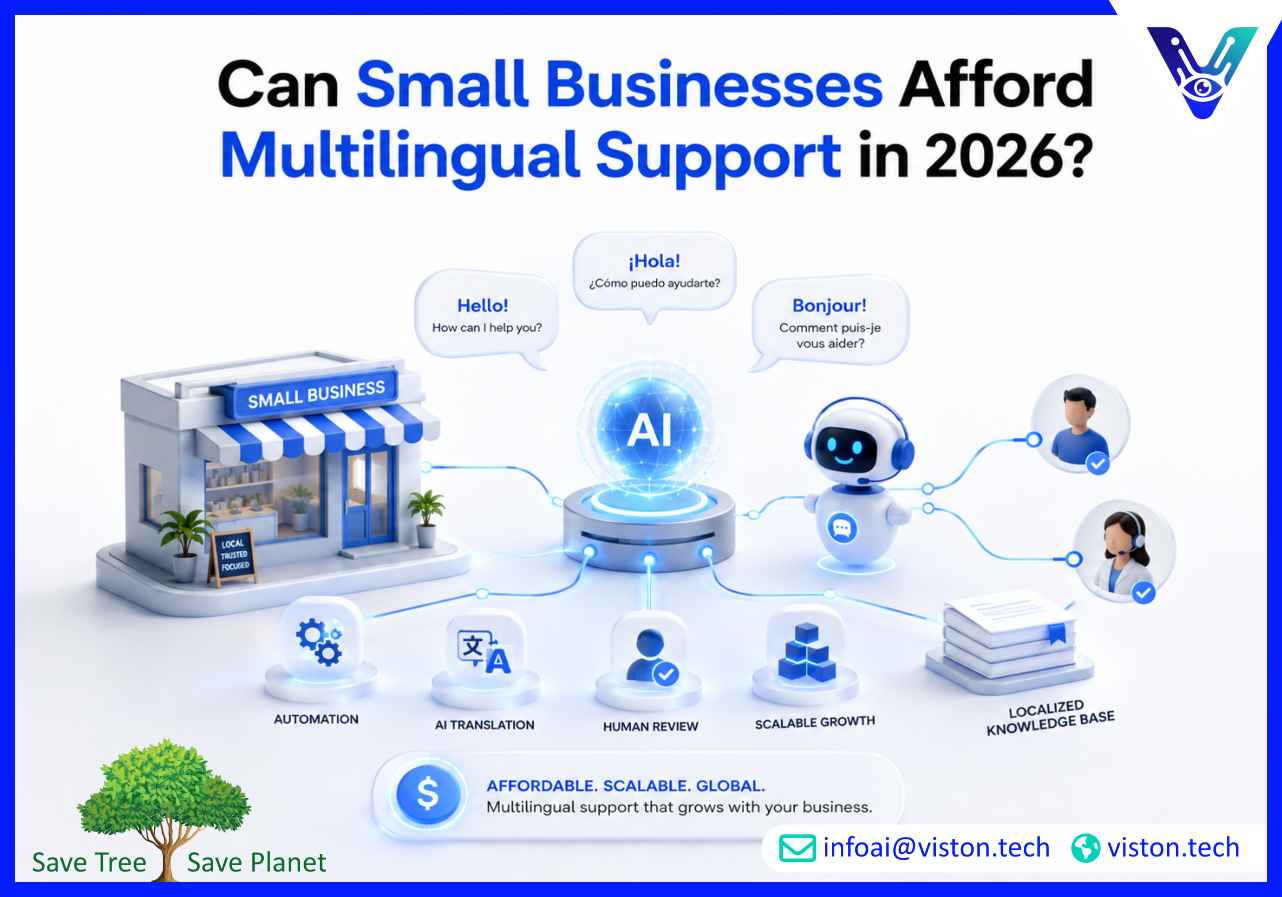
Can Small Businesses Afford Multilingual Support in 2026?
Can small businesses afford multilingual support? In 2026, the answer is usually yes—provided they start with the languages and customer journeys that matter most. Modern automation, AI-assisted translation, localized self-service, and selective human review make multilingual customer service more accessible without requiring a separate support team for every market.
Can Small Businesses Afford Multilingual Support in 2026?
Multilingual support was once associated with large contact centres, regional offices, and teams of native-speaking agents. Small businesses can now combine translated knowledge content, multilingual chatbots, shared inbox tools, agent translation, and specialist escalation to serve customers in several languages at a controlled cost.Affordability depends less on the total number of languages available and more on the scope of service. A small ecommerce company may only need multilingual help for order tracking, returns, delivery questions, and product information. A SaaS business may focus on onboarding, billing, password access, and common troubleshooting.Commercial customer-service platforms now offer entry-level, per-seat, and usage-based pricing models aimed at startups and small businesses. Some also allow companies to add multilingual help centres, automated translation, or AI outcomes as demand grows rather than paying for a large deployment from the beginning.The main mistake is treating affordability as a software-price question only. The real cost also includes content preparation, testing, integration, and ongoing optimization. A low-cost tool can become expensive if it gives inaccurate answers, creates duplicate tickets, mishandles refunds, or forces employees to correct every translated response.Small businesses can afford multilingual support when they use a phased model. They do not need to translate the entire website, every policy, and every support workflow at once. They should invest first where language barriers are causing lost sales, repeat contacts, or slow resolution.
What Determines the Cost of Multilingual Support?
The cost of multilingual support varies because businesses are not solving the same problem. Supporting two languages through email is very different from providing 24/7 assistance across chat, WhatsApp, voice, social messaging, and a mobile app. A realistic budget begins with the operating requirements, not a generic price per language.
Number and complexity of languages
Each additional language adds content, testing, reporting, and quality-control requirements. Languages with regional dialects or specialized terminology may require more human review. Product names, legal wording, technical instructions, and culturally sensitive phrases also need controlled translation rather than direct word substitution.
Conversation volume and channel coverage
A company handling fifty multilingual enquiries per month has a different cost profile from one handling thousands. Email may be easier to manage asynchronously, while live chat and messaging create expectations for immediate responses. Voice support adds complexity through speech recognition, accents, routing, and real-time escalation.
Level of automation
Automation can reduce repetitive work, but only when the underlying knowledge is accurate and the workflows are well designed. Language detection, translated responses, multilingual search, and AI chatbots can handle routine questions at scale. Current support platforms can automatically detect or configure customer languages, translate standard messages, and use language-specific help content, but they also recommend testing each supported language and replacing weak automatic translations where needed.
Human review and escalation
Not every enquiry should be automated. Complaints, refunds, chargebacks, contract questions, medical or financial information, safety issues, and emotionally sensitive conversations may require a fluent employee or specialist reviewer. The affordable model uses automation for predictable work and people where judgment matters.
Integration with business systems
Multilingual support becomes more useful when it can access order status, bookings, subscriptions, CRM records, inventory, or support history. Integration can lower operating costs by reducing manual lookups and repeat questions. A translated answer that cannot confirm the customer’s actual order or account may still generate another ticket.
Quality, security, and compliance
Businesses should budget for language-specific testing, access controls, data handling, auditability, and content ownership. This matters when conversations include personal, payment, health, or contractual information. Cheap translation without governance can create reputational and operational risk that outweighs the initial savings.
Affordable Multilingual Support Models for Small Businesses
The most cost-effective approach usually combines several methods according to enquiry type, risk, and customer value.
Localized self-service content
Translating a focused set of high-traffic help articles is often the lowest-risk starting point. Review support tickets and website searches to identify the questions customers ask most frequently. Localize the top articles, policy summaries, setup guides, and troubleshooting instructions into one or two priority languages.This reduces avoidable contacts and gives automated systems a trusted source for answers. It is more reliable than translating isolated replies because the business maintains one approved knowledge base with clear owners and review dates.
AI-assisted agent translation
Small teams can use translation inside a shared inbox so existing agents can read and respond to customers in other languages. This avoids hiring a full-time agent for every language. It works well for moderate volumes, provided agents can see the original message, use approved terminology, and escalate uncertain translations.
Multilingual chatbot for routine enquiries
A multilingual chatbot can answer common questions, collect customer details, identify intent, and route complex cases. Suitable early use cases include order tracking, opening hours, appointment requests, account access, product availability, subscription guidance, and basic onboarding.The chatbot should be restricted to approved knowledge and clear actions. It should not guess when information is missing. Confidence thresholds, fallback messages, and human handover rules are essential, particularly when the customer is asking about money, legal rights, cancellations, or service failures.
On-demand language specialists
Freelance translators, language-service providers, or part-time bilingual specialists can review high-risk content and difficult cases without becoming permanent payroll costs. This model is useful when a business has occasional demand in several languages or needs native review before launching a new market.
Phased language rollout
Start with the language that has the strongest combination of customer demand, revenue opportunity, and support pressure. Launch a limited set of use cases, measure results, fix weaknesses, and then add the next language. A phased rollout prevents spending on languages with little demand.A practical first phase may include one additional language, one channel, ten to twenty approved intents, five to ten localized help articles, and a defined escalation path.
How to Budget for Multilingual Support and Prove Its Value
A small-business budget should compare the cost of multilingual support with the cost of leaving language demand unmanaged. Unanswered questions, abandoned purchases, failed onboarding, repeat contacts, and refund disputes all carry a commercial cost.
Build a demand-based business case
Review customer locations, browser languages, ticket languages, sales enquiries, refund reasons, chat transcripts, and international revenue. This shows whether the business has a real language-support need and where the first investment should go. Do not select languages only because they are widely spoken; select them because they are connected to measurable customer activity.
Separate setup and operating costs
Setup costs may include discovery, content cleaning, glossary creation, translation, chatbot configuration, integration, testing, and employee training. Operating costs may include software subscriptions, usage fees, language review, content updates, analytics, and support. Separating them clarifies the initial investment and ongoing cost per resolved interaction.
Measure results by language
Track first-response time, resolution rate, self-service usage, fallback rate, escalation rate, repeat contact, customer satisfaction, conversion, and cost per resolved enquiry for each supported language. A strong average can hide a weak experience in one market, so language-level reporting is essential.
Calculate operational and commercial return
Operational return may come from fewer repetitive tickets, shorter handling times, reduced reliance on a single bilingual employee, and better after-hours coverage. Commercial return may come from higher conversion, more completed bookings, stronger onboarding, fewer cancellations, or improved retention.
Set clear limits
Affordability improves when the service promise is precise. State which languages and channels are supported, when human assistance is available, and which issues require specialist review. Clear scope protects service quality and prevents inconsistent promises.
How Viston AI Can Help Small Businesses Build Scalable Multilingual Support
Viston AI provides Multilingual AI Chatbot Support that combines language-aware conversational AI, real-time translation and localization, omnichannel deployment, intelligent routing, performance analytics, and integration with business systems. Its published capabilities include support across web chat, mobile apps, WhatsApp, SMS, voice assistants, and social platforms, with centralized knowledge and conversation control.For a small business, the relevant value is not maximum language coverage from the first day. It is the ability to design a focused deployment around priority languages and repeatable customer needs. A retailer might begin with order tracking and returns. A SaaS company might automate onboarding and billing questions. A service provider might support bookings, appointments, and common pre-sales enquiries.Viston AI also describes integration capabilities for CRM platforms, knowledge bases, transaction systems, inventory, calendars, and support workflows. This can help multilingual conversations produce useful outcomes, such as retrieving account information, creating tickets, updating records, or routing a case with context rather than simply translating text.Its analytics capabilities are relevant to cost control because businesses can monitor conversation success, customer satisfaction, escalation patterns, and performance by language. This supports a phased approach: launch a controlled use case, evaluate results, and expand where demand justifies it.
Frequently Asked Questions
Is multilingual support expensive for a small business?
It can be expensive if the company hires separate teams for many languages immediately. A phased combination of localized self-service, AI-assisted translation, chatbot automation, and human escalation is usually more affordable.
How many languages should a small business support first?
Start with one or two languages linked to real customer demand, revenue potential, or repeated service problems. Expand only after measuring usage, quality, and return.
Can AI fully replace multilingual support agents?
No. AI is useful for routine, well-documented enquiries, but complex complaints, sensitive issues, exceptions, and high-value cases still need human judgment and appropriate language expertise.
What is the cheapest way to start multilingual support?
Begin by localizing the most-used help articles and standard replies, then add agent translation or a chatbot for a small number of high-volume intents. This creates value without redesigning the entire support operation.
How should a small business measure multilingual support ROI?
Track ticket reduction, response time, resolution rate, repeat contact, conversion, retention, customer satisfaction, and cost per resolved enquiry by language. Compare these results with the total setup and operating cost.
Can Viston AI support a small phased rollout?
Viston AI’s multilingual chatbot, routing, integration, and analytics capabilities can support a deployment that begins with selected languages and use cases, then expands according to demand and measured performance.
Conclusion
Small businesses can afford multilingual support when they treat it as a focused service investment rather than an all-or-nothing global expansion project. The most practical approach is to prioritize real language demand, localize trusted knowledge, automate low-risk enquiries, preserve human escalation, and measure results by language. Multilingual Support should reduce customer friction and operational workload without creating uncontrolled complexity. Viston AI offers relevant chatbot, translation, integration, routing, and analytics capabilities for companies seeking a scalable model that can grow with customer demand.