
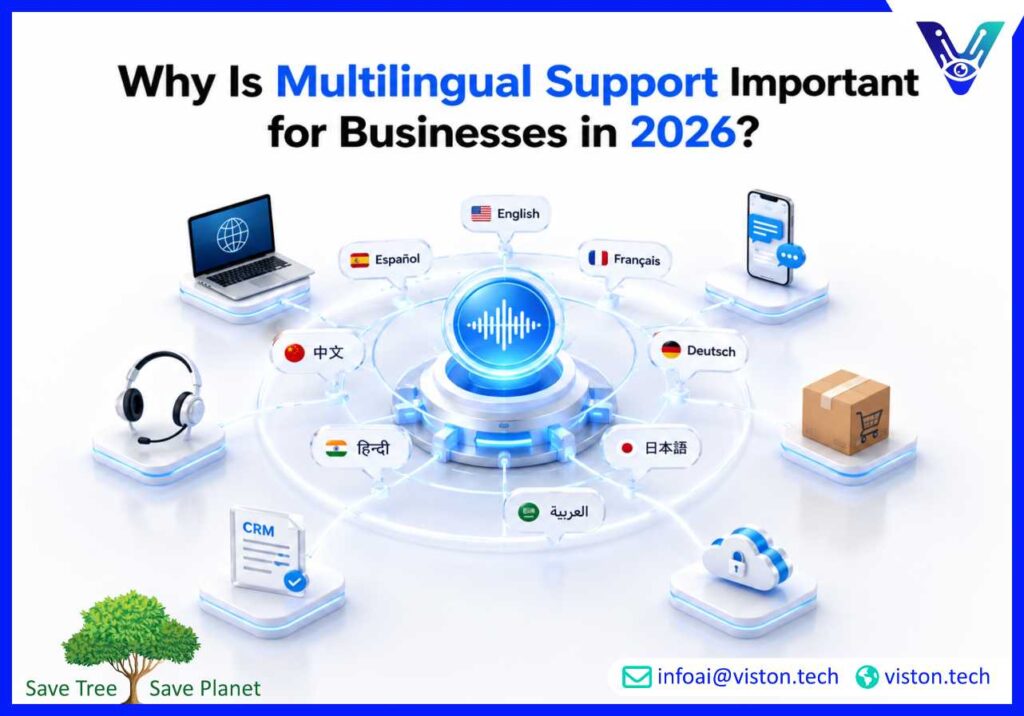
Why is multilingual support important for businesses? It allows companies to communicate clearly with customers in their preferred languages, reduce service friction, build trust, and serve international markets more effectively. In 2026, multilingual support is becoming a practical requirement for businesses that sell, operate, or provide digital services across diverse customer groups.
Businesses can now reach customers across borders through websites, ecommerce platforms, mobile applications, online marketplaces, social media, and digital advertising. However, reaching an international audience does not automatically create a strong customer experience. Customers still need to understand products, policies, prices, instructions, and support responses before they feel confident enough to buy or continue using a service.
Multilingual support gives customers the ability to ask questions and receive assistance in a language they understand well. This is particularly important when an enquiry involves billing, account access, product setup, returns, subscriptions, technical troubleshooting, booking changes, or other situations where small misunderstandings can lead to frustration.
A customer may be able to read a second language but still prefer their native language when making an important decision. This preference becomes stronger when the customer must explain a complicated problem, understand contractual conditions, share personal information, or follow detailed instructions.
When a business provides clear language options, it removes part of the effort required to interact with the company. Customers can describe what they need more precisely, understand the response more quickly, and make decisions with greater confidence.
A company expanding into another country may translate its website and marketing campaigns but overlook customer support. This creates a gap between acquisition and service delivery. Customers may understand the sales page but struggle to receive help after making a purchase.
Multilingual Support helps close this gap by extending language coverage across the customer journey. Depending on the business, this may include:
Businesses do not necessarily need to support every language immediately. A focused strategy can begin with the languages associated with the highest customer demand, strongest commercial opportunity, or greatest service pressure.
Customer service is not only about providing an answer. The answer must be accurate, understandable, relevant, and delivered through the right channel. Multilingual support improves customer experience when it preserves these qualities across languages rather than simply translating individual words.
People communicate with greater precision when they are comfortable with the language being used. They can provide more complete details, describe the sequence of events, and clarify what outcome they expect.
This can reduce repeated questions and prevent agents or automated systems from acting on incorrect assumptions. It is especially valuable for technical support, financial enquiries, healthcare administration, travel disruption, logistics, and other situations where details affect the resolution.
Without a structured multilingual process, businesses often depend on individual employees, browser-based translation tools, or improvised replies. Different customers may receive different explanations of the same policy, depending on who handles the enquiry.
A more reliable model uses approved knowledge, terminology glossaries, localized response templates, language-aware routing, and defined escalation rules. This makes it easier to keep important information consistent across channels and languages.
Asking every customer to communicate in one company language may be operationally convenient, but it transfers the communication burden to the customer. Some users will continue, while others may abandon the conversation, delay a purchase, submit an incomplete request, or look for another provider.
Offering language-appropriate assistance shows that the business has considered how different customers interact with its products and services. This can strengthen trust without requiring excessive promotional messaging.
Automation should not prevent customers from reaching a person when necessary. Complaints, sensitive cases, unusual requests, disputes, and high-value opportunities often require human judgment.
A well-designed multilingual system can identify the customer’s language, preserve the original message, generate a working translation, summarize the conversation, and route the case to the correct team. The receiving agent should see what the customer asked, what information was provided, and what the automated system already attempted.
This prevents customers from repeating the entire issue and allows employees to begin with useful context.
Multilingual support is often viewed as a customer-experience initiative, but it also affects operational efficiency, revenue opportunities, product adoption, and service quality. Its value becomes clearer when language support is connected to business systems and measured against practical outcomes.
Support teams frequently answer the same types of questions about delivery, pricing, account access, opening hours, subscriptions, product features, and return procedures. Translating each reply manually creates unnecessary work and makes quality dependent on the person responding.
Businesses can localize approved answers for common enquiries and make them available through help centres, chatbots, email workflows, or agent-assistance tools. Employees can then focus on conversations that require investigation, empathy, negotiation, or specialist knowledge.
Hiring a separate team for every language may not be practical for a growing business. Multilingual automation can provide first-line assistance, identify intent, retrieve relevant knowledge, and collect information before a human becomes involved.
This does not remove the need for people. Instead, it creates a layered service model in which routine, well-documented enquiries can be automated while complex or sensitive cases receive human attention.
Current multilingual customer-service research also shows why real-world testing matters. Native customer messages can be noisier and more varied than machine-translated test data, meaning businesses should evaluate systems using realistic conversations from each supported language rather than assuming that strong performance in one language will transfer automatically.
Potential buyers may leave a website if they cannot understand product information or explain what they need. Multilingual chat and enquiry flows can answer initial questions, identify requirements, collect contact details, and route prospects to the correct sales team.
For B2B businesses, a multilingual assistant can also gather structured information such as company size, intended use case, location, timeline, and preferred communication channel. This gives sales teams better context for follow-up.
Language-specific reporting helps businesses understand which markets generate demand and where customers experience difficulty. A company may discover that one language has unusually high abandonment, repeated billing questions, poor onboarding completion, or frequent escalation.
These patterns can reveal more than a translation issue. They may identify unclear policies, missing product documentation, regional payment problems, unsuitable workflows, or differences in customer expectations.
Useful multilingual support metrics include:
Understanding why multilingual support is important for businesses is only the first step. Reliable delivery requires clear scope, controlled knowledge, suitable technology, human oversight, and ongoing quality review.
Businesses should review customer locations, browser-language data, support tickets, sales enquiries, order history, product usage, and growth plans. This helps identify which languages should be supported first.
The priority should be based on demand and commercial relevance rather than the ambition to advertise a large language count. Supporting three languages well is more valuable than offering ten languages with inconsistent answers and weak escalation.
Multilingual support is only as accurate as the knowledge behind it. Before translating or automating responses, businesses should review their FAQs, policies, product documentation, troubleshooting guides, and internal procedures.
Every important content area should have an owner and review cycle. Outdated or contradictory source material will produce unreliable answers in every language.
Localization considers how information should be presented within a particular market. It may involve terminology, tone, dates, currencies, measurements, addresses, form fields, payment options, and region-specific policies.
Literal translation can be grammatically correct while still sounding unnatural or creating confusion. High-impact content should therefore be reviewed by fluent or native-language specialists, particularly when it concerns legal conditions, safety, money, healthcare, or regulated services.
Customers normally contact support because they need information or an action. A useful multilingual solution may need to retrieve an order, check a booking, update a CRM record, create a ticket, reset an account, or schedule an appointment.
Integrating language support with CRM, helpdesk, ecommerce, knowledge-base, scheduling, and transaction systems allows conversations to move beyond generic answers. Access controls must ensure that users and agents receive only the information they are authorized to see.
Quality should be evaluated separately for each language, channel, and use case. Teams should review native customer conversations, failed queries, mistranslated terminology, unnatural phrasing, abandoned flows, and unnecessary escalations.
Regular evaluation helps the business identify new customer intents, update knowledge, refine automation rules, and maintain service quality as products and policies change.
Viston AI provides Multilingual AI Chatbot Support as part of its wider AI service portfolio. Its published capabilities include enterprise AI chatbots, language translation services, natural language processing, text analysis, workflow automation, and integration with existing business systems. These services are relevant to organizations that want multilingual conversations connected to practical customer-service and operational processes.
A business may need more than a translation layer. It may require language detection, business-specific intent recognition, localized knowledge retrieval, multilingual conversation flows, intelligent routing, CRM or helpdesk integration, analytics, and controlled human escalation. Viston AI’s service positioning aligns with these requirements, particularly where businesses want conversational AI to support customer enquiries, lead handling, internal assistance, and workflow execution.
The company’s broader capabilities also make it relevant to businesses planning a phased multilingual rollout. An organization can begin with selected languages and clearly defined enquiries, measure performance, and expand coverage as demand grows.
This implementation-focused approach helps businesses treat Multilingual Support as an operational capability rather than a standalone translation feature. The objective is to deliver understandable, context-aware assistance while maintaining accuracy, security, scalability, and measurable service quality.
Multilingual support helps businesses communicate with customers in their preferred languages. It can improve understanding, trust, customer satisfaction, international market access, lead handling, and support efficiency.
Not every business needs extensive language coverage. It becomes important when a company serves customers from different language groups, receives international enquiries, enters new markets, or experiences service problems caused by language barriers.
Translation converts content from one language into another. Multilingual support includes translation but also covers localized knowledge, language detection, routing, automation, system integration, human escalation, and quality monitoring.
Routine and well-documented enquiries can often be automated through multilingual chatbots, localized help content, and agent-assistance tools. Complex, sensitive, high-risk, or unusual cases should still have access to trained human support.
Review customer locations, enquiry volumes, website-language data, sales opportunities, product usage, support demand, and expansion plans. Begin with languages that have the strongest combination of customer need and business relevance.
Viston AI offers multilingual AI chatbot, language-processing, translation, automation, and integration capabilities. These services can support language-aware customer conversations connected to knowledge bases, business systems, routing workflows, analytics, and human handovers.
Why is multilingual support important for businesses? It enables companies to remove language barriers, communicate more accurately, improve customer trust, and serve wider markets without sacrificing service consistency. Effective Multilingual Support requires more than direct translation. It depends on localized knowledge, suitable automation, connected systems, clear escalation, and language-specific quality monitoring. Businesses should begin with the languages and use cases that matter most, then expand based on measurable demand. Viston AI offers relevant multilingual chatbot, NLP, integration, and automation capabilities for organizations developing a more scalable, business-focused support model.
