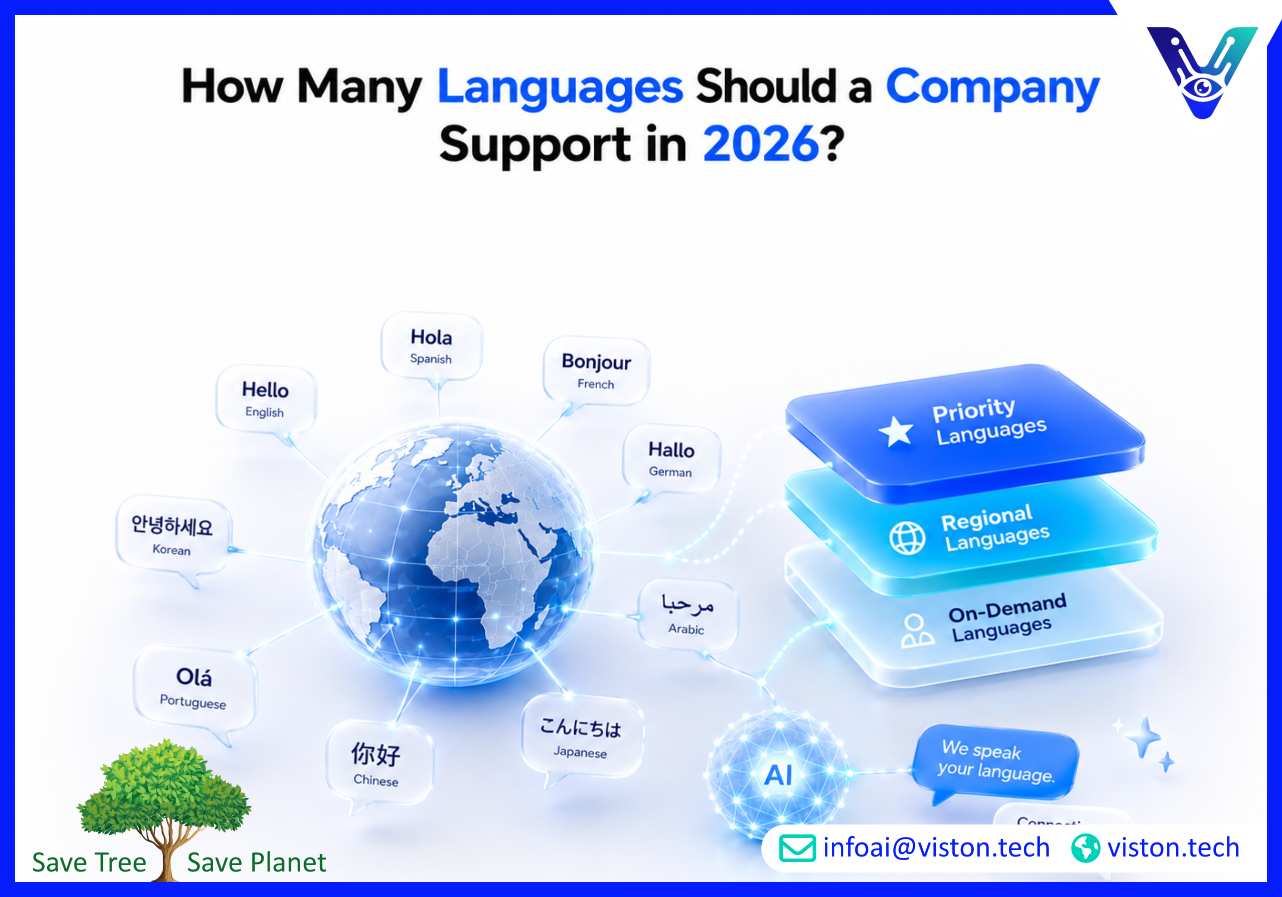
How Many Languages Should a Company Support in 2026?
How many languages should a company support? There is no universal number. The right level of multilingual support depends on customer demand, market value, service risk, available resources, and the quality a business can maintain. Most companies should begin with a focused group of priority languages and expand when performance data justifies it.
What Is the Right Number of Languages for a Company?
A company should support enough languages to serve its most valuable customer groups effectively, but not so many that accuracy, response quality, and operational control decline. Supporting ten languages poorly is usually less valuable than supporting three languages consistently across the customer journey.For many businesses, a practical starting point is two to five languages. This range is not a fixed industry rule. It is a manageable initial scope for companies that already receive enquiries from multiple markets but do not yet have mature multilingual operations.The appropriate range often depends on the company’s stage and business model:
Local or early-stage companies: One primary language plus one additional high-demand language may be sufficient.
Growing online businesses: Two to five priority languages can cover the markets generating most sales, support enquiries, or expansion opportunities.
Regional companies: Five to ten languages may be needed when operations span several countries or linguistically diverse markets.
Global enterprises: Ten or more languages may be justified, although service depth may differ by region, channel, and customer segment.
The key question is not how many languages a company can technically translate. It is how many languages the company can support reliably. Reliable support requires accurate information, approved terminology, suitable automation, access to customer context, quality assurance, escalation processes, and measurable service standards.
Language availability is not the same as complete support
A website may be translated into several languages while customer service remains available only in English. A chatbot may recognize dozens of languages but lack localized knowledge for billing, returns, contracts, or technical troubleshooting. A business should therefore define what “supporting a language” actually includes.Complete multilingual support may cover:
Website and product information
Chatbot and live-chat conversations
Email and helpdesk responses
Knowledge-base and self-service content
Onboarding and account guidance
Billing, cancellation, and refund processes
Human escalation for complex enquiries
Voice support where customer demand requires it
A company may offer full support in its three most important languages while providing translated self-service content and limited escalation in several secondary languages. This tiered approach is often more practical than promising identical service across every language.
How to Decide Which Languages to Support
The decision should be based on customer and commercial data rather than population size or assumptions about international demand. A widely spoken language may have little relevance to a company if it does not align with customer locations, sales activity, product availability, or market strategy.
Review current customer demand
Start by examining where language barriers already occur. Useful signals include customer locations, browser settings, support tickets, chat transcripts, email languages, sales enquiries, abandoned conversations, refund requests, and messages that employees currently translate manually.Companies should identify:
Which languages appear most frequently in customer conversations
Which languages create the highest number of unresolved enquiries
Which customer groups generate meaningful revenue or retention value
Where employees are relying on informal translation workarounds
Which markets are experiencing increasing demand
A language that accounts for a modest share of total enquiries may still deserve priority when those enquiries come from high-value customers or a strategically important market.
Consider market opportunity
Current support volume should not be the only factor. Low enquiry volume may reflect a language barrier rather than low demand. Potential customers may leave before contacting the company because product information, checkout instructions, onboarding content, or help resources are unavailable in a language they understand comfortably.Before adding a language, assess whether the company can genuinely serve the associated market. Product availability, delivery coverage, payment options, pricing, local regulations, sales capacity, and customer success resources all affect whether multilingual support will produce business value.
Evaluate the complexity and risk of conversations
Not every language requires the same delivery model. Routine questions about opening hours, product availability, order status, appointment booking, or password resets may be suitable for automated multilingual support.Higher-risk conversations require stronger controls. These may include financial decisions, medical information, legal terms, insurance claims, account security, contract changes, complaints, refund disputes, and technical instructions that could affect safety or operations.For these cases, the company may need approved localized content, specialist reviewers, human escalation, access controls, audit logs, and language-specific compliance checks. Adding a language without these safeguards may increase risk rather than improve service.
Measure the cost of not supporting a language
Language coverage should also be evaluated against the cost of leaving a customer group unsupported. This cost may appear as abandoned purchases, slow resolution, repeated contact, poor onboarding, avoidable cancellations, lower product adoption, or excessive dependence on bilingual employees.A company should prioritize a language when the expected improvement in customer access, conversion, retention, or operational efficiency is likely to justify the cost of implementation and ongoing quality management.
Why Quality Matters More Than the Total Language Count
Modern multilingual support technology can process a large number of languages, but technical availability does not guarantee a good customer experience. Customers need answers that are accurate, relevant to their situation, and consistent with the company’s actual policies.
Translation alone is not enough
Direct translation may produce grammatically correct text while missing product terminology, cultural expectations, regional processes, or the intended tone. Words related to subscriptions, warranties, returns, delivery, technical features, and regulated services must be used consistently.Companies need a controlled terminology library covering product names, industry terms, policy language, prohibited phrases, and escalation messages. The underlying source content must also be current. Translating an outdated help article simply distributes inaccurate information across more languages.
Native customer language must be tested
Customers rarely write like professionally translated examples. They use abbreviations, incomplete sentences, spelling variations, local expressions, mixed languages, and product-specific shorthand. A multilingual chatbot should therefore be tested using realistic customer enquiries from each target market.Testing should examine whether the system can:
Detect the correct language and regional variation
Escalate sensitive or unresolved cases appropriately
Performance should be measured by language
Overall chatbot or helpdesk results can hide weak performance in smaller language groups. A company should monitor each supported language separately.Useful multilingual support metrics include:
First-response time
Resolution rate
Fallback or misunderstanding rate
Human escalation rate
Repeat-contact rate
Customer satisfaction
Translation correction frequency
Workflow completion rate
A language should not be considered fully supported simply because automated replies are available. It should meet an agreed level of accuracy, resolution quality, and escalation coverage.
A Practical Framework for Expanding Multilingual Support
A phased rollout allows a company to learn from real interactions before increasing language coverage. It also prevents teams from translating large volumes of content that customers rarely use.
Phase 1: Establish the primary language
Before adding languages, organize the primary support environment. Review the knowledge base, remove conflicting information, document common customer intents, define escalation rules, and identify authoritative data sources.Multilingual automation will only be as reliable as the knowledge and workflows behind it. Poorly structured source content creates inconsistent answers in every language.
Phase 2: Add one to three priority languages
Select the languages with the strongest combination of existing demand, revenue relevance, support pain, and market opportunity. Begin with high-volume, well-documented use cases such as order tracking, account access, onboarding, appointments, product information, and standard policy questions.Define the service level for each language. For example, a priority language may receive chatbot, email, knowledge-base, and human escalation coverage, while another may initially receive translated self-service content and ticket intake.
Phase 3: Integrate customer and business systems
Multilingual support becomes more useful when it can access appropriate customer context. Connections with CRM, ecommerce, helpdesk, scheduling, subscription, transaction, and knowledge systems allow the support channel to provide relevant answers rather than generic translations.Integration also improves handovers. When escalation is required, the agent should receive the original message, a translated summary, customer details, detected intent, and actions already attempted.
Phase 4: Expand based on evidence
After the first languages are stable, review demand for the next group. Expansion may be justified when a language shows growing conversation volume, repeated translation requests, strong market potential, or significant customer friction.Before launch, confirm that the business has enough localized knowledge, testing data, escalation capacity, and reporting capability. A new language should have a clear owner and measurable success criteria.
Use language tiers to control scope
A tiered model helps balance reach with quality:
Tier 1: Complete support across automated channels, human service, and localized knowledge.
Tier 2: Automated support for common enquiries with translated human escalation.
Tier 3: Localized self-service resources and structured ticket collection.
On-demand coverage: Translation assistance for low-volume or unexpected languages.
This structure allows a company to offer broader language access without pretending that every language has identical service capacity.
How Viston AI Helps Companies Scale Language Coverage
Viston AI provides Multilingual AI Chatbot Support for businesses that need to manage conversations across languages, channels, and operational systems. Its published capabilities include multilingual intent recognition, real-time translation and localization, centralized knowledge management, omnichannel deployment, intelligent routing, language-specific analytics, and connections with CRM platforms, knowledge bases, transaction systems, and other business applications.These capabilities are relevant when a company wants to begin with a few priority languages and expand without rebuilding its support operation for each market. A structured deployment can define language tiers, approved knowledge sources, automation boundaries, escalation requirements, and performance targets before customer conversations are launched.Viston AI’s delivery approach covers discovery, data preparation, model selection, testing, system integration, deployment, monitoring, and ongoing optimization. This helps organizations evaluate language coverage as an operational capability rather than a one-time translation project.For ecommerce, SaaS, financial services, healthcare, manufacturing, hospitality, logistics, and other customer-facing businesses, this approach can support a phased multilingual rollout. The practical objective is not to activate the highest possible number of languages. It is to give each selected customer group accurate answers, suitable automation, and a reliable path to human help.
Frequently Asked Questions
How many languages should a small company support?
A small company may begin with its primary language and one or two additional languages supported by clear customer demand. The company should expand only after it can maintain accurate knowledge, reliable automation, and suitable escalation for the initial languages.
Should a company support every language spoken by its customers?
Not necessarily. Low-volume languages can be handled through on-demand translation or structured ticket intake. Full support should usually be reserved for languages with meaningful demand, commercial relevance, or customer-service risk.
Which language should a company add first?
The first additional language should represent the strongest combination of customer volume, revenue potential, unresolved enquiries, strategic market importance, and operational feasibility. Customer and support data should guide the decision.
Can AI provide support in more languages without hiring agents?
AI chatbots, real-time translation, and localized knowledge bases can handle many routine enquiries without a dedicated agent team for every language. Human review remains important for sensitive, complex, regulated, or high-value conversations.
How should a company measure whether a language is worth supporting?
Track conversation volume, conversion, resolution rate, response time, escalation, repeat contact, customer satisfaction, retention indicators, and operating cost for that language. These measures show whether language coverage is creating useful business outcomes.
Can Viston AI support a phased language rollout?
Viston AI’s multilingual chatbot, integration, routing, analytics, and optimization capabilities are relevant to phased deployments. A company can begin with priority languages and selected workflows, then expand based on demand and measured performance.
Conclusion
How many languages should a company support depends on the customers it serves and the quality it can sustain. For many businesses, beginning with two to five priority languages is more practical than attempting broad coverage immediately. The strongest multilingual support strategy uses demand data, language tiers, localized knowledge, realistic testing, system integration, human escalation, and language-specific reporting. Viston AI provides relevant multilingual chatbot and integration capabilities for organizations seeking to expand language coverage through a controlled, scalable, and business-focused approach.