
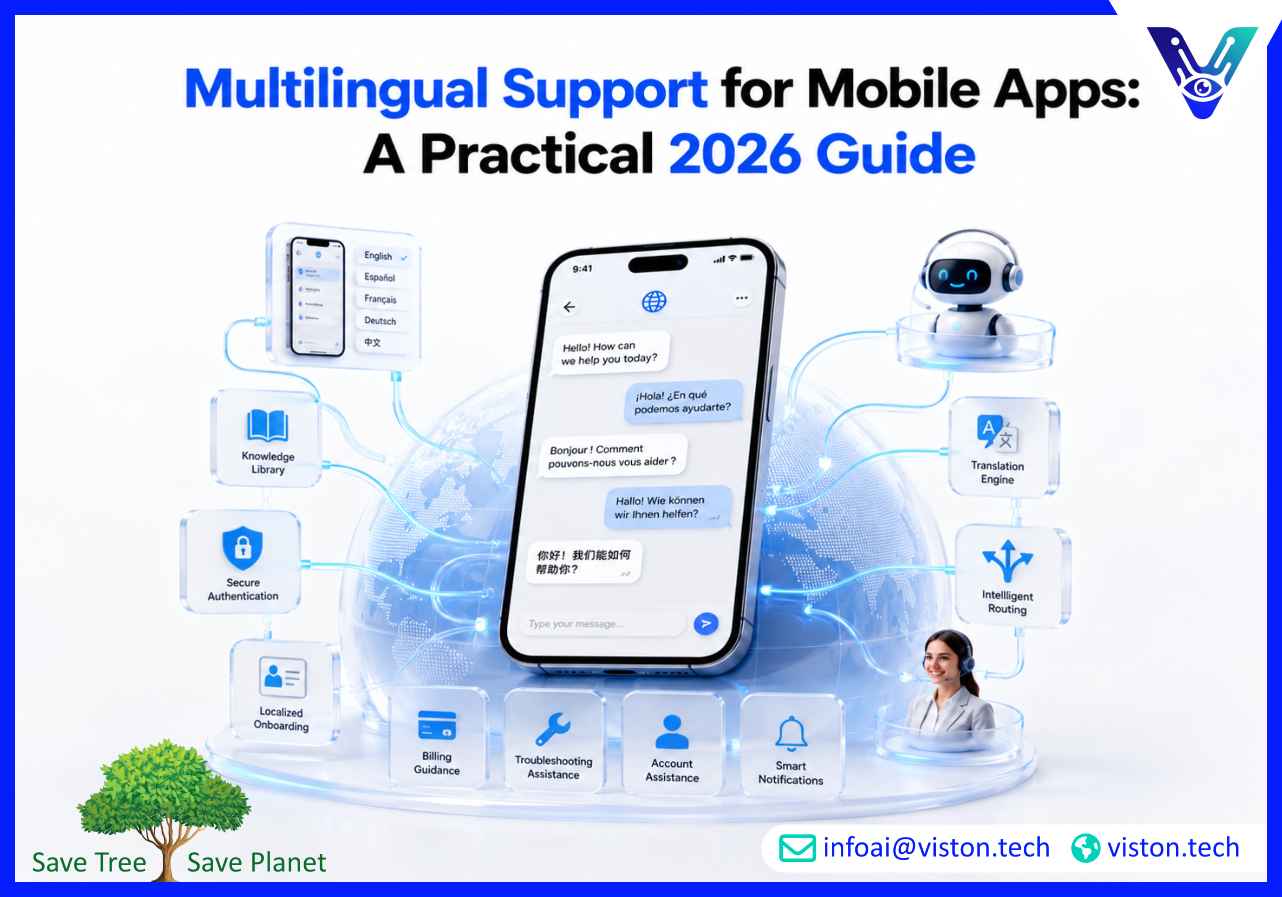
Multilingual support for mobile apps is no longer limited to translating menus and buttons. Global users expect in-app assistance, onboarding, troubleshooting, notifications, and human escalation in a language they understand. Delivering that experience requires coordinated localization, conversational AI, knowledge management, system integration, quality assurance, and continuous performance monitoring.
Multilingual mobile app support enables users to receive help in their preferred language throughout the application experience. It covers more than the visual interface. It includes help content, automated conversations, live-agent interactions, error messages, support forms, notifications, account guidance, transaction explanations, and escalation workflows.
A localized interface may help a user navigate an app, but it does not guarantee that the support experience is equally accessible. A customer can understand a translated checkout screen and still become frustrated when the support chatbot, help centre, or human agent works only in English. Effective multilingual support connects product localization with customer service operations.
The experience must also account for regional variations. Spanish used in Mexico may differ from Spanish used in Spain. French support for users in Canada may require different terminology from support designed for France. Date formats, currencies, measurement units, tone, legal wording, and cultural expectations can also change by market.
For mobile apps, context is especially important. The support system should understand which screen the user is viewing, the device and operating system involved, the app version, the user’s account status, and the action that failed. When that context is available securely, a multilingual assistant can provide more useful guidance than a generic translated response.
Mobile apps frequently serve users across countries from the moment they are published in major app stores. This creates an opportunity for rapid international adoption, but it also exposes language gaps quickly. A product may attract downloads in several markets before the company has support teams ready to serve those users.
In 2026, users increasingly expect conversational support to be available inside the product rather than requiring them to leave the app, search an external website, or write an email. They also expect support to retain context across interactions. Repeating account information, explaining the same issue twice, or switching to an unsupported language creates unnecessary friction.
Poor multilingual support can contribute to incomplete onboarding, abandoned purchases, failed account verification, subscription cancellations, negative app reviews, and higher support escalation. Users may also misunderstand billing conditions, privacy choices, refund procedures, or security instructions when these are not explained clearly in their preferred language.
The risks increase for mobile applications handling sensitive or high-value activities. Financial, healthcare, travel, insurance, education, logistics, and marketplace apps may need to explain complex processes accurately while maintaining appropriate safeguards. Automated responses should not overstate what the system can confirm, and high-risk requests must be routed to qualified human teams.
Hiring a separate support team for every language can be difficult for growing app businesses. AI-supported translation, automated self-service, shared multilingual knowledge, and intelligent routing can reduce the amount of language-specific manual work required for routine requests.
Automation is most useful for common, structured needs such as password recovery, order status, appointment changes, subscription management, feature guidance, basic troubleshooting, and account navigation. Complex complaints, exceptional refund requests, safety concerns, and regulated decisions should still have clear human escalation routes.
Modern multilingual customer support typically combines automatic language detection, conversational AI, translated agent interactions, and localized self-service content rather than relying on a single translation layer.
A successful implementation begins with user demand, not with a target number of languages. Businesses should identify where users are located, which languages generate the most support requests, which markets influence revenue, and where language barriers create measurable product friction.
Review app-store distribution, active-user geography, device language settings, support ticket language, customer value, expansion plans, and abandonment patterns. These signals help determine which languages should be fully supported first.
Language coverage should be defined in operational terms. A business might translate the app into ten languages but offer complete support workflows in only five. Users should not be given the impression that full support is available when only selected screens or automated answers have been translated.
The chatbot, help centre, live agents, and internal support tools should draw from consistent, approved information. Product instructions, refund rules, security guidance, subscription terms, and troubleshooting steps must not contradict one another across languages.
A governed knowledge base should include content ownership, review dates, version history, market applicability, and approval workflows. Product updates should trigger corresponding updates to support content. Outdated translated articles can be more damaging than missing content because they appear authoritative while guiding users incorrectly.
An in-app support layer becomes more effective when it can securely access relevant application context. Depending on the use case, integration may include:
Access should follow the principle of least privilege. The support assistant should retrieve only the information required for the task, and sensitive actions should use authentication, confirmation, and audit controls. Translation services should also be assessed for how they process, retain, and transfer customer data.
Multilingual automation should make escalation easier, not obstruct it. The handover should include the original user message, translated content where appropriate, detected language, conversation history, attempted solutions, account context, and the reason for escalation.
Routing should consider language capability, issue type, urgency, market, customer tier, and operating hours. When no language-matched agent is available, real-time translation may help a broader agent pool respond, but teams should be trained to recognise ambiguity and request clarification instead of relying blindly on automated translation.
Multilingual support quality cannot be evaluated only by checking whether a response is grammatically correct. A sentence can be fluent while still being inaccurate, culturally inappropriate, inconsistent with the product, or unsafe for the user’s situation.
Testing should include regional vocabulary, spelling variations, slang, abbreviations, typing errors, code-switching, and product-specific terminology. Teams should also test support flows across different app versions, screen sizes, operating systems, accessibility settings, and network conditions.
High-priority tasks should receive deeper review. Billing explanations, privacy choices, identity verification, cancellations, refunds, health guidance, and security alerts require stricter accuracy thresholds than general feature discovery.
A multilingual terminology glossary helps ensure that product names, feature labels, industry terms, and prohibited translations remain consistent. Style guidance should define tone, formality, pronoun use, punctuation, and market-specific language preferences.
Consistency matters because users move between touchpoints. A feature described one way in the app and another way in the chatbot can make instructions difficult to follow. The same terminology should appear in onboarding, navigation, help content, automated support, agent scripts, and release notes.
Overall support metrics can hide poor performance in smaller language groups. Businesses should analyse each supported language using indicators such as:
Conversation reviews should combine automated monitoring with human evaluation. Native or highly proficient reviewers are valuable for checking nuance, tone, terminology, and sensitive workflows. Lower-volume languages should not be ignored simply because they produce fewer tickets.
Mobile products change frequently. New releases introduce features, modify interface labels, and create new questions. Support systems therefore need a repeatable process for updating knowledge, translations, intents, workflows, and testing scenarios.
Teams should review failed conversations, negative feedback, repeated escalations, newly emerging requests, and language-specific performance gaps. Improvements may involve clearer source content, a refined glossary, additional training examples, better app context, stronger integration logic, or revised escalation rules.
Viston AI is directly relevant to multilingual support for mobile apps because the company offers Multilingual AI Chatbot Support as part of its conversational AI services. Its published service capabilities include multilingual intent recognition, real-time translation and localization, intelligent routing, performance analytics, and centralized orchestration across channels that include mobile applications, web chat, messaging, SMS, voice assistants, and social platforms.
This approach can help mobile app businesses connect multilingual conversations with knowledge bases, customer records, support workflows, and human escalation. Instead of treating translation as an isolated feature, the support layer can be designed around the user’s task, application context, preferred language, and required operational action.
Viston AI also describes capabilities for language-specific performance monitoring, culturally appropriate responses, sentiment-aware routing, and continuous optimization. These functions are useful for organizations that need to understand whether support quality remains consistent across markets rather than relying on a single global average.
For mobile app teams, the practical value lies in combining multilingual self-service with secure integrations and well-designed handovers. That can support common workflows such as onboarding, feature assistance, billing guidance, order tracking, booking management, technical troubleshooting, and account support while preserving a route to human expertise for complex or sensitive cases.
Multilingual support for mobile apps provides in-app help, automated assistance, knowledge content, live-agent communication, and escalation in multiple languages. It goes beyond interface translation by supporting users throughout onboarding, troubleshooting, transactions, billing, and account management.
No. Interface localization improves navigation, but users also need translated help content, accurate chatbot responses, language-aware ticket routing, localized policies, and access to human assistance. The product and support experience should use consistent terminology.
Prioritize languages using active-user geography, device settings, support demand, customer value, app-store growth, expansion plans, and observed conversion or retention friction. Begin with languages that combine meaningful demand with clear operational value.
AI can resolve many routine, low-risk requests, but it should not replace human judgment in every situation. Complex complaints, sensitive account issues, safety concerns, regulated decisions, and unusual exceptions require reliable escalation to qualified agents.
Track resolution rate, fallback rate, satisfaction, escalation, response time, abandonment, translation corrections, and workflow completion for each language. Combine analytics with reviews by native or highly proficient speakers, especially for high-risk content.
Viston AI offers multilingual chatbot capabilities designed for channels including mobile apps. Its service focuses on multilingual conversations, localization, knowledge integration, routing, analytics, and continuous optimization, helping businesses connect in-app support with wider customer service workflows.
Multilingual support for mobile apps should be treated as a complete service experience rather than a translation project. Businesses need consistent knowledge, language-aware automation, secure app and backend integrations, rigorous quality testing, transparent escalation, and performance reporting by language. When these elements work together, users can complete tasks and resolve problems without language becoming an unnecessary barrier. Viston AI offers relevant Multilingual Support capabilities for organizations seeking to build scalable, context-aware assistance across mobile apps and other customer channels.
