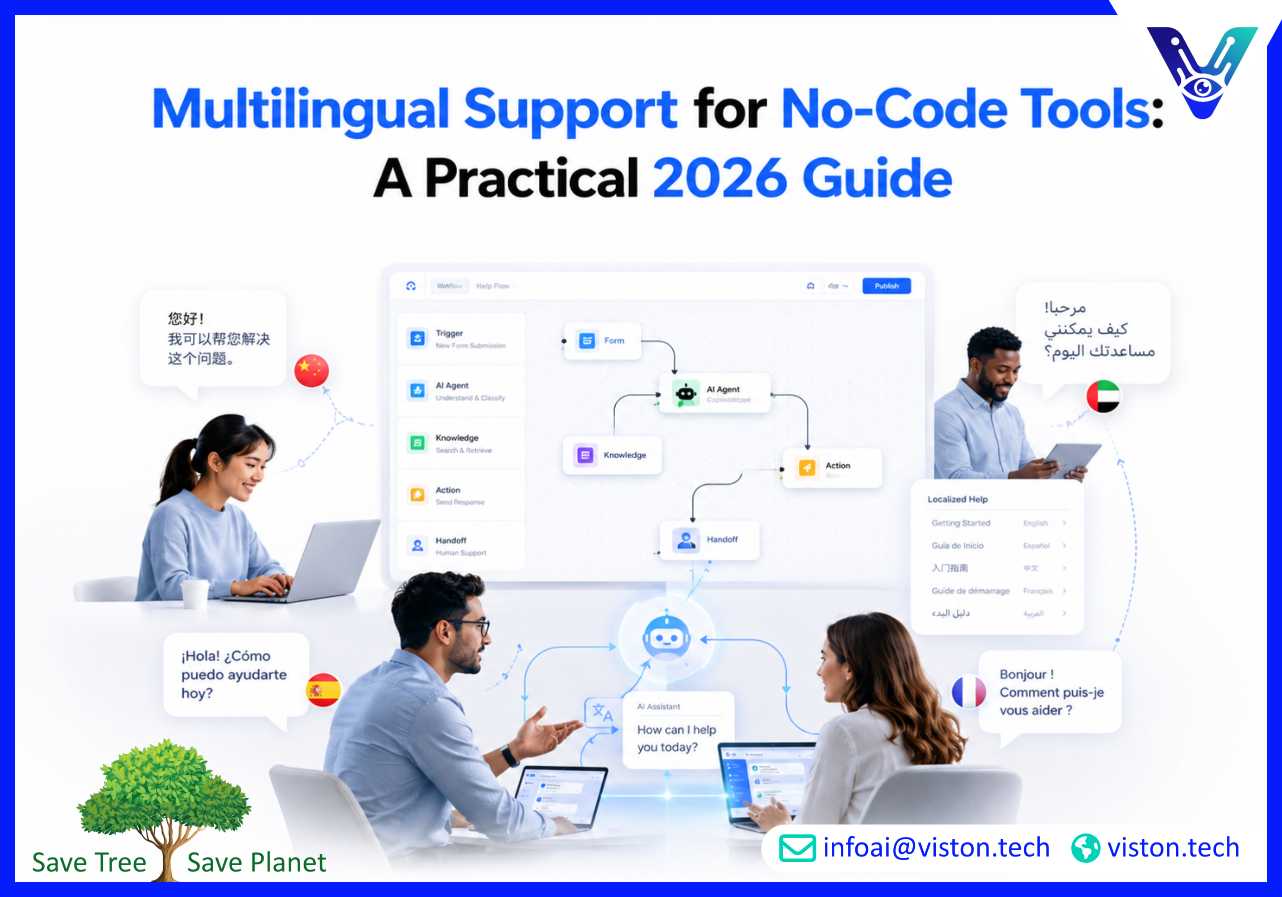
Multilingual Support for No-Code Tools: A Practical 2026 Guide
Multilingual support for no-code tools helps software companies serve users across markets without rebuilding every customer journey from scratch. However, effective support requires more than automatic translation. It depends on localized product guidance, reliable language detection, consistent terminology, integrated workflows, accurate knowledge sources, and appropriate human escalation.
What Multilingual Support for No-Code Tools Involves
No-code tools allow users to create applications, websites, databases, automations, forms, portals, and internal workflows through visual interfaces rather than traditional software development. Their users may include founders, operations teams, marketers, agencies, product managers, and business departments with very different levels of technical knowledge.Multilingual support for no-code tools means enabling these users to obtain useful assistance in their preferred languages across the full customer journey. This can include onboarding content, help centres, AI chatbots, live chat, ticketing, in-product guidance, email support, community resources, and automated workflow notifications.Translation is one part of the process, but it is not the complete service. A translated answer may still be unhelpful when it uses inconsistent platform terminology, ignores regional expectations, or fails to explain a visual workflow clearly. Effective multilingual service combines language capability with product knowledge and customer context.
Support must reflect how no-code users solve problems
No-code customers rarely describe issues using formal engineering terminology. They may say that an automation has stopped, a form is not saving data, a connection has expired, or a published application looks different from its preview. The support system must understand these natural descriptions and connect them to the correct component, integration, workflow, or account setting.Language support therefore needs to cover:
Interface labels, menu names, buttons, and visual builder terminology
Templates, conditional logic, database fields, and workflow steps
API connections, webhooks, authentication, and third-party integrations
Billing, permissions, workspaces, publishing, and account administration
Error messages, troubleshooting procedures, and escalation paths
Region-specific wording, examples, formats, and customer expectations
A well-designed system should preserve the exact meaning of product-specific terms while explaining them naturally in the customer’s language. Localization specialists increasingly distinguish this broader work from literal translation because it includes cultural adaptation, terminology control, and content management across markets.
Customer-facing and internal multilingual support
Multilingual support may serve external customers, internal support teams, or both. Customer-facing systems help users find answers, troubleshoot workflows, and complete tasks. Internal tools help agents translate conversations, search multilingual knowledge, summarize cases, and respond consistently.For growing no-code companies, the internal layer is important. Support agents should be able to understand the original request, review an accurate translation, see relevant account or integration data, and escalate the issue without losing context. This reduces the risk of customers repeating technical information during every transfer.
Why Multilingual Support Matters for No-Code Platforms in 2026
No-code products can attract international users quickly because they are distributed digitally and often provide self-service registration. A company may begin receiving users from multiple language markets before it has local offices, dedicated regional teams, or a formal localization operation.This creates an operational challenge. Product adoption can grow faster than the support organisation’s ability to answer questions in each language. When users are building business-critical applications or automations, unclear support can delay launches, interrupt workflows, and reduce confidence in the platform.
Product simplicity does not eliminate support complexity
No-code platforms are designed to make development more accessible, but the systems customers build can still be complex. A visual automation may connect payment tools, customer databases, email platforms, spreadsheets, AI services, and internal approval processes. When something fails, the customer may need help understanding several connected components.Multilingual support must therefore handle both simple questions and technically detailed cases. Basic questions may be resolved through localized self-service content or an AI assistant. More complex cases may require structured diagnostics, integration logs, screenshots, account context, and a specialist handover.
Language quality influences onboarding and retention
New users commonly need help selecting a template, understanding platform concepts, connecting services, and publishing their first workflow. When guidance is available only in an unfamiliar language, users may misunderstand important settings or abandon the setup process.Localized onboarding can explain not only what a feature does but how it fits into the user’s intended outcome. This may include guiding a retailer through an order notification workflow, helping a consultant build a client portal, or showing an operations team how to automate approvals.The same principle applies after onboarding. Customers are more likely to use advanced features when documentation, chatbot responses, and support explanations use consistent language and practical examples.
AI has raised expectations for speed and coverage
In 2026, buyers increasingly expect automatic language detection, conversational assistance, multilingual knowledge retrieval, and continuity across chat, email, help centres, and messaging channels. Modern customer-support localization platforms also connect tickets, knowledge content, and translated responses to reduce manual copying between systems.AI can expand language coverage, but it does not remove the need for governance. Support answers must still be grounded in approved product information. Technical terms need controlled translations. Sensitive or ambiguous cases require human review, and low-confidence answers should trigger clarification or escalation rather than confident guessing.
How to Implement Multilingual Support Without Disrupting No-Code Workflows
A successful implementation begins with the customer journey rather than a list of languages. Businesses should identify where language barriers create the greatest commercial or operational risk and then design support coverage around those moments.
Prioritise languages using real customer demand
Language selection should be based on evidence such as active users, trial registrations, support volume, website traffic, conversion opportunities, churn feedback, and planned market expansion. Supporting a smaller number of languages well is usually more valuable than providing inconsistent coverage across many languages.Teams should also analyse the types of requests received in each market. One language group may need onboarding assistance, while another generates integration or billing questions. These patterns help determine where translated documentation, chatbot coverage, or specialist agents will deliver the greatest value.
Create a controlled terminology system
No-code tools use distinctive terminology for blocks, actions, triggers, tables, scenarios, records, branches, connectors, and publishing environments. Translating these terms differently across the interface, help centre, and support responses can confuse users.A multilingual terminology system should define approved translations, terms that remain untranslated, product names, common abbreviations, and writing guidance for each language. The glossary should be shared across chatbot prompts, knowledge articles, support macros, interface content, and human translation workflows.
Prepare the knowledge base for multilingual retrieval
AI support performs best when it can retrieve current, well-structured information. Before expanding language coverage, teams should remove outdated articles, resolve contradictory instructions, identify authoritative sources, and assign content owners.Knowledge should be organised around user intent. Instead of relying only on broad product articles, the support system should be able to locate specific procedures such as reconnecting an integration, restoring a workflow version, updating permissions, or diagnosing a failed automation.Translated content also needs version control. When an English source article changes, the localisation workflow should identify every affected language and prevent obsolete instructions from remaining live.
Connect multilingual conversations to business systems
The support experience should not operate as an isolated translation layer. It may need to retrieve workspace details, subscription information, recent workflow errors, ticket history, integration status, or previous conversations from approved systems.Relevant connections can include:
Helpdesk and ticketing platforms
CRM and customer-success systems
Product analytics and event data
Knowledge bases and documentation platforms
Authentication and account-management systems
Workflow automation and notification tools
These integrations allow a multilingual assistant to provide contextual answers, create complete tickets, route cases to the correct team, and preserve the original message alongside its translation.
Design clear human handover rules
Automation should resolve repetitive, well-documented questions while recognising situations that need human judgment. Escalation may be appropriate for security concerns, billing disputes, data-loss reports, inaccessible accounts, complex integrations, repeated failures, or unclear customer intent.The receiving agent should see the original conversation, translated summary, detected language, attempted troubleshooting, relevant account context, and reason for escalation. This creates a smoother experience and prevents translation technology from becoming another barrier between the customer and the specialist.
How to Evaluate Quality, Risk, and Business Value
Multilingual support should be measured through customer and operational outcomes rather than the number of languages listed on a website. Leaders need to know whether customers receive accurate answers, complete tasks, and reach specialists when necessary.
Measure performance by language and intent
Overall averages can hide serious differences between markets. Performance should be segmented by language, channel, issue type, customer tier, and automation flow.Useful measures include:
First-contact and self-service resolution rates
Fallback and misunderstanding rates
Customer satisfaction by language
Escalation rate and handover quality
Average resolution time
Knowledge article success and search failure
Workflow or ticket creation accuracy
Translation correction and terminology error rates
A high automation rate is not automatically positive. If customers receive incomplete answers or repeatedly reopen cases, the system may be deflecting tickets without resolving the underlying problem.
Test technical accuracy, not only linguistic fluency
A response can sound natural while giving the wrong product instruction. Quality reviews should therefore include native-language assessment and product-specialist validation. Reviewers should check terminology, steps, links, permissions, warning messages, and whether the answer matches the current version of the platform.Testing should include real variations in how users describe the same issue, including spelling errors, mixed-language messages, informal wording, abbreviations, and copied error messages. It should also assess whether the system asks a useful clarifying question when several interpretations are possible.
Manage privacy and security across the workflow
Customer messages may contain personal information, account identifiers, access details, workflow data, or commercially sensitive content. Businesses should understand where conversation data is processed, which providers can access it, how long it is retained, and whether it is reused for model training.Access controls should limit sensitive information to authorised users and systems. Logging, redaction, encryption, retention settings, and regional data requirements should be considered during implementation rather than added after launch.
Build a continuous improvement cycle
Language coverage requires ongoing maintenance. Teams should regularly review failed conversations, new feature terminology, unresolved tickets, content changes, and feedback from regional users. This evidence can guide new knowledge articles, glossary updates, chatbot refinements, and agent training.The most sustainable approach treats multilingual support as a managed product capability. It has owners, quality standards, reporting, release processes, and clear responsibility for maintaining language accuracy as the no-code platform evolves.
How Viston AI Supports Multilingual Experiences for No-Code Tools
Viston AI is relevant to multilingual support for no-code tools because its published service portfolio includes Multilingual AI Chatbot Support, Language Translation Services, NLP and Text Analysis, AI Chatbot Development, AI Chatbot Integration, and automation-focused AI capabilities. The company also offers low-code and no-code development expertise, creating a practical connection between conversational support and the platforms, integrations, and visual workflows that customers use.This combination can support businesses that need more than a translated chat interface. A multilingual solution may require language detection, product-specific terminology, knowledge retrieval, chatbot conversation design, workflow automation, CRM or helpdesk integration, and structured escalation to human teams.For no-code product providers, Viston AI’s relevant role is helping connect these capabilities into an operational support experience. That may involve designing multilingual chatbot journeys, integrating approved knowledge sources, routing conversations, automating ticket creation, preserving context across handovers, and supporting language-aware workflows across customer channels.Its broader capabilities in enterprise AI chatbots, natural language processing, system integration, and low-code or no-code development make the company a suitable specialist for organisations seeking scalable multilingual support linked to real product and service processes. The value lies in aligning language technology with the way users build, troubleshoot, and manage no-code solutions rather than treating translation as an isolated feature.
Frequently Asked Questions
What is multilingual support for no-code tools?
Multilingual support for no-code tools provides product assistance in multiple languages through channels such as chatbots, help centres, tickets, live chat, email, and in-product guidance. It combines translation with product terminology, localized knowledge, workflow context, and human escalation.
Can AI provide multilingual support without hiring agents for every language?
AI can handle many repetitive questions, translate conversations, retrieve approved information, and create structured support tickets. Human specialists are still important for complex technical issues, sensitive cases, low-confidence answers, and quality review. A hybrid model usually provides better control than fully automated support.
Which languages should a no-code company support first?
Prioritise languages using active-user data, trial demand, support volume, revenue opportunity, market plans, and customer feedback. The best starting languages are those where clearer support can improve onboarding, reduce unresolved cases, or support commercially important expansion.
How do multilingual chatbots handle product-specific terminology?
They should use an approved glossary containing interface labels, feature names, workflow terms, technical phrases, and translations. The glossary must be applied consistently across chatbot prompts, knowledge articles, support macros, and human-agent responses.
What integrations are important for multilingual support?
Common integrations include helpdesk platforms, CRM systems, knowledge bases, product analytics, customer databases, workflow automation tools, and account-management systems. These connections help the support system provide contextual answers and complete actions instead of only translating text.
Can Viston AI help implement multilingual support for a no-code platform?
Viston AI offers services relevant to this requirement, including multilingual AI chatbot support, language translation, NLP, chatbot development, chatbot integration, automation, and low-code or no-code development expertise. The appropriate solution would depend on the platform’s languages, channels, knowledge sources, integrations, security needs, and support workflows.
Conclusion
Multilingual support for no-code tools is a product, knowledge, and workflow capability rather than a simple translation project. In 2026, effective multilingual support should help users understand platform concepts, resolve technical issues, complete onboarding, and reach specialists without losing context. Businesses should prioritise languages using real demand, maintain controlled terminology, connect support to trusted systems, test technical accuracy, and measure outcomes by language. Viston AI offers relevant multilingual, chatbot, NLP, integration, automation, and no-code capabilities for companies seeking a practical support experience that can scale across global customer markets.