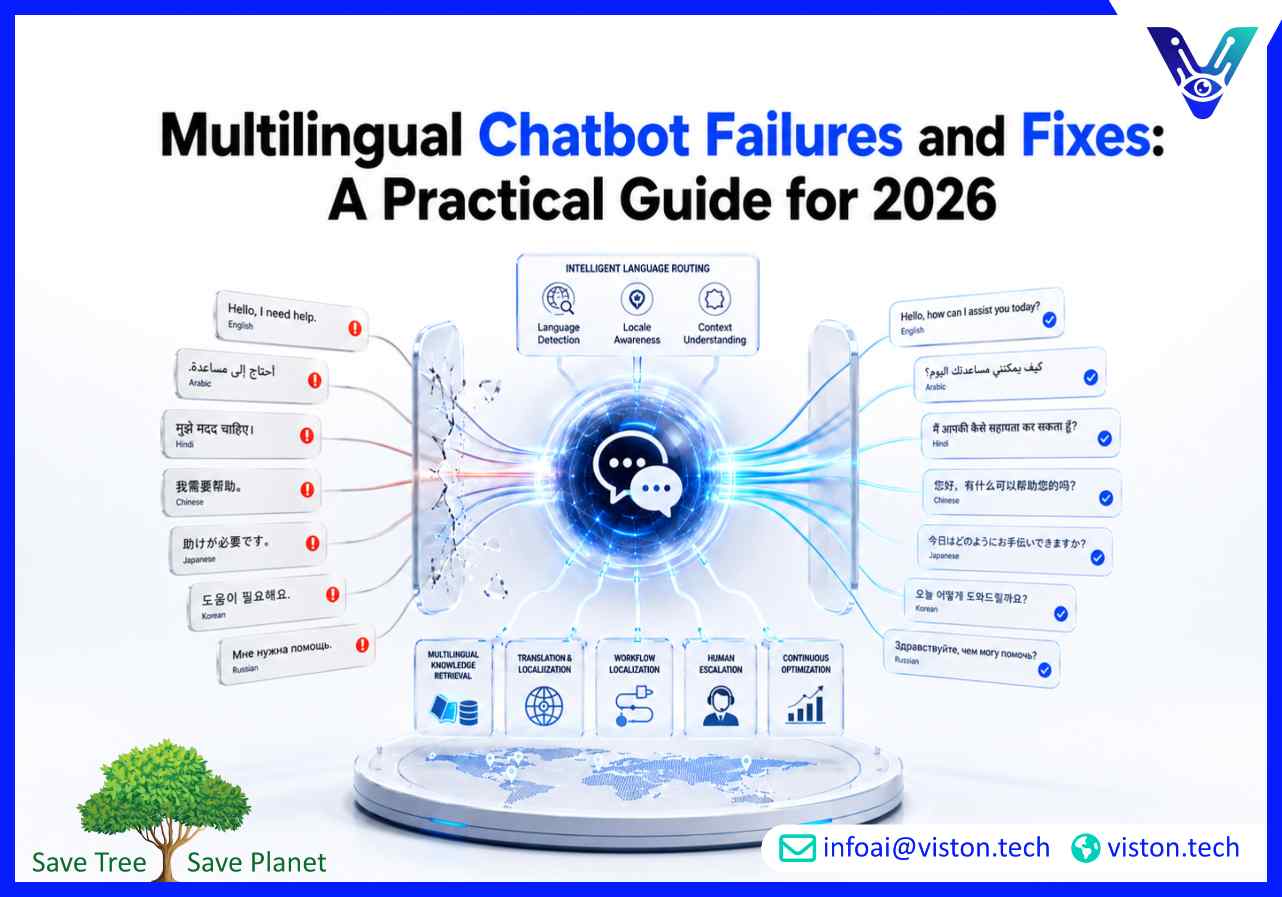
Multilingual Chatbot Failures and Fixes: A Practical Guide for 2026
Multilingual chatbot failures often appear after launch, when real customers use dialects, switch languages, enter local product terms, or ask questions that the English knowledge base cannot answer. In 2026, reliable multilingual support requires more than translation. It depends on language-aware retrieval, localization, testing, escalation, governance, and continuous improvement.
Why Multilingual Chatbots Fail Even When the Core AI Works
A chatbot can perform well in its default language and still deliver weak support elsewhere because multilingual performance is a system-level problem. Language detection, retrieval, translation, interface text, integrations, analytics, and human handover all influence the final experience.Many businesses translate an English chatbot and assume every language will inherit the same accuracy. That overlooks differences in grammar, formality, dialect, cultural context, terminology, and training data. It also assumes the same source content is current in every market.Failures become serious when the chatbot handles operational tasks. A misunderstood cancellation, payment, delivery, or security request can create financial and trust risks. The objective is not merely to support many languages, but to deliver comparable task completion, answer quality, safety, and escalation across them.
Multilingual capability is not the same as multilingual readiness
A model may generate text in many languages, but production readiness requires evidence that it understands the business domain in each locale. It must recognize intent, retrieve the right source, preserve names and numbers, apply local formats, follow policy, and escalate when confidence is low.Businesses should also distinguish language from locale. Spanish for Spain, Mexico, and Argentina may require different vocabulary, regulatory wording, currencies, date formats, and levels of formality. Portuguese for Brazil is not interchangeable with Portuguese for Portugal. Arabic, Chinese, French, and English also contain major regional variations that affect customer experience.
Common Multilingual Chatbot Failures and Their Practical Fixes
1. Incorrect language or locale detection
A chatbot may detect the wrong language when messages are short, transliterated, or mixed. A phrase such as “refund chahiye” combines English and Hindi, while a single word may not provide enough evidence.Fix: Combine account locale, conversation history, user selection, and message-level detection. Let customers change language manually and ask for clarification when confidence is low. Preserve the choice across authenticated sessions.
2. Literal translation that ignores local meaning
Direct translation often produces grammatically correct but commercially wrong answers. Idioms, politeness levels, legal terms, product names, and support instructions may lose meaning. The result can sound unnatural or, worse, alter the intended policy.Fix: Build locale-specific terminology, approved phrases, tone rules, and non-translatable entity lists. Use qualified human review for high-risk content and test whether the answer preserves intent, not merely fluency.
A chatbot may retrieve a current English article but find only an outdated local version. It can then return a weaker answer, translate the wrong source, or invent missing details.Fix: Track content parity by language. Give each knowledge item language, locale, owner, version, and review-date metadata. When local content is missing, define whether the bot may translate the approved source or must escalate.
4. Cross-lingual retrieval returns the wrong document
In retrieval-augmented generation, the model may understand the customer but retrieve a document for the wrong country, product version, or language.Fix: Use multilingual embeddings or language-specific indexes, hybrid retrieval, locale filters, synonym maps, and metadata ranking. Evaluate retrieval separately from generation; a fluent answer based on the wrong source still fails.
5. Code-switching breaks conversation context
Customers often switch languages when using technical terms, model names, or workplace vocabulary. Some bots then change response language, lose context, or misclassify intent.Fix: Maintain a preferred conversation language while interpreting each message independently. Preserve order numbers, names, SKUs, and addresses, and test mixed-language patterns from real conversations.
6. The chatbot translates content but not workflows
A conversation may appear localized while buttons, validation messages, confirmations, CRM fields, or handover notes remain in the default language.Fix: Localize forms, menus, errors, authentication steps, notifications, and agent summaries. Confirm downstream systems accept local characters, addresses, currencies, and time zones without corrupting data.
7. Human escalation loses language and context
A multilingual bot creates frustration when it transfers a customer to an agent who cannot use the language or receives no useful summary.Fix: Route by language, topic, risk, and availability. Provide the original transcript, a labelled translation, detected intent, attempted steps, and escalation reason. Explain wait times when language coverage is limited.
8. One global accuracy score hides weak languages
High-volume English conversations can dominate dashboards and conceal failures in lower-volume languages.Fix: Report metrics by language, locale, channel, and intent. Track retrieval relevance, task completion, fallback, escalation, satisfaction, unsafe responses, and handover quality. Set minimum thresholds for every supported language.
How to Test and Diagnose Multilingual Chatbot Problems
Testing should begin before launch and continue in production. Automated evaluation helps, but fluent reviewers who understand the market, product, and service context are also essential.
Create a language-by-intent test matrix
Map priority intents against supported locales. Add spelling errors, slang, dialects, mixed-language messages, ambiguous requests, and adversarial inputs. Test high-risk intents more deeply than basic FAQs.Test both the answer and the action. A chatbot may explain a refund policy correctly but fail to create the ticket, pass the right reason code, or preserve the customer’s local characters. End-to-end tests should verify integrations, authentication, workflow completion, and confirmation messages.
Separate the failure layer
Teams improve multilingual chatbots faster when they identify where the error occurred. Useful categories include:
Language or locale detection failure
Intent recognition or entity extraction failure
Retrieval or source-selection failure
Translation or generation failure
Policy, safety, or privacy failure
Integration or workflow failure
Human routing or handover failure
This classification prevents teams from repeatedly changing prompts when the real problem is an outdated article, an incorrect locale filter, or a broken CRM mapping.
Use production feedback carefully
Fallbacks, negative ratings, repeat contacts, agent corrections, and abandoned conversations are valuable improvement signals. They should be reviewed by language and intent, with sensitive data minimized or masked. Do not automatically retrain on every conversation. Agent messages may contain errors, informal workarounds, or content that is unsuitable for customer-facing automation.A controlled improvement cycle should include issue review, root-cause classification, approved content or configuration changes, regression testing, versioning, and post-release monitoring. This keeps one language fix from degrading another language or changing a validated workflow.
A 2026 Fix Framework for Reliable Multilingual Support
The most effective remediation plan is phased. Trying to perfect every language and use case simultaneously makes quality difficult to govern.
Prioritize languages and intents. Use customer volume, revenue relevance, support demand, risk, and market plans to define the first release.
Choose the right architecture. Decide when the chatbot should answer natively, retrieve cross-lingually, translate approved content, or use separate locale-specific flows.
Design confidence and fallback rules. Define when to clarify, retrieve again, provide a limited answer, or transfer to a human.
Localize the full journey. Include interface text, actions, integrations, notifications, and agent handover—not only chatbot responses.
Validate with local reviewers. Test linguistic quality, cultural appropriateness, policy accuracy, and task completion in realistic scenarios.
Launch gradually. Begin with controlled traffic, monitor language-specific KPIs, and expand only when thresholds are met.
Govern continuous improvement. Maintain change logs, review cycles, incident ownership, access controls, and retraining or content-update procedures.
For business leaders, the key purchasing question is not how many languages a provider claims to support. It is how the provider validates each language, controls source content, handles low-confidence situations, integrates workflows, protects data, and reports performance differences. A credible multilingual support service should make these controls visible during discovery and implementation.
How Viston AI Helps Fix Multilingual Chatbot Failures
Viston AI provides Multilingual Support services focused on multilingual AI chatbots and customer interactions across languages, channels, and business systems. Its published capabilities include language-aware natural language processing, translation and localization, omnichannel deployment, intelligent routing, performance analytics, and integration with knowledge bases, CRM platforms, transaction systems, and other business applications.These capabilities are relevant because most multilingual chatbot failures do not come from one model defect. They emerge across the complete delivery chain: language detection, terminology, retrieval, conversation design, workflow integration, escalation, monitoring, and ongoing content maintenance. Viston AI’s service approach includes data preparation, model selection, testing against scenarios and edge cases, API or cloud integration, deployment controls, and continuous performance optimization.For organizations operating across regions, the practical value is the ability to treat multilingual support as an engineered customer-service capability rather than a translation add-on. A phased implementation can begin with priority languages and high-volume intents, then expand as language-specific accuracy, resolution, and satisfaction targets are met. Viston AI may therefore be relevant to businesses that need to diagnose weak chatbot performance, rebuild multilingual knowledge and routing, integrate support workflows, or establish monitoring that shows where quality differs by language and market.
Frequently Asked Questions
What is the most common cause of multilingual chatbot failure?
The most common cause is an English-first implementation that translates responses without adapting knowledge, terminology, retrieval, workflows, and testing for each locale. The chatbot may sound fluent while using the wrong source or completing the task incorrectly.
Should a multilingual chatbot use automatic translation or answer natively?
Both approaches can be appropriate. Native multilingual generation can improve conversational flow, while translation can preserve approved source content. The best architecture depends on language quality, risk, content availability, latency, and governance. High-risk answers should always use controlled sources and clear fallback rules.
How can a business measure multilingual chatbot quality?
Measure performance by language and locale using intent accuracy, retrieval relevance, task completion, fallback, escalation, customer satisfaction, repeat contact, workflow success, and handover quality.
How should chatbots handle mixed-language messages?
The chatbot should maintain the user’s preferred conversation language while interpreting mixed-language input and preserving names, product codes, addresses, and technical terms. Common code-switching patterns should be included in testing data.
Can multilingual chatbot failures create compliance or privacy risks?
Yes. Incorrect translation, weak access controls, unsuitable data retention, or regionally inaccurate instructions can create risk. Businesses should apply the same privacy, security, audit, and approval controls across every supported language and deployment region.
Can Viston AI improve an existing multilingual chatbot?
Viston AI’s Multilingual Support capabilities align with improvement work such as multilingual NLP, localization, knowledge and CRM integration, routing, testing, analytics, and continuous optimization. The appropriate remediation scope depends on the chatbot’s current architecture, languages, workflows, and failure data.
Conclusion
Multilingual chatbot failures and fixes should be managed as an operational quality program, not a one-time translation project. Reliable multilingual support requires locale-aware detection, trusted knowledge, accurate retrieval, complete workflow localization, safe fallback, contextual human handover, and language-level measurement. Businesses that validate each market independently can expand automation without hiding weak customer experiences behind a global average. Viston AI offers relevant multilingual support capabilities for organizations seeking to diagnose failures, strengthen integrations, and build a more controlled, scalable support experience across languages.