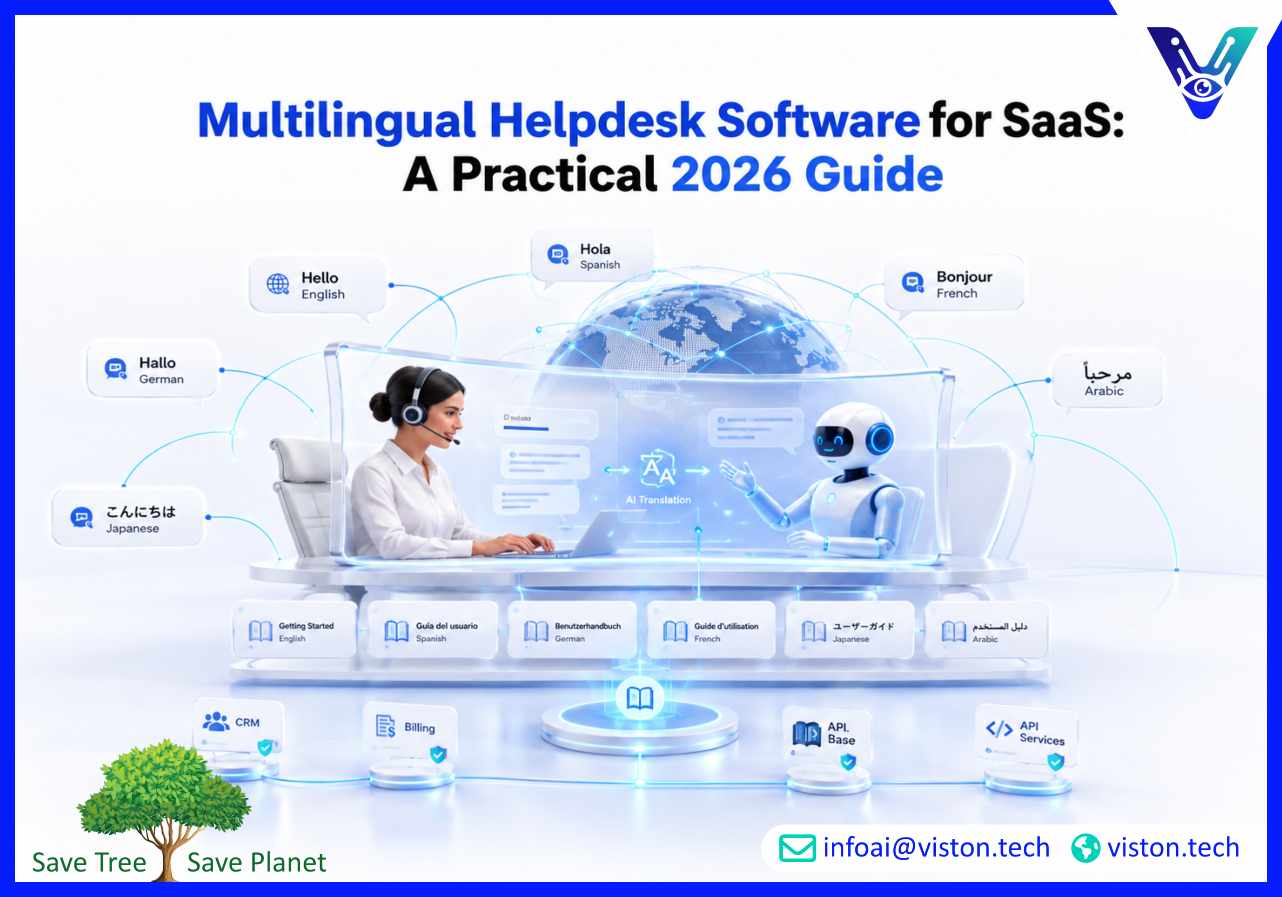
Multilingual Helpdesk Software for SaaS: A Practical 2026 Guide
Multilingual helpdesk software for SaaS helps growing software companies support customers in their preferred language without creating disconnected regional service operations. The right approach combines localized self-service, intelligent ticket handling, skilled human support, reliable integrations, and language-specific quality control to deliver consistent assistance across global markets.
What Multilingual Helpdesk Software for SaaS Actually Involves
A multilingual helpdesk is more than an English ticketing system with automatic translation added. It is a coordinated support environment that can identify a customer’s language, display localized help content, translate conversations where appropriate, route cases to suitably skilled agents, preserve product terminology, and maintain a complete support history across channels.For a SaaS company, this environment commonly supports onboarding questions, account access, subscription changes, billing explanations, feature guidance, bug reports, integrations, API issues, security enquiries, renewals, and incident communication. Each category has different risk. A simple navigation question may be suitable for automated assistance, while a billing dispute or production-impacting technical issue may require immediate human review.Modern helpdesk products increasingly provide multilingual portals, translated knowledge articles, localized forms and notifications, language preferences, and real-time translation features. Their documentation also shows why configuration alone is not enough: translated content must be maintained, language variants need governance, and fallback behaviour must be planned when localized content is unavailable.
The Operating Model Behind the Software
The software is only one part of the service model. Effective multilingual support also requires language ownership, approved terminology, escalation rules, knowledge management, agent training, quality assurance, and reporting. SaaS teams should decide which languages receive native-agent coverage, which can use assisted translation, and which enquiries require escalation.A practical model often blends three layers:
Localized self-service for repeatable product, account, and setup questions.
AI-assisted or machine-translated support for suitable low-risk conversations.
Fluent human support for complex, high-value, technical, contractual, or sensitive cases.
This blended approach allows a SaaS business to expand language coverage without treating every request identically.
Why SaaS Companies Need Multilingual Helpdesk Capability in 2026
SaaS products can gain users in new countries long before the company builds a local office. Product-led growth, online trials, app marketplaces, channel partners, and remote sales create global demand quickly. Support operations often lag behind that growth, leaving customers to interpret technical answers, billing policies, and troubleshooting steps in a second language.
Language Affects Adoption and Retention
Customers usually need the most support during onboarding, configuration, integration, and early value realization. Confusing guidance at these stages can slow activation and increase avoidable tickets. Localized instructions and language-aware assistance make it easier for users to complete setup, understand features, and resolve common problems without repeated contact.For established accounts, multilingual support also strengthens renewal conversations. Customers expect clear explanations when discussing usage limits, invoices, security controls, service incidents, and contract-related processes. Translation that loses technical meaning or changes the tone of an important message can create unnecessary risk.
It Improves Support Scalability
Without a unified system, regional teams may create separate inboxes, macros, and knowledge articles. That fragmentation makes reporting difficult and can produce different answers to the same question. A centralized multilingual helpdesk gives leaders one operating view while allowing language-specific queues, content, and escalation paths.It can also reduce pressure on bilingual specialists. Instead of using fluent agents for every basic request, the system can resolve routine enquiries through localized knowledge, provide translated context to generalist agents, and reserve specialist capacity for conversations where cultural understanding or precise language is essential.
It Creates Better Product Insight
Language-level reporting helps SaaS teams identify where customers struggle. A rise in German onboarding tickets may signal unclear localized setup content. Repeated Spanish billing questions may reveal a problem in checkout wording. High escalation rates in one language may indicate weak knowledge coverage, translation errors, or insufficient agent capability.
Core Capabilities to Look for in a Multilingual SaaS Helpdesk
The best solution is not necessarily the platform with the longest language list. Buyers should examine how the software handles real support work, especially when conversations move between automation, agents, and backend systems.
Language Detection and Customer Preference
The helpdesk should detect likely language while allowing the customer or agent to correct it. Browser language, profile settings, portal locale, and message content can all provide signals, but none should be treated as infallible. The customer’s saved preference should follow the conversation across email, chat, portal, and other supported channels.
Localized Knowledge Management
A strong multilingual knowledge base needs version control, ownership, review dates, and alerts when the source article changes. Translating the first version is not enough. Every product update, pricing change, policy revision, or UI change can make a localized article inaccurate. Current helpdesk documentation reflects this operational need by providing ways to flag or track outdated translations.SaaS teams should also maintain a terminology glossary covering feature names, plan names, technical terms, error messages, and phrases that must remain untranslated. This reduces inconsistency across articles, tickets, chatbot answers, and release notes.
Translation with Confidence Controls
Real-time translation can help an agent communicate across languages, but the system should preserve the original message, show the translated version clearly, and support review when confidence is low. Sensitive categories such as security, cancellation, legal, payment, accessibility, and major incidents should have stricter controls than routine how-to questions.
Intelligent Routing and Contextual Handover
Routing should consider language alongside account tier, product area, issue severity, customer sentiment, region, and technical skill. When automation hands a ticket to a person, the agent should receive the original message, translation, detected intent, relevant account details, troubleshooting already attempted, and the complete conversation history.
SaaS and Business-System Integrations
The helpdesk should connect with the systems agents need to solve problems: CRM, subscription billing, identity management, product analytics, status monitoring, issue tracking, knowledge repositories, and customer success platforms. Good integration reduces tab switching and lets the support team answer questions using current account and product context rather than generic scripts.
Security, Permissions, and Auditability
Multilingual workflows must follow the same security standards as the wider support operation. Buyers should review role-based access, retention, encryption, audit logs, regional requirements, redaction, subprocessors, and controls over data sent to translation or AI services.
How to Select, Implement, and Measure the Right Solution
Selection should begin with support demand rather than a feature checklist. Review ticket volume, customer value, growth plans, self-service usage, escalation patterns, and language requests. This creates a realistic language roadmap and prevents the team from enabling languages it cannot maintain.
Prioritize Languages by Business Need
Score each language using customer volume, revenue exposure, strategic market importance, ticket complexity, available internal expertise, and documentation readiness. The result may show that one language needs full native coverage while another can begin with localized self-service and translation-assisted agents.
Test Real SaaS Scenarios
A proof of concept should use representative conversations, not generic greetings. Test password recovery, failed integrations, API errors, subscription changes, outage questions, and multi-step troubleshooting. Include spelling mistakes, mixed-language messages, regional variants, and product terminology.Review whether the system preserves meaning, selects the correct knowledge, routes to the right team, and keeps the original message available. Native speakers or qualified reviewers should assess tone and accuracy before launch.
Build Governance Before Expanding
Assign owners for every supported language. Define who approves translations, updates the glossary, reviews failed automation, monitors knowledge freshness, and handles urgent incidents. Establish rules for human review and create a fallback experience for unsupported or uncertain queries.Roll out in stages. Begin with a limited set of high-volume intents, measure results, improve the content and routing, then add more workflows or languages. This is safer than launching broad automated coverage with weak oversight.
Measure Outcomes by Language
Overall averages can hide poor performance in smaller markets. Track first-response time, resolution time, first-contact resolution, self-service success, escalation rate, reopened tickets, customer satisfaction, translation corrections, knowledge gaps, and backlog by language.For SaaS support, also monitor activation-related tickets, time to complete onboarding tasks, technical escalation quality, incident communication performance, renewal-risk cases, and the percentage of conversations that require a fluent specialist. The goal is not simply to reduce ticket count. It is to improve resolution quality while operating efficiently.
How Viston AI Supports Multilingual Helpdesk Experiences for SaaS
Viston AI is directly relevant to multilingual helpdesk software for SaaS because its published Multilingual Support offering covers context-aware conversational assistance, translation and localization, omnichannel deployment, intelligent routing, escalation, and language-level performance analytics. Its service page also identifies SaaS scenarios such as onboarding, feature guidance, billing support, technical troubleshooting, contextual help, and escalation workflows.For a SaaS business, these capabilities can support a broader helpdesk design rather than a standalone chatbot. Multilingual assistance can be connected to localized knowledge, customer records, ticket workflows, and human support teams so that users receive consistent help across web, mobile, messaging, and service channels.Viston AI also presents chatbot integration capabilities for CRM, customer service platforms, workflow automation, role-based access, audit logging, and multi-channel data orchestration. That integration focus matters because multilingual answers are only useful when they reflect the customer’s current plan, account status, case history, and product context.Its practical relevance is strongest for organizations that need a tailored multilingual support layer, language-aware automation, and system integration around an existing SaaS support operation. The engagement should still begin with clear language priorities, approved knowledge, security requirements, escalation logic, and measurable service objectives.
Frequently Asked Questions
What Is Multilingual Helpdesk Software for SaaS?
It is a support platform or integrated support environment that manages customer service across multiple languages. It may include localized portals, translated knowledge, language detection, ticket translation, multilingual automation, language-based routing, human escalation, and reporting by language.
Can AI Translation Replace Multilingual Support Agents?
Not completely. AI translation can improve coverage and agent productivity for many routine conversations, but fluent human support remains important for complex technical issues, sensitive cases, contractual discussions, complaints, major incidents, and situations where cultural nuance affects the outcome.
Which SaaS Support Content Should Be Translated First?
Start with high-traffic onboarding guides, account access instructions, billing FAQs, core troubleshooting articles, integration setup, security information, incident guidance, and the forms or messages customers see when creating and tracking tickets.
How Many Languages Should a SaaS Helpdesk Support?
There is no universal number. Support the languages justified by customer demand, revenue, growth strategy, ticket volume, and the company’s ability to maintain accurate content and service quality. A focused, well-governed rollout is better than broad but unreliable coverage.
How Should Multilingual Helpdesk Performance Be Measured?
Measure response time, resolution time, first-contact resolution, self-service success, escalation, reopen rate, customer satisfaction, translation corrections, and knowledge gaps separately for each language. SaaS teams should also connect these metrics to onboarding, product adoption, retention risk, and incident handling.
Can Viston AI Integrate Multilingual Support with an Existing Helpdesk?
Viston AI describes multilingual conversational support and business-system integration capabilities that can be applied around existing customer service workflows. Suitability depends on the helpdesk, APIs, channels, security needs, required languages, knowledge structure, and escalation model.
Conclusion
Multilingual helpdesk software for SaaS should make global support more consistent, not merely translate isolated messages. Success depends on localized knowledge, reliable language detection, controlled automation, skilled human escalation, secure integrations, and performance measurement by language. SaaS companies should begin with real customer demand, test product-specific scenarios, and expand only when governance is in place. Viston AI offers relevant multilingual support and integration capabilities for businesses building a tailored, scalable support environment around their software, customers, and operational systems.