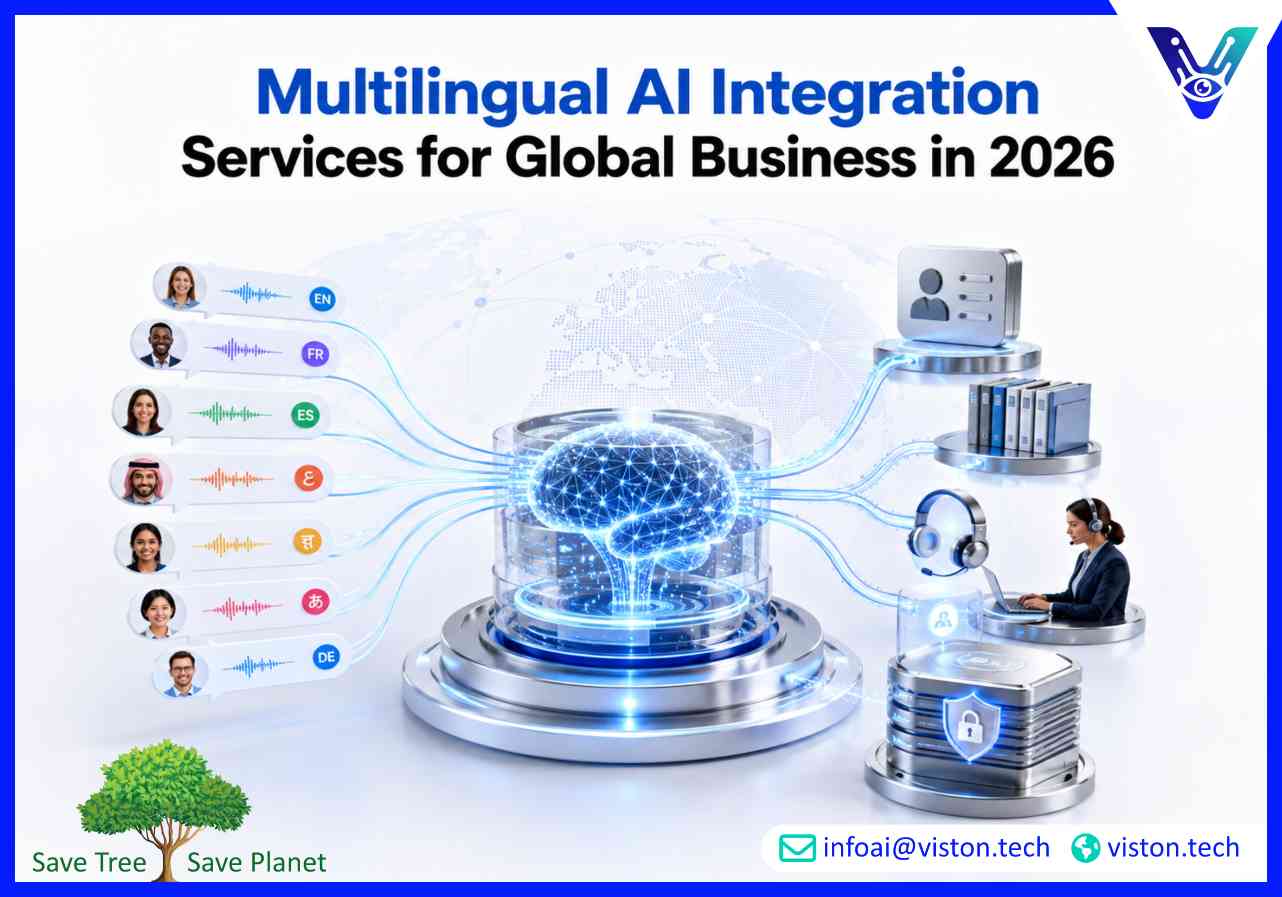
Multilingual AI Integration Services for Global Business in 2026
Multilingual AI integration services help businesses connect language-aware AI with customer support, sales, knowledge, and operational systems. In 2026, the value is not simply automatic translation. It is the ability to deliver accurate, context-aware, secure, and consistent experiences across languages, channels, markets, and business workflows.
What Multilingual AI Integration Services Actually Include
Multilingual AI integration services combine conversational AI, natural language processing, translation technology, knowledge retrieval, workflow automation, and business system connectivity. The objective is to let customers, employees, or partners interact in their preferred language while the AI accesses the right information and completes approved tasks inside existing platforms.This is different from adding a translation widget to a website. A translated interface may change visible text, but it does not necessarily understand user intent, local terminology, regional product rules, or the context of a multi-step conversation. A well-integrated multilingual AI solution must understand what the user wants, retrieve trusted information, preserve meaning, and respond in a way that fits the business process.
Core capabilities within a multilingual AI integration
Automatic language and locale detection
Multilingual intent recognition and entity extraction
Translation or native multilingual model support
Retrieval from approved knowledge bases and documents
Integration with CRM, helpdesk, ERP, ecommerce, and booking systems
Channel deployment across web, mobile, messaging, email, and voice
Human escalation with full conversation context
Language-specific analytics, quality review, and continuous optimization
The technical approach may use direct multilingual processing, translation through a central operating language, or a hybrid design selected by language, use case, risk, cost, and response-speed requirements.The integration layer turns language capability into business value. An assistant that cannot check an order, create a ticket, update a lead, retrieve a policy, or route a complaint remains limited. Buyers should view the service as an operational project, not a standalone chatbot purchase.
Why Businesses Need Multilingual AI Integration Services in 2026
Businesses increasingly serve customers across regions without building a full local support operation in every market. At the same time, users expect fast, clear, and consistent responses in the language they are most comfortable using. Multilingual AI integration services help close this gap by extending access to approved information and workflows beyond standard business hours and primary-language support teams.
More consistent global customer support
Customers often receive different answers depending on the language, channel, or agent handling the request. A centralized multilingual AI system can use the same approved knowledge and policy logic across markets while adapting wording to the user’s language. This supports consistency without removing the need for local review where cultural, legal, or product differences matter.
Lower pressure on language-specific teams
Routine questions about account access, delivery status, product availability, appointment scheduling, returns, onboarding, or basic troubleshooting can consume a large amount of agent time. AI can handle suitable low-risk requests and pass complex cases to people. The goal is not to prevent escalation, but to reserve human attention for situations requiring judgment, empathy, negotiation, or specialist expertise.
Faster market expansion
Entering a new market usually creates demand for localized support content, language coverage, and workflow adaptation. A reusable multilingual AI architecture can reduce the need to build separate systems for every region. Businesses can add languages in stages, validate performance, and expand coverage based on actual demand rather than launching an oversized global deployment at once.
Stronger sales and lead handling
Multilingual AI can qualify inbound enquiries, collect structured requirements, answer product questions, and route prospects to the right regional team. When connected to a CRM, it can create or update records in a consistent format even when the conversation happens in another language. This helps reduce lost enquiries and gives sales teams cleaner context for follow-up.
Better internal access to knowledge
The same approach can support employees. Multinational teams may need access to HR guidance, IT help, operational procedures, product documentation, or compliance information across several languages. A multilingual internal assistant can make approved knowledge easier to find while respecting user roles, permissions, and regional differences.These benefits depend on quality. Poor translation, weak intent recognition, outdated knowledge, and unsafe automation can create more work than they save. Buyers should expect language-specific testing, transparent escalation, data controls, monitoring, and accountable ownership.
How a Multilingual AI Integration Project Is Delivered
A successful project starts with business requirements, not model selection. The delivery team needs to understand who will use the system, which languages matter, what tasks should be automated, which systems must be connected, and where human approval is required.
1. Define use cases, languages, and success criteria
The first step is to identify high-value, manageable use cases. These might include answering common support questions, checking order status, booking appointments, qualifying leads, guiding onboarding, or helping employees find internal information. Languages should be prioritized by customer demand, ticket volume, market importance, and operational readiness.Success criteria should be specific. Useful measures include task completion rate, resolution rate, fallback rate, escalation rate, customer satisfaction, response time, translation quality, workflow success, and accuracy of CRM or ticket updates.
2. Prepare knowledge and language assets
Multilingual AI is only as reliable as the information it can access. Teams must identify authoritative sources, remove outdated or conflicting content, and decide which material is suitable for automation. Glossaries, product names, abbreviations, industry terminology, restricted phrases, and approved translations should be documented.High-risk contractual, financial, medical, safety, or regulated content may require professional linguistic and subject matter review.
3. Design the architecture and integrations
The architecture should define how language detection, translation, model processing, knowledge retrieval, API calls, security controls, logging, and escalation work together. Integration may involve CRM platforms, service desks, ecommerce systems, identity tools, payment services, scheduling applications, document repositories, or custom databases.API reliability and permission design are critical. The AI should access only the data needed for the task, require authentication or confirmation for sensitive actions, and handle connected-system failures safely.
4. Test by language, channel, and scenario
Testing should include common requests, ambiguous phrasing, spelling variation, dialect differences, code-switching, unsupported requests, abusive language, and escalation scenarios. A solution that works well in English may perform differently in Arabic, German, Spanish, Hindi, Japanese, or other languages because grammar, terminology, scripts, and user expectations differ.Testing must cover the complete workflow, not only the wording of the response. Ticket creation, lead routing, and record updates must also be validated.
5. Launch in phases and optimize continuously
A controlled pilot allows the business to compare AI outcomes with existing processes. After launch, teams should review unresolved conversations, low-confidence answers, escalations, negative feedback, and language-specific error patterns. New content, prompts, rules, and workflow logic can then be introduced through a governed improvement cycle.
How to Evaluate Providers, Costs, Risks, and Results
Choosing a multilingual AI provider requires more than checking how many languages a platform claims to support. Buyers need evidence that the provider can deliver reliable integrations, maintain language quality, protect business data, and support the system after deployment.
Key provider evaluation questions
Which languages and regional variants have been tested for the intended use case?
Does the solution use direct multilingual processing, translation, or a hybrid approach?
How are glossaries, brand terminology, and approved answers managed?
Which business systems and channels can be integrated?
How are authentication, permissions, encryption, retention, and audit logs handled?
What happens when the AI is uncertain or a workflow fails?
Can performance be measured separately by language, market, channel, and intent?
What ongoing optimization and support are included?
What affects project cost
Pricing depends on the number of languages, channels, integrations, workflows, data sources, monthly conversation volume, model usage, hosting requirements, security controls, testing depth, and level of customization. A simple multilingual FAQ assistant costs less than a system that authenticates users, accesses account data, supports voice, completes transactions, and operates across regulated markets.Buyers should request a cost model separating discovery, development, integration, content preparation, testing, infrastructure, model usage, maintenance, and optimization.
Risks that need active management
Common risks include inaccurate translation, hallucinated answers, inconsistent policy interpretation, privacy exposure, unauthorized actions, weak escalation, and uneven performance across languages. These risks are managed through approved knowledge sources, access controls, confidence thresholds, human review, automated testing, monitoring, and clear ownership.
How to measure business value
Results should be linked to the original use case. Support teams may track self-service resolution, reduced repeat contact, handling time, and customer satisfaction. Sales teams may track qualified leads, booking rates, response speed, and CRM data quality. Internal service teams may measure task completion, adoption, time saved, and reduced helpdesk demand.A strong business case combines customer experience with operational efficiency. Success means completing useful tasks accurately, escalating appropriately, and improving the quality of work around the AI.
How Viston AI Supports Multilingual AI Integration
Viston AI is directly relevant to multilingual AI integration services because its service portfolio includes multilingual AI chatbot support, language translation, natural language processing, enterprise chatbots, AI chatbot integration, voice-enabled assistants, and integration with business systems.Its approach is suited to organizations that need more than translated responses. Viston AI positions multilingual support around context-aware conversations, centralized knowledge, routing and escalation, analytics, and deployment across channels such as web, mobile applications, messaging, SMS, and voice. These capabilities can support customer service, sales, internal help, and operational workflows where language coverage must connect with real business systems.For a practical implementation, the value lies in combining language capability with APIs, data access, automation rules, and monitoring. This can help a business create consistent multilingual experiences while retaining controls around permissions, human handover, and performance review. Viston AI also presents broader capabilities in AI strategy, workflow automation, MLOps, and ongoing optimization, which are relevant when a multilingual assistant needs to scale across teams, markets, or use cases.Organizations evaluating Viston AI should still define their priority languages, integration requirements, security expectations, and measurable outcomes before deployment. That creates a clearer basis for designing, testing, and governing a solution that supports both customer needs and operational goals.
Frequently Asked Questions
What are multilingual AI integration services?
They are services that connect language-aware AI with business systems, data sources, and customer channels. The solution can understand and respond in multiple languages while retrieving information, creating records, routing requests, or completing approved workflows.
Is multilingual AI the same as machine translation?
No. Machine translation converts text from one language to another. Multilingual AI integration also includes intent recognition, knowledge retrieval, system connectivity, conversation management, automation, analytics, and human escalation.
Which systems can multilingual AI integrate with?
Common integrations include CRM platforms, helpdesk software, ERP systems, ecommerce platforms, knowledge bases, booking tools, identity services, payment systems, messaging channels, and custom internal applications.
How long does a multilingual AI integration take?
Timelines depend on scope. A focused pilot with limited languages and one or two integrations can be delivered more quickly than a global, omnichannel deployment with complex workflows, regulated data, and extensive language testing.
How should multilingual AI quality be measured?
Measure intent accuracy, task completion, resolution rate, fallback rate, escalation quality, customer satisfaction, response time, workflow success, and language-specific error patterns. Results should be reviewed separately for each priority language and use case.
Can Viston AI integrate multilingual support with existing systems?
Viston AI offers multilingual chatbot support and business system integration capabilities. A suitable project would begin with an assessment of the required languages, channels, workflows, data sources, and security controls.
Conclusion
Multilingual AI integration services give businesses a structured way to support customers, employees, and partners across languages without creating disconnected systems for every market. The best results come from combining reliable language processing with approved knowledge, secure integrations, human escalation, and measurable workflows. In 2026, buyers should evaluate providers on language quality, integration depth, governance, scalability, and ongoing optimization rather than language count alone. Viston AI offers relevant multilingual support and integration capabilities for organizations seeking a practical, business-focused implementation.