Multilingual Support Vendors Comparison: How to Choose the Right Partner in 2026
A useful multilingual support vendors comparison should look beyond language counts and headline pricing. The right provider must deliver accurate, culturally appropriate service across channels while integrating with business systems, protecting customer data, and maintaining consistent quality as volumes, markets, and use cases grow.
What Multilingual Support Vendors Actually Provide
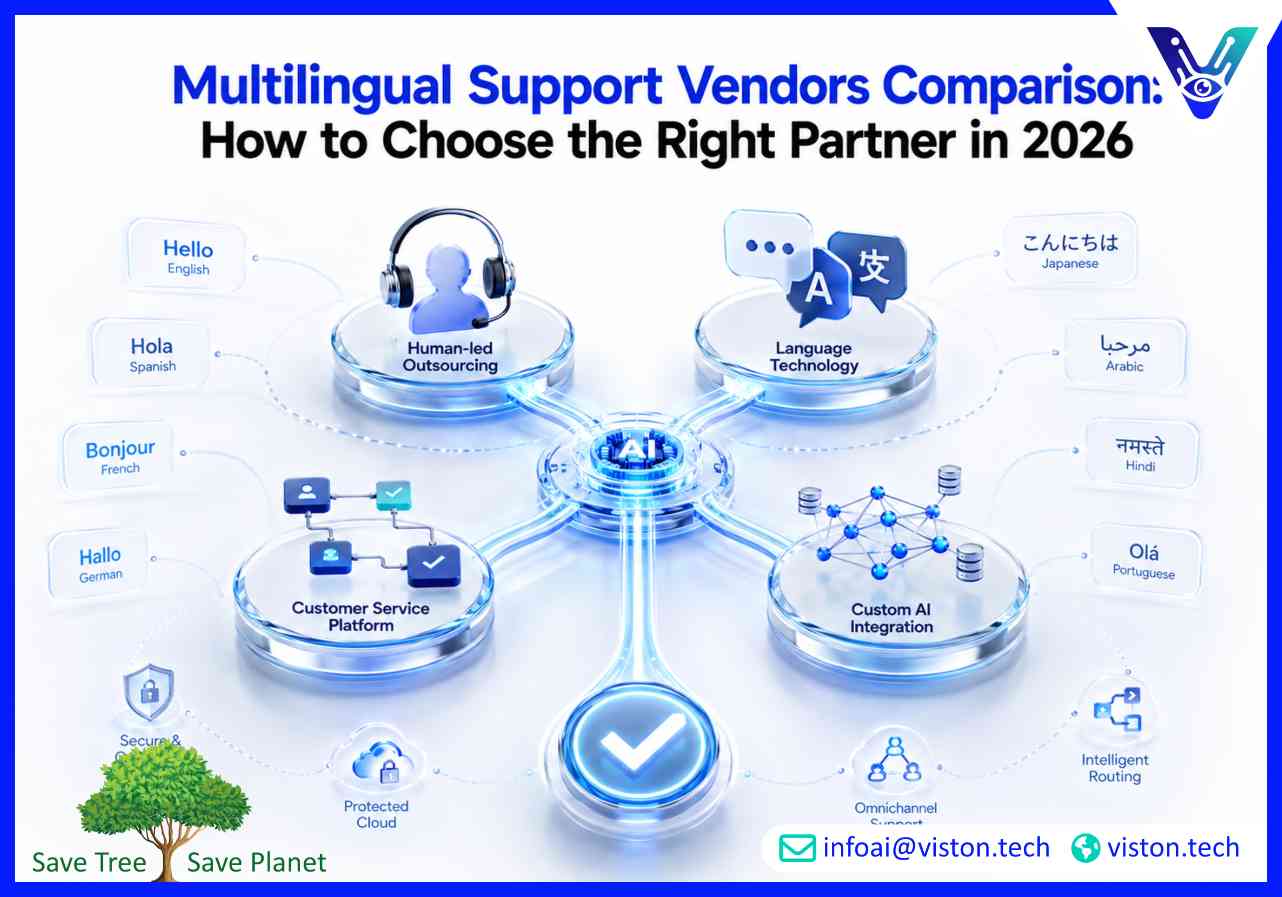
Multilingual support vendors help organizations serve customers, employees, or partners in more than one language. However, their delivery models differ. Some provide human contact centre teams, some supply translation technology, some offer customer service platforms, and others build AI-powered support systems connected to business workflows.A provider that is strong at staffed phone support may not suit a company needing automated web chat, WhatsApp, email, and CRM updates. A translation tool may convert text accurately but still lack intent detection, customer context, escalation logic, or reporting. Buyers should first decide which service model matches their operating requirements.
Human-led outsourcing providers
Traditional multilingual outsourcing providers recruit and manage agents who handle calls, emails, chat, and back-office work in selected languages. This model is useful for sensitive or complex conversations where empathy and judgment matter. Buyers should examine agent availability, dialect coverage, training, turnover, quality assurance, time-zone coverage, and data access controls.
Translation and language technology vendors
Language technology vendors focus on machine translation, localization, speech recognition, terminology management, and multilingual content workflows. They work well when a business already has a support platform and mainly needs language conversion. Buyers still need to confirm how translated messages enter the helpdesk, how intent is understood, and how uncertain outputs are escalated.
Customer service software platforms
Helpdesk and contact-centre platforms increasingly include language detection, translated replies, multilingual knowledge retrieval, call transcription, and automation. This model can simplify reporting and administration, particularly for existing platform users. However, feature depth and language performance may vary by channel, plan, or market.
Custom AI and integration specialists
AI specialists build multilingual chatbots, voice assistants, agent-assist tools, and workflows around a company’s own knowledge and systems. This model suits businesses with specific language, compliance, integration, or process requirements. Greater control is possible, but delivery quality depends on data preparation, testing, security design, monitoring, and ongoing optimization.
Multilingual Support Vendors Comparison Criteria for 2026
The strongest multilingual support vendors comparison uses measurable business criteria. A long language list is not enough. Buyers need evidence that a provider can understand real customer requests, maintain quality across languages, and complete the operational task behind each conversation.
Language accuracy, dialects, and cultural context
Ask vendors to demonstrate performance in the exact languages, dialects, and markets you serve. Testing should include informal phrasing, misspellings, code-switching, industry terminology, product names, and culturally specific expressions. High-resource languages often perform better than regional or lower-resource languages.Use native-language reviewers and real support examples rather than only machine-translated scripts. A system can appear accurate on clean content but fail on short, emotional, ambiguous, or noisy customer messages.
Channel and workflow coverage
Compare web chat, mobile apps, email, messaging platforms, social channels, SMS, and voice. Confirm whether the same knowledge, customer history, routing rules, and terminology work across channels. Customers should not receive conflicting answers when they move between a chatbot, email, and a human agent.Also test whether the vendor can complete actions such as creating tickets, checking orders, scheduling appointments, updating CRM records, processing returns, or routing cases to specialists.
Human handover and quality control
No multilingual support system should automate every interaction. Buyers need escalation rules for complaints, regulated advice, payment disputes, safety concerns, unusual requests, and low-confidence responses. A handover should include the conversation history, language, customer context, attempted resolution, and a concise agent summary.Quality assurance should be language-specific. Track resolution accuracy, customer satisfaction, fallback rate, escalation rate, first-contact resolution, and repeat-contact rate by language. Aggregate dashboards can hide weak performance in smaller markets.
Security, privacy, and governance
Vendors should explain data residency, encryption, access control, retention, audit logging, subprocessors, and model-training policies. Governance should also cover knowledge ownership, response approval, regional policy updates, incident handling, and version control.
Integration and scalability
The provider should connect with CRM, helpdesk, knowledge base, commerce, identity, telephony, analytics, and workflow systems without fragile manual work. Ask about APIs, connectors, authentication, rate limits, error handling, monitoring, and maintenance ownership.Scalability means adding languages, regions, brands, and use cases without rebuilding the service. A credible vendor should explain how it manages language-specific knowledge, testing, releases, and performance monitoring as coverage expands.
How Vendor Models Compare on Cost, Control, and Risk
Multilingual support pricing cannot be compared through one headline rate. Vendors may charge per agent, hour, conversation, resolved case, translation volume, software seat, API request, implementation project, or subscription. The best model depends on demand, channel mix, automation goals, and conversation complexity.
Human outsourcing
Human-led support offers depth for nuanced interactions but usually carries higher variable costs. Compare productive hours, minimum staffing, recruitment, language premiums, supervision, training, and management overhead rather than only hourly rates.
Software platforms
Platform-based support can be faster to launch and easier to manage. Pricing may be predictable, especially for existing users. The trade-off is that language quality, workflows, and integrations remain limited by the platform’s configuration options and product roadmap.
AI automation
AI can handle repetitive, high-volume requests continuously across languages, reducing response times and scaling without equivalent headcount growth. Buyers must still budget for discovery, knowledge preparation, integration, evaluation, monitoring, and improvement. Poor governance creates hidden costs through incorrect answers, failed workflows, complaints, and agent rework.
Hybrid delivery
Many organizations benefit from a hybrid approach. AI handles routine requests, retrieves approved knowledge, translates messages, and collects context. Human specialists manage complex, emotional, regulated, or high-value interactions. This balances efficiency with judgment.Total cost of ownership should include implementation, licensing, staffing, translation review, integrations, knowledge maintenance, quality assurance, model usage, reporting, security, and change management. A cheaper vendor may cost more if resolution rates are low or manual correction is extensive.
How to Shortlist and Test a Multilingual Support Vendor
A structured selection process reduces the risk of buying an impressive demonstration that fails in production. Start with a clear brief covering languages, markets, channels, volumes, service hours, customer journeys, systems, compliance obligations, service levels, and desired outcomes.
Define outcomes before features
Decide whether the priority is faster response, 24/7 availability, lower ticket volume, improved conversion, better customer satisfaction, market expansion, or agent productivity. These goals determine which vendor model and metrics matter most.
Create a language-specific proof of concept
Test at least one high-volume language, one strategically important language, and one difficult or lower-resource language. Use real, anonymized inquiries covering common intents and edge cases, including slang, incomplete sentences, mixed-language messages, complaints, and requests requiring backend data.Score vendors on intent understanding, factual accuracy, tone, task completion, latency, escalation, translation quality, and system updates. Native speakers and operational teams should participate.
Review delivery capability and ownership
Ask who will design flows, prepare training data, connect systems, perform linguistic validation, monitor performance, and resolve incidents. Clarify which responsibilities remain internal. Strong providers offer a defined path from discovery through testing, deployment, training, and optimization.
Use a weighted decision framework
Weight the factors that matter most: language quality, operational fit, security, integration depth, scalability, reporting, implementation support, and total cost. Avoid allowing a broad language count or low initial price to outweigh service quality and risk.
Validate the exact languages and channels required.
Measure successful resolution, not only response accuracy.
Inspect handover quality and exception management.
Confirm data controls and regional requirements.
Test integrations under realistic workloads.
Agree on language-level KPIs and ownership.
Where Viston AI Fits in a Multilingual Support Vendors Comparison
Viston AI is most relevant for organizations comparing custom, AI-led multilingual support providers rather than conventional staffed contact centres. Its multilingual AI chatbot support offering combines natural language processing, generative AI, real-time translation, intent recognition, intelligent routing, omnichannel delivery, analytics, and integration with business systems.This approach suits companies that need multilingual conversations to trigger practical actions across web chat, mobile applications, WhatsApp, SMS, voice, CRM, knowledge bases, and operational platforms. Centralized knowledge management can help maintain consistent policies and brand voice while allowing language-specific adaptation.Viston AI also presents a delivery model covering discovery, data preparation, model selection, testing, integration, deployment, change management, monitoring, and continuous improvement. That is important because multilingual support quality depends on ongoing governance rather than a one-time translation setup.For global businesses in retail, financial services, healthcare, SaaS, manufacturing, travel, logistics, insurance, and other service-intensive sectors, Viston AI may be relevant when requirements include automation, multilingual knowledge retrieval, workflow completion, human escalation, and language-level analytics. Buyers should validate their required languages, integrations, security controls, and service levels through a proof of concept using their own use cases.
Frequently Asked Questions
What should I compare when evaluating multilingual support vendors?
Compare language accuracy, dialect coverage, channels, workflow completion, human escalation, integrations, security, analytics, scalability, implementation support, and total cost of ownership. Test performance separately for every priority language.
Is multilingual support software better than outsourced agents?
Neither model is universally better. Software and AI are efficient for repetitive, high-volume requests, while human agents are stronger for complex, sensitive, or judgment-based interactions. Many businesses use a hybrid model.
How many languages should a vendor support?
The relevant number is the languages your customers use. Strong performance in ten priority languages is more valuable than weak coverage across one hundred. Evaluate dialects, terminology, and real-world accuracy, not only the published language count.
How should businesses test multilingual AI support?
Use anonymized customer conversations reviewed by native speakers. Test common requests, edge cases, mixed-language input, workflow actions, escalation, and backend integrations. Measure resolution, accuracy, tone, latency, and customer effort.
What is the biggest vendor-selection risk?
The biggest risk is choosing based on feature claims without validating production performance. Language quality, security, integration reliability, escalation, and governance should be tested before wider rollout.
When is Viston AI relevant to a multilingual support project?
Viston AI is relevant when a business needs custom multilingual chatbots or conversational AI connected to knowledge bases, customer systems, workflows, analytics, and human escalation across digital or voice channels.
Conclusion
A meaningful multilingual support vendors comparison should focus on operational outcomes rather than language counts alone. Businesses need to assess accuracy, cultural context, channels, integrations, security, escalation, governance, and long-term cost. Human outsourcing, software platforms, language technology, and custom AI specialists each serve different needs, while hybrid delivery is often practical. For organizations seeking multilingual support that automates routine service and connects with business workflows, Viston AI offers a relevant AI-led approach. Define measurable goals, run a realistic multilingual proof of concept, and select the provider that performs consistently in the languages and situations that matter most.