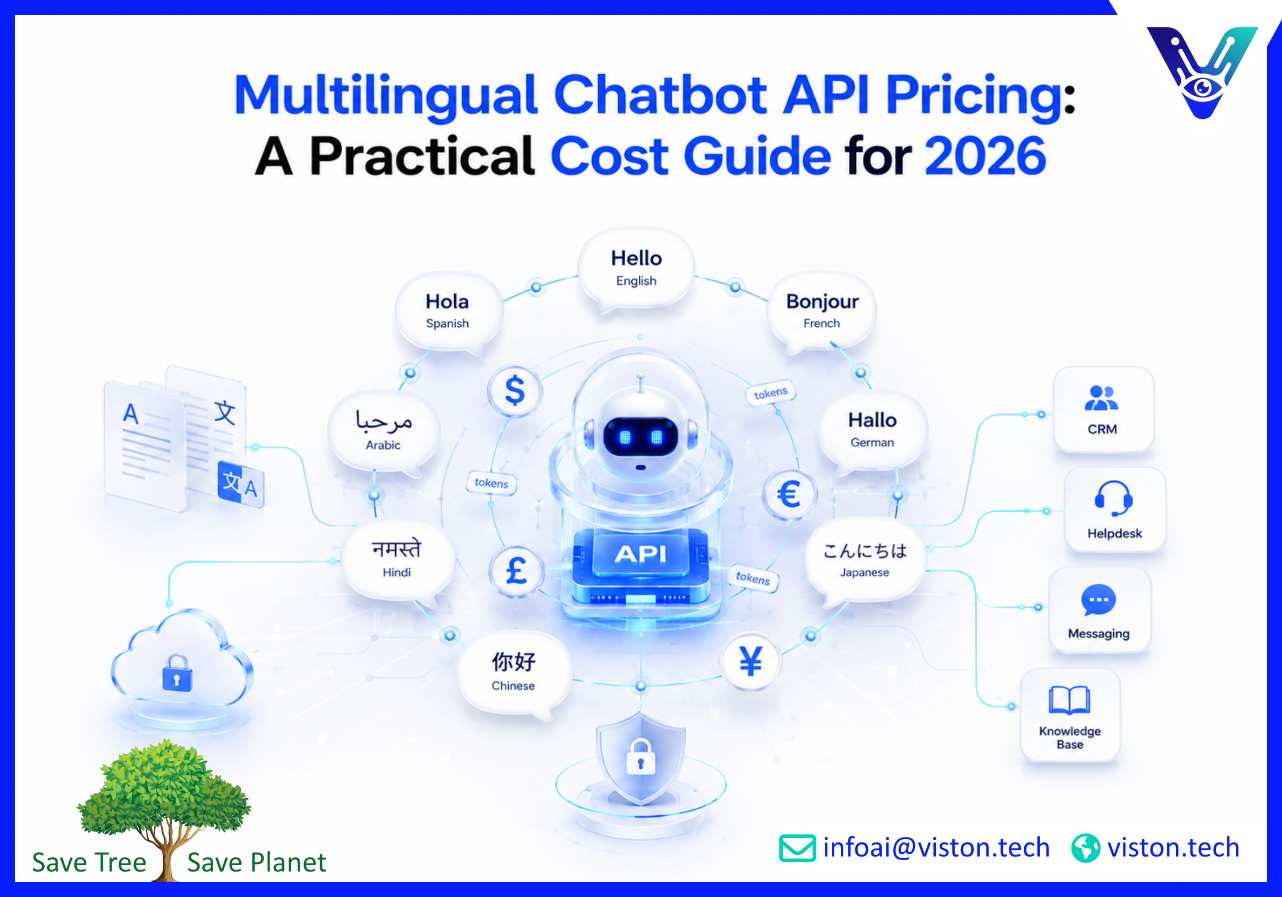
Multilingual Chatbot API Pricing: A Practical Cost Guide for 2026
Multilingual chatbot API pricing can look simple until translation, language models, messaging channels, integrations, and quality controls appear on the same invoice. For businesses planning global customer support, the real task is not finding the cheapest API rate. It is estimating the complete cost of delivering accurate, secure, and scalable conversations across languages.
What Multilingual Chatbot API Pricing Actually Includes
A multilingual chatbot normally relies on several connected services rather than one API. The chatbot must detect the user’s language, understand intent, retrieve approved information, generate or translate a response, take an action in a business system, and record the outcome. Each layer can have its own pricing method.
Translation API charges
Traditional machine translation APIs commonly charge by the number of characters processed. Spaces, punctuation, markup, and text that does not visibly change may still count toward billable usage. Current public cloud pricing shows standard translation rates commonly around $15 to $20 per million characters, although free allowances, volume commitments, custom models, and regional terms vary.This means buyers should measure actual source and response text rather than simply counting conversations. A short order-status exchange may use a few hundred characters, while a technical troubleshooting session can use several thousand. If the bot translates both incoming and outgoing messages, both directions contribute to usage.
Large language model usage
Many modern multilingual bots use a large language model to interpret intent, retrieve context, summarize information, and produce natural answers. These services are usually billed by input and output tokens. Input may include the customer message, system instructions, conversation history, retrieved knowledge, and tool results. Output covers the generated reply.Model choice can change cost substantially. Smaller models may be suitable for language detection, routing, classification, and straightforward support. Larger models may be justified for complex reasoning, nuanced writing, or difficult multilingual cases. Public API pricing in 2026 continues to separate input, cached input, and output rates, so prompt size and response length directly affect spend.
Platform and conversation charges
Some chatbot platforms charge per conversation, active user, automated resolution, agent seat, or monthly usage tier. Messaging channels may also apply their own fees. WhatsApp, SMS, voice, social messaging, and contact-center platforms can create separate charges that do not appear in the translation or model invoice.
Main Cost Drivers for Multilingual Chatbots in 2026
The number of supported languages matters, but it is rarely the only or largest pricing factor. Cost is shaped by usage patterns, conversation design, language complexity, integrations, quality requirements, and the level of operational responsibility assigned to the chatbot.
Conversation volume and average length
Monthly conversation count is the starting point. Buyers should also estimate messages per conversation, characters per message, average prompt size, response length, and the percentage of interactions requiring translation. A chatbot serving mostly short FAQs will have a different cost profile from one handling returns, claims, technical support, or onboarding workflows.
Language architecture
There are two common approaches. A translation-layer architecture converts the user’s message into a working language, runs the chatbot logic, and translates the answer back. A natively multilingual model processes the user’s language directly. Some systems combine both methods.Translation layers can offer predictable costs, while native multilingual models may produce more natural responses. Performance still varies by language, dialect, domain, and model, so architecture should be selected through testing rather than language-count claims alone.
Knowledge, integrations, and actions
A bot that only answers public FAQs is less expensive to implement than one connected to CRM, ecommerce, billing, ticketing, identity, logistics, or appointment systems. Each integration requires authentication, permissions, error handling, monitoring, and testing across languages.Action-based workflows require stronger validation, audit logs, role controls, and human escalation. These controls add cost but reduce operational risk.
Localization and language quality assurance
Multilingual support is not simply word-for-word translation. Product names, policy terms, dates, currencies, honorifics, writing systems, tone, and cultural expectations need to be handled correctly. High-risk industries may require approved terminology, legal review, or native-language subject matter experts.Quality assurance should cover intent recognition, factual accuracy, terminology, tone, fallback behavior, escalation, and task completion for each priority language. A smaller group of well-governed languages is often more useful than a long list with inconsistent performance.
Security, compliance, and deployment
Costs can rise when data must stay in a particular region, pass through private infrastructure, use customer-managed encryption, support single sign-on, or meet strict retention requirements. Private cloud, on-premises, or hybrid deployments usually require more engineering and operational support than a standard public cloud setup.Buyers should ask how prompts and conversations are stored, retained, accessed, and masked. These requirements affect architecture and total cost even when the API rate is low.
How to Estimate Monthly Multilingual Chatbot API Costs
A useful estimate starts with measurable usage assumptions. Avoid asking for a single “price per language” because most APIs do not work that way. Instead, build a cost model from conversation traffic and the services used during each interaction.
Step 1: Estimate translated character volume
Use this planning formula:Monthly translated characters = conversations × messages per conversation × average characters per message × translated shareSuppose a business expects 10,000 conversations per month, with 10 messages per conversation and an average of 150 characters per message. If 70% of messages require translation, the estimated volume is 10.5 million translated characters. At an illustrative standard rate of $15 to $20 per million characters, the translation layer would cost roughly $158 to $210 per month before free allowances, custom translation, or volume discounts.
Step 2: Estimate model tokens
Model cost should include more than visible chat text. Count system instructions, retrieved knowledge, conversation history, tool responses, and generated output. Long prompts can make input tokens much larger than the customer’s message.Teams can control model cost by routing simple tasks to smaller models, caching stable instructions, limiting unnecessary history, retrieving only relevant knowledge, and capping response length.
Step 3: Add channel and platform fees
Include chatbot platform subscriptions, messaging fees, voice minutes, SMS, agent seats, automated-resolution fees, and contact-center charges. These are often billed separately. A web-only bot may have a simpler cost structure than a deployment spanning web, WhatsApp, mobile apps, email, and voice.
Step 4: Add implementation and ongoing operations
API usage is only one part of total cost of ownership. Initial work may include discovery, architecture, conversation design, language prioritization, knowledge preparation, integrations, testing, security review, deployment, and analytics setup.Ongoing costs may include monitoring, workflow updates, knowledge maintenance, language reviews, incident response, model evaluation, human escalation, and optimization. These services are often priced through a retainer, support plan, or dedicated team.
Step 5: Calculate cost per successful outcome
The most useful metric is not cost per API call. It is cost per resolved conversation, qualified lead, completed booking, deflected ticket, or successful workflow. A cheaper API that produces more fallbacks, escalations, or inaccurate answers may create a higher overall service cost.Track resolution, satisfaction, fallback, escalation, latency, task completion, and language-specific accuracy. Pricing decisions should be connected to these outcomes.
How to Compare Multilingual Chatbot Pricing Without Hidden Surprises
Procurement teams should request a cost model that separates variable usage from fixed delivery costs. This makes it easier to compare proposals, forecast growth, and understand which changes will increase the monthly bill.
Ask what counts as billable usage
Confirm whether billing includes source text, output text, spaces, HTML, detected-language requests, cached context, retries, failed calls, documents, audio, and testing traffic. Translation services may count whitespace and markup as processed characters, so raw application payloads can be larger than the visible customer text.
Separate standard and custom language services
Custom terminology, domain adaptation, glossary management, model training, and hosted custom models can have separate charges. These features may be valuable when the bot must handle regulated terminology, product-specific language, or highly specialized support. They should not be added automatically to every project.
Review language-level performance
A platform may advertise broad language support while delivering uneven quality across low-resource languages, dialects, code-switching, or industry terminology. Ask for evaluation results by priority language and use case. Test real customer questions, not only prepared demos.
Check scaling, quotas, and service levels
Free tiers may have time limits, monthly caps, or lower throughput. Production planning should cover rate limits, peak capacity, uptime, data residency, support response, and overage pricing.
Require cost visibility
The operating dashboard should show spend by language, channel, model, intent, and outcome. Alerts should identify unusual spikes, retry loops, and excessive prompt growth before they become overruns.
How Viston AI Approaches Multilingual Chatbot Cost and Delivery
Viston AI provides multilingual AI chatbot support that combines natural language processing, generative AI, translation and localization, omnichannel deployment, routing, and performance analytics. Its published service scope includes web chat, mobile apps, WhatsApp, SMS, voice assistants, and social platforms, alongside centralized knowledge and conversation controls.This service alignment is relevant to pricing because API spend should be designed around the full operating workflow. A business may need language detection, multilingual responses, CRM or helpdesk integration, escalation to the correct team, analytics by language, and controls for data handling. Treating these as one delivery architecture makes it easier to forecast total cost and identify where automation creates value.Viston AI also describes flexible cloud, private cloud, on-premises, and hybrid deployment options, together with monitoring and ongoing optimization. For organizations comparing multilingual chatbot API pricing, this can support a more practical evaluation than choosing a provider by character or token rate alone. The appropriate solution should be based on priority languages, conversation volume, integration complexity, security requirements, channels, and measurable service outcomes. A phased launch can keep initial scope controlled while generating real usage data for future budgeting.
Frequently Asked Questions
How much does a multilingual chatbot API cost?
There is no universal price. Standard translation APIs commonly charge per million characters, while generative models charge for input and output tokens. Platform fees, channels, integrations, hosting, testing, support, and localization quality assurance must also be included.
Is multilingual chatbot pricing charged per language?
Usually not. Most usage-based APIs charge for characters, tokens, messages, conversations, or minutes. Adding more languages may increase implementation, testing, glossary, and maintenance costs even when the raw API rate stays the same.
What is the cheapest architecture for a multilingual chatbot?
For straightforward support, a focused bot using standard translation, a smaller language model, concise prompts, and a limited number of channels can be cost-effective. The cheapest production architecture is the one that meets accuracy, security, and resolution requirements without unnecessary complexity.
Why can the final bill exceed the translation API estimate?
Translation is only one component. Large language model tokens, messaging fees, chatbot platform charges, CRM calls, vector search, monitoring, retries, human escalation, and managed support may contribute more than the translation layer.
How should businesses compare multilingual chatbot vendors?
Compare total cost of ownership, priority-language accuracy, integrations, channel coverage, security, deployment options, analytics, service levels, and cost per successful outcome. Do not compare only the advertised API unit price.
Can Viston AI provide a custom multilingual chatbot pricing estimate?
Viston AI’s multilingual support service is structured around business requirements such as languages, channels, integrations, deployment, governance, and ongoing optimization. A meaningful estimate would therefore need usage volumes and delivery requirements rather than only a language count.
Conclusion
Multilingual chatbot API pricing in 2026 depends on far more than a translation rate. Businesses need to account for characters, model tokens, channels, integrations, localization quality, security, deployment, monitoring, and human escalation. The strongest budget model connects these costs to successful resolutions and business outcomes. Start with priority languages and high-value use cases, measure real usage, and expand only after quality and economics are proven. Viston AI is relevant for organizations seeking multilingual support designed as an integrated operational capability rather than a standalone translation feature.