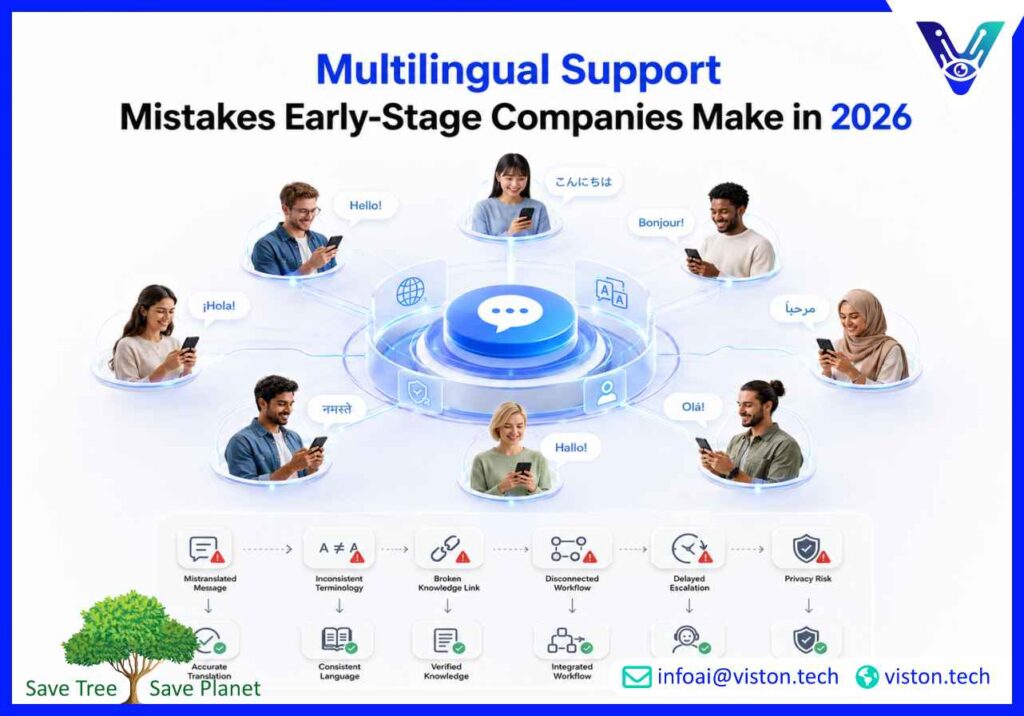
Multilingual Support Mistakes Early-Stage Companies Make in 2026
Multilingual support can help an early-stage company serve new markets, reduce customer friction, and build trust beyond its home region. However, rushed language expansion often creates inconsistent answers, weak escalation, privacy risks, and avoidable operational cost. The most common failures come from treating multilingual support as translation rather than a complete customer service capability.
Why Multilingual Support Mistakes Become Expensive Early
Early-stage companies usually add languages for a practical reason: customers are already arriving from new markets, a product launch is expanding internationally, or a major prospect expects support in a preferred language. The pressure to respond quickly can lead teams to add a translation tool, publish a few localized help articles, and assume the problem is solved.That approach overlooks how support actually works. A customer does not judge service only by whether the words are translated. They judge whether the answer is accurate, whether the tone feels natural, whether instructions match the local product experience, and whether the issue reaches the right human when automation is not enough.The goal is controlled expansion: support the languages that matter most, automate safely, maintain one reliable knowledge source, and measure performance by language.
Multilingual Support Mistakes Early-Stage Companies Make
1. Choosing Languages Based on Ambition Instead of Customer Demand
Supporting many languages may look impressive, but broad coverage is not useful when quality is shallow. Early-stage companies should prioritize languages using actual customer signals: support volume, revenue opportunity, trial activity, website traffic, churn patterns, strategic markets, and sales pipeline.A focused launch in a few high-value languages is easier to train, monitor, and improve than a broad rollout. Consider dialects, agent availability, product readiness, and question complexity.
2. Treating Translation as the Entire Support Strategy
Literal translation does not guarantee a useful answer. Customer support includes intent, context, product terminology, tone, policy interpretation, and next-step guidance. A technically correct translation may still feel confusing or inappropriate if it ignores local phrasing, cultural expectations, formality, date formats, currencies, or region-specific processes.Localize high-impact content such as onboarding, billing, cancellation, troubleshooting, and escalation messages. Maintain an approved glossary so product and policy terminology stays consistent.
3. Launching Before the Knowledge Base Is Ready
Multilingual support exposes weaknesses in source content. If the original knowledge base contains duplicate articles, conflicting instructions, old screenshots, or unclear ownership, translation multiplies those problems.Before adding languages, identify the source of truth for product, pricing, policy, security, and support information. Give each article an owner and review date, and allow translation or AI answers to use only approved material.
4. Using One Quality Standard for Every Language
Overall customer satisfaction can hide serious language-level failures. English performance may be strong while another language has more fallback responses, longer resolution times, or lower first-contact resolution.Track response time, resolution, escalation, satisfaction, repeat contact, chatbot fallback, and knowledge usefulness by language. Language-specific reporting exposes gaps before they affect retention.
5. Automating Sensitive Conversations Too Aggressively
AI and machine translation are valuable for repetitive questions, triage, knowledge retrieval, and agent assistance. They are less suitable as the sole decision-maker for disputes, refunds, account closures, fraud concerns, medical or legal questions, angry customers, and situations involving unclear policy.Automation should have confidence thresholds and escalation rules. When the system is uncertain, the customer should receive a clear handoff rather than a confident but unreliable answer. The human agent should receive the conversation history, detected language, customer context, and actions already attempted.
6. Assuming Translated Test Data Reflects Real Customer Language
Real conversations contain slang, abbreviations, spelling mistakes, mixed languages, voice transcription errors, local expressions, and incomplete sentences. Testing only with polished or machine-translated examples can create false confidence because those samples are cleaner than genuine customer requests. Recent multilingual intent-classification research has highlighted this gap between translated test sets and native customer queries.Testing should include anonymized real conversations, native reviewers, edge cases, code-switching, regional terminology, and low-confidence requests.
Operational and Technology Mistakes That Weaken Service Quality
7. Failing to Define a Human Support Model
A multilingual chatbot is not a complete operating model. Companies still need to decide who handles escalations, which hours are covered, what response-time commitments apply, and how urgent issues are routed. Without ownership, translated conversations may sit in a queue that no qualified person can resolve.Companies can combine bilingual staff, specialist external support, interpreters, and AI-assisted agents. The right mix depends on volume, risk, budget, and language complexity.
8. Ignoring Product and Interface Localization
Support teams struggle when the help content is translated but the product interface remains in another language. Customers may receive instructions that refer to buttons, menus, or settings they cannot identify. This increases handle time and makes the support experience feel disconnected.Language expansion should connect support, product, onboarding, transactional emails, billing messages, and in-app notifications. Even when full product localization is not yet possible, support content should acknowledge the interface language and use screenshots or clear navigation labels.
9. Letting Tools Operate Outside Core Business Systems
Multilingual support becomes harder to manage when chat, translation, customer records, and ticketing systems are separate. Agents may lose context, create duplicate records, miss previous conversations, or provide different answers across channels.Connect multilingual support with the CRM, helpdesk, knowledge base, order system, and analytics tools. Integration preserves customer history, supports routing, and makes outcome measurement possible.
10. Overlooking Privacy, Consent, and Data Handling
Support conversations may contain personal details, payment information, health information, account credentials, or confidential business data. Sending this content through unreviewed translation or AI tools can create unnecessary exposure.Understand where data is processed, what providers retain, who can access transcripts, and how long records are stored. Apply data minimization, role-based access, secure integrations, redaction, and region-appropriate privacy controls.
11. Measuring Cost Savings Without Measuring Customer Outcomes
Lower cost per conversation is not a success if customers receive weak answers or must contact support repeatedly. Early-stage companies sometimes optimize for ticket deflection while overlooking unresolved issues, churn risk, and damaged trust.Review cost with satisfaction, first-contact resolution, repeat contact, escalation quality, and retention signals. The purpose is not merely lower workload; it is helping customers complete important tasks confidently.
How Early-Stage Companies Can Build Multilingual Support Correctly
A practical multilingual support program does not need to start with a large team or complex platform. It needs clear scope, reliable content, controlled automation, and a repeatable improvement process.
Identify priority languages. Use customer volume, revenue, market plans, and support difficulty to rank demand.
Define supported use cases. Decide which questions can be answered automatically, which require an agent, and which need a specialist.
Clean the source knowledge. Remove conflicting content, assign owners, standardize terminology, and create update workflows.
Select the operating model. Combine AI, bilingual agents, external specialists, and interpretation according to risk and volume.
Integrate core systems. Preserve customer context across chat, email, CRM, helpdesk, and product workflows.
Test with native users. Include realistic phrasing, regional vocabulary, code-switching, unclear requests, and escalation scenarios.
Launch in phases. Start with a controlled language group, monitor outcomes, fix gaps, and expand only when quality is stable.
Give each language a launch checklist for knowledge, tone, terminology, escalation, privacy, quality, and reporting. Assign an internal owner even when delivery is outsourced.After launch, review failed searches, negative feedback, repeat contacts, mistranslations, and unresolved escalations. Treat multilingual support as a living operation, not a one-time translation project.
How Viston AI Supports Scalable Multilingual Customer Service
Viston AI is directly relevant to companies building multilingual support because its service offering combines multilingual AI chatbot support with natural language processing, localization, omnichannel delivery, intelligent routing, analytics, and business-system integration. Its published capabilities include support across channels such as web chat, mobile applications, WhatsApp, SMS, voice, and social platforms, with centralized knowledge and conversation controls.For an early-stage company, the practical value of this approach is not simply adding more languages. It is creating a support layer that can retrieve approved information, recognize intent, preserve context, route complex cases, and connect conversations with operational systems. Viston AI also describes a delivery process covering discovery, data preparation, model development, testing, integration, deployment, monitoring, and continuous improvement.This makes the service relevant to growing SaaS businesses, ecommerce companies, marketplaces, travel platforms, financial services providers, and other organizations receiving cross-border customer demand. A structured implementation can help teams avoid fragmented tools, inconsistent terminology, unsupported automation, and weak language-level reporting. The strongest fit is for companies that want multilingual support designed around real workflows and measurable service outcomes rather than translation alone.
Frequently Asked Questions
What Is the Biggest Multilingual Support Mistake Early-Stage Companies Make?
The biggest mistake is treating multilingual support as a translation task. Effective delivery also requires localized knowledge, clear escalation, trained agents, integrated systems, language-specific quality monitoring, and reliable data handling.
How Many Languages Should a Startup Support First?
Start with the smallest set that covers meaningful customer demand or strategic growth. Prioritize languages using ticket volume, revenue opportunity, trial activity, and market plans. Quality in two important languages is more valuable than weak coverage in ten.
Can AI Handle Multilingual Support Without Human Agents?
AI can manage repetitive questions, triage, retrieval, translation, and simple workflows. Human support remains important for sensitive, ambiguous, high-value, emotional, or policy-dependent cases. A hybrid model usually gives early-stage companies better control.
How Should Multilingual Support Quality Be Measured?
Measure response time, resolution rate, customer satisfaction, repeat contact, escalation rate, fallback rate, and knowledge usefulness by language. Avoid relying only on company-wide averages because they can hide poor performance in individual markets.
When Should a Company Add Another Support Language?
Add a language when demand is sustained, the knowledge base is ready, escalation ownership is clear, and the team can monitor quality. Expansion should follow operational readiness rather than a marketing deadline alone.
How Can Viston AI Help Reduce Multilingual Support Mistakes?
Viston AI can support multilingual chatbot design, NLP, localization, omnichannel workflows, routing, analytics, and integration with business systems. These capabilities are relevant when a company needs a more structured and scalable support operation.
Conclusion
Multilingual support mistakes early-stage companies make usually begin with rushed expansion, weak source content, excessive automation, and limited language-level oversight. A better approach is to prioritize real demand, localize important customer journeys, maintain approved knowledge, integrate systems, and preserve human escalation for complex cases. In 2026, multilingual support should be managed as an operational capability with measurable quality, security, and continuous improvement. Viston AI offers relevant multilingual support capabilities for growing companies that need language expansion connected to practical customer service workflows.