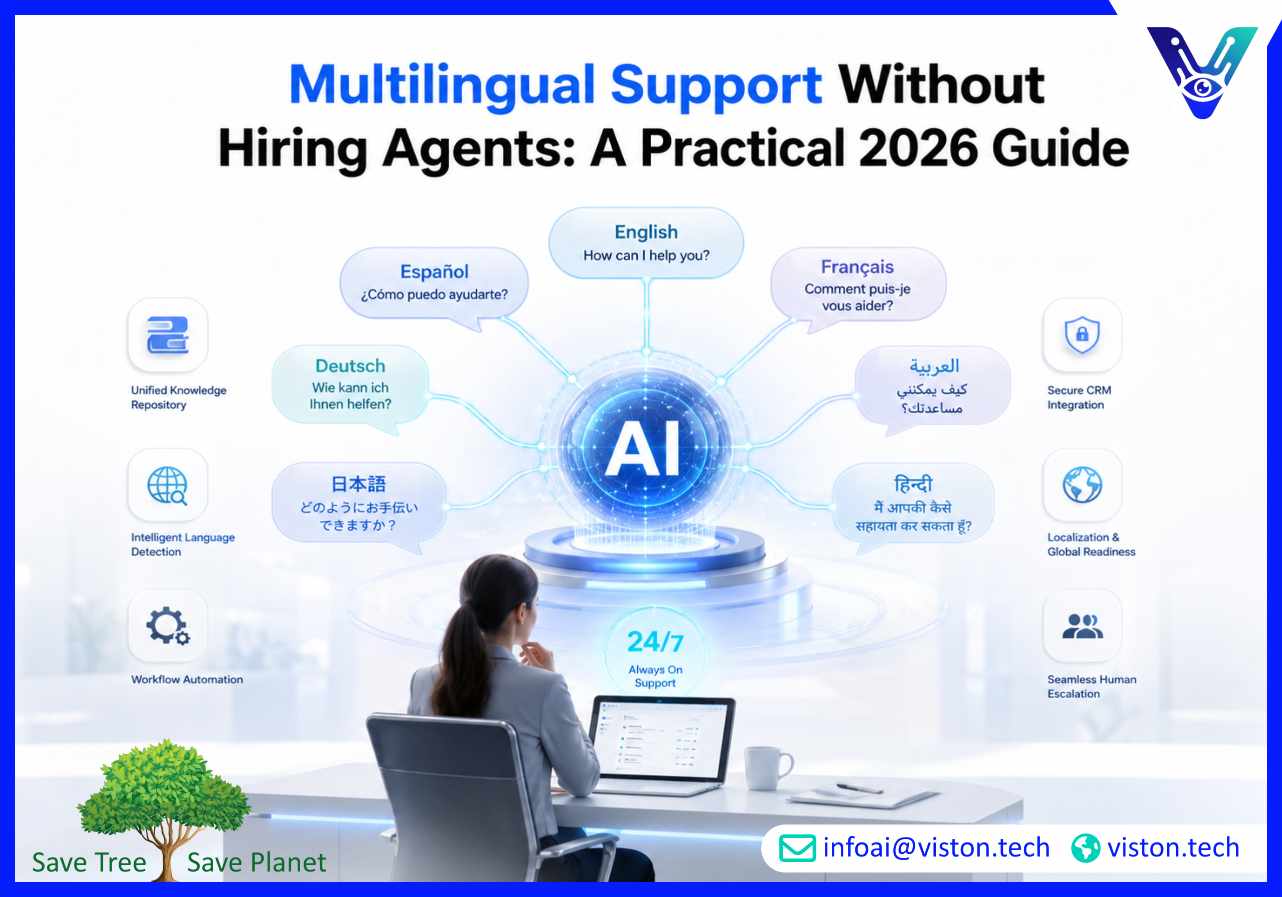
Multilingual Support Without Hiring Agents: A Practical 2026 Guide
Multilingual support without hiring agents allows businesses to serve customers in more languages without building a separate support team for every market. In 2026, the practical approach combines multilingual AI, centralized knowledge, automated workflows, quality controls, and clear escalation paths for conversations that still require human judgment.
What Multilingual Support Without Hiring Agents Really Means
Providing multilingual support without hiring additional agents does not mean removing people from customer service. It means avoiding a direct relationship between every new language and additional support headcount.Under a traditional model, entering a new market may require recruiting native-speaking agents, creating regional shifts, translating training materials, maintaining separate response libraries, and managing language-specific queues. That model can work for large service operations, but it is often expensive and slow for startups, SaaS companies, ecommerce businesses, digital platforms, and growing enterprises.AI-enabled multilingual support changes the operating model. A business can use one approved knowledge base and a shared set of support workflows to answer routine questions in multiple languages. The system can detect the customer’s language, understand the request, retrieve relevant information, generate an appropriate response, and escalate the conversation when automation is not suitable.
What can be handled without language-specific agents?
Common support requests that are structured, repetitive, and supported by reliable business data are usually the best candidates for multilingual automation. These may include:
Account access and password guidance
Order, shipment, and delivery status
Product information and availability
Subscription and billing explanations
Appointment booking and rescheduling
Return, refund, and cancellation policies
Technical troubleshooting steps
Onboarding and knowledge-base questions
Lead capture and initial qualification
The goal is not to automate every possible conversation. The goal is to resolve predictable requests consistently while directing sensitive, unusual, or high-risk cases to the appropriate human team.
Where the cost advantage comes from
A multilingual support system reduces the need to duplicate routine support capacity across languages. Instead of maintaining separate teams for English, Spanish, French, German, Arabic, or other languages, a company can automate a significant share of first-line assistance from a common operational foundation.This can reduce recruitment pressure, shorten the time needed to enter new markets, extend service availability outside normal business hours, and help existing agents focus on cases that require negotiation, empathy, investigation, or commercial authority.
How AI Delivers Multilingual Support Without Hiring Agents
Reliable multilingual support requires more than translating an English chatbot response. Translation alone may preserve the words while losing the intended meaning, tone, product terminology, or local context.A stronger system combines language detection, natural language processing, generative AI, knowledge retrieval, workflow automation, business-system integration, and conversation monitoring.
Automatic language detection
The system should identify the language from the customer’s first message without forcing the user through a long language-selection menu. It should also manage situations where customers switch languages, use regional expressions, write with spelling errors, or combine product terminology with local language.
Centralized knowledge retrieval
The AI should retrieve answers from approved sources such as help-center content, policy documents, product documentation, CRM records, order systems, internal procedures, and service databases.A centralized knowledge model is easier to maintain than multiple disconnected language libraries. When a return policy, pricing rule, onboarding step, or product feature changes, the source information can be updated once and made available across supported languages.However, the source content must be accurate and well structured. Multilingual AI cannot compensate for outdated, contradictory, or incomplete business information.
Localized response generation
Good multilingual support adapts the response rather than performing a literal word-for-word translation. It should account for:
Regional vocabulary and spelling
Formality and preferred forms of address
Date, time, number, and currency formats
Product names and technical terminology
Local policies and market-specific restrictions
Brand tone and customer communication standards
This distinction matters because an answer may be linguistically correct but operationally wrong. For example, refund timelines, payment methods, shipping coverage, warranties, or cancellation rights may differ between markets.
Integration with support and business systems
Multilingual automation becomes more useful when the AI can do more than provide information. Integration with CRM, helpdesk, ecommerce, booking, billing, and order-management platforms allows the system to complete practical tasks.A customer may ask for an order update in Spanish, change an appointment in French, submit a technical issue in German, or request account information in Arabic. The support system should be able to retrieve the correct record, apply authorized workflow rules, document the interaction, and provide the result in the customer’s language.
Intelligent escalation
Some conversations should not be fully automated. The system needs clear escalation triggers based on issue type, confidence level, customer sentiment, repeated failure, account value, urgency, or compliance risk.When escalation occurs, the human agent should receive the translated conversation history, detected intent, customer details, actions already attempted, and relevant system records. This prevents customers from repeating the entire issue and allows a smaller central support team to handle cases from several language markets.
Where Automation Works and Where Human Review Still Matters
The most effective strategy is not maximum automation. It is appropriate automation. Businesses should decide which conversations can be resolved safely, which require approval, and which should always be handled by a person.
Strong use cases for automation
Automation works best when the request has a defined answer or repeatable workflow. Examples include checking delivery status, explaining a subscription tier, resetting a password, finding documentation, collecting lead details, or confirming appointment availability.These use cases can usually be tested against clear success criteria. The business can verify whether the answer was correct, the workflow completed successfully, and the customer reached the intended outcome.
Cases that need human involvement
Human review remains important for complex complaints, unusual refund disputes, legal requests, vulnerable customers, fraud concerns, safety issues, contract negotiations, emotionally sensitive conversations, and decisions requiring discretion.High-stakes sectors may also require stricter controls. Healthcare, financial services, insurance, employment, education, and public services can involve regulated information or decisions with serious consequences. In these environments, multilingual AI should support approved processes rather than make unsupported judgments.
Quality must be measured by language
A system that performs well in one language may underperform in another. Businesses should evaluate each important language separately instead of relying on an overall accuracy score.Useful quality measures include:
Intent recognition accuracy by language
Resolution and completion rates
Fallback and misunderstanding rates
Customer satisfaction by language and channel
Escalation frequency
Translation and terminology errors
Workflow completion accuracy
Human correction rates
Native speakers or qualified reviewers should test priority languages before launch. Testing should include informal language, abbreviations, mixed-language messages, regional expressions, negative sentiment, ambiguous requests, and attempts to obtain restricted information.
Transparency, privacy, and responsible deployment
Customers should understand when they are interacting with an automated system and how they can reach a person. This is becoming especially important for organizations serving European users. The European Commission states that EU AI Act transparency rules become applicable on 2 August 2026 and require users to be informed when they are interacting with an AI system.Businesses should also apply data minimization, access controls, secure integrations, retention rules, monitoring, and documented ownership. Guidance from NIST and the UK Information Commissioner’s Office emphasizes ongoing AI risk management, trustworthy system evaluation, lawful processing, security, and appropriate handling of personal data.
How to Implement Multilingual Support in 2026
A controlled rollout is usually more reliable than enabling every language and workflow at once. Businesses should start with the markets, channels, and request types that offer the clearest operational value.
1. Identify priority languages
Use real customer data rather than assumptions. Review ticket language, website traffic, sales inquiries, geographic demand, expansion plans, abandoned conversations, and requests currently handled through manual translation.Prioritize languages where demand is measurable and where slow or unavailable support is affecting revenue, retention, or customer experience.
2. Select suitable support intents
Start with high-volume, low-risk requests. Map the customer’s goal, required information, approved answer, connected system, possible failure points, and escalation rule for each intent.A focused launch with 20 well-designed workflows is generally more useful than a broad system that claims to answer hundreds of topics inconsistently.
3. Prepare the knowledge base
Remove duplicate articles, resolve conflicting policies, assign content owners, and separate global information from region-specific rules. Define approved terminology for product names, technical terms, legal wording, and brand expressions.Knowledge should be written clearly in the source language. Complex sentences, unexplained abbreviations, and inconsistent policy language make reliable multilingual generation harder.
4. Configure guardrails and escalation
Set confidence thresholds, restricted topics, identity-verification requirements, workflow permissions, and handover rules. The system should know when to answer, when to ask a clarifying question, when to refuse an action, and when to transfer the customer.
5. Test real conversations
Testing should cover more than perfect sample questions. Use genuine customer phrasing, spelling mistakes, dialects, mixed languages, vague requests, emotional language, and multi-step conversations.Review not only linguistic quality but also factual accuracy, workflow completion, data handling, response speed, tone, and escalation quality.
6. Measure business outcomes
Track whether multilingual support is reducing unresolved requests, shortening response times, improving self-service completion, increasing after-hours coverage, and helping the business enter markets without proportional staffing growth.Performance should be reviewed continuously. New questions, product changes, failed conversations, regional policy updates, and customer feedback should feed an ongoing optimization process.
How Viston AI Supports Multilingual Customer Service Automation
Viston AI is directly relevant to businesses exploring multilingual support without hiring agents because the company offers Multilingual AI Chatbot Support alongside AI chatbot development, NLP, language translation, workflow automation, and integration with business systems.Its multilingual service is designed around context-aware customer interactions across languages, channels, and time zones. Verified capabilities presented by Viston AI include language and intent processing, localized response generation, centralized knowledge management, omnichannel deployment, intelligent routing, escalation, and performance analytics. The service can support interactions through channels such as web chat, mobile applications, messaging platforms, SMS, and voice interfaces.This combination is useful for organizations that need more than a standalone translation tool. A practical multilingual support deployment must connect customer conversations with approved knowledge, operational workflows, CRM or helpdesk records, security controls, and human handover processes.Viston AI’s wider capabilities in AI chatbot integration and NLP can help businesses design this operating model around their existing systems. For growing companies and global service teams, the objective is to increase language coverage without creating a separate support department for every region. The result should be a controlled, measurable support capability that automates routine conversations while preserving human involvement for cases where judgment and accountability matter.
Frequently Asked Questions
Can a business really provide multilingual support without hiring agents?
Yes, for many routine and structured requests. Multilingual AI can answer common questions, retrieve account information, complete approved workflows, and provide 24/7 first-line support. Businesses should still maintain human escalation for complex, sensitive, or high-risk cases.
Is multilingual AI the same as machine translation?
No. Machine translation converts text from one language to another. Multilingual AI support also detects intent, retrieves business knowledge, maintains conversation context, follows workflows, applies permissions, and escalates cases when necessary.
Which support requests should be automated first?
Begin with high-volume, low-risk requests such as order tracking, account guidance, appointment booking, product FAQs, subscription information, basic troubleshooting, and lead capture. These use cases have clear answers and measurable outcomes.
How can multilingual support quality be tested?
Test each priority language independently using native speakers or qualified reviewers. Evaluate factual accuracy, natural wording, terminology, intent recognition, workflow completion, fallback handling, tone, and escalation quality.
Does multilingual AI eliminate the need for human customer service?
No. It reduces repetitive workload and the need to hire separate teams for every language. Human agents remain important for complaints, exceptions, negotiation, sensitive situations, regulated decisions, and conversations requiring empathy or judgment.
Can Viston AI connect multilingual support with existing business systems?
Viston AI offers multilingual chatbot support and AI chatbot integration capabilities designed to connect conversational experiences with knowledge sources, workflows, and business platforms. The required integration scope depends on the organization’s existing helpdesk, CRM, ecommerce, or operational systems.
Conclusion
Multilingual support without hiring agents is achievable when businesses combine AI language capabilities with accurate knowledge, reliable integrations, controlled workflows, and human escalation. The objective is not to remove customer service teams, but to expand language coverage without increasing headcount for every new market. In 2026, successful multilingual support requires language-level testing, responsible data practices, transparent automation, and continuous performance monitoring. Viston AI provides relevant multilingual support, NLP, chatbot, and integration capabilities for organizations building a scalable service model across languages and channels.