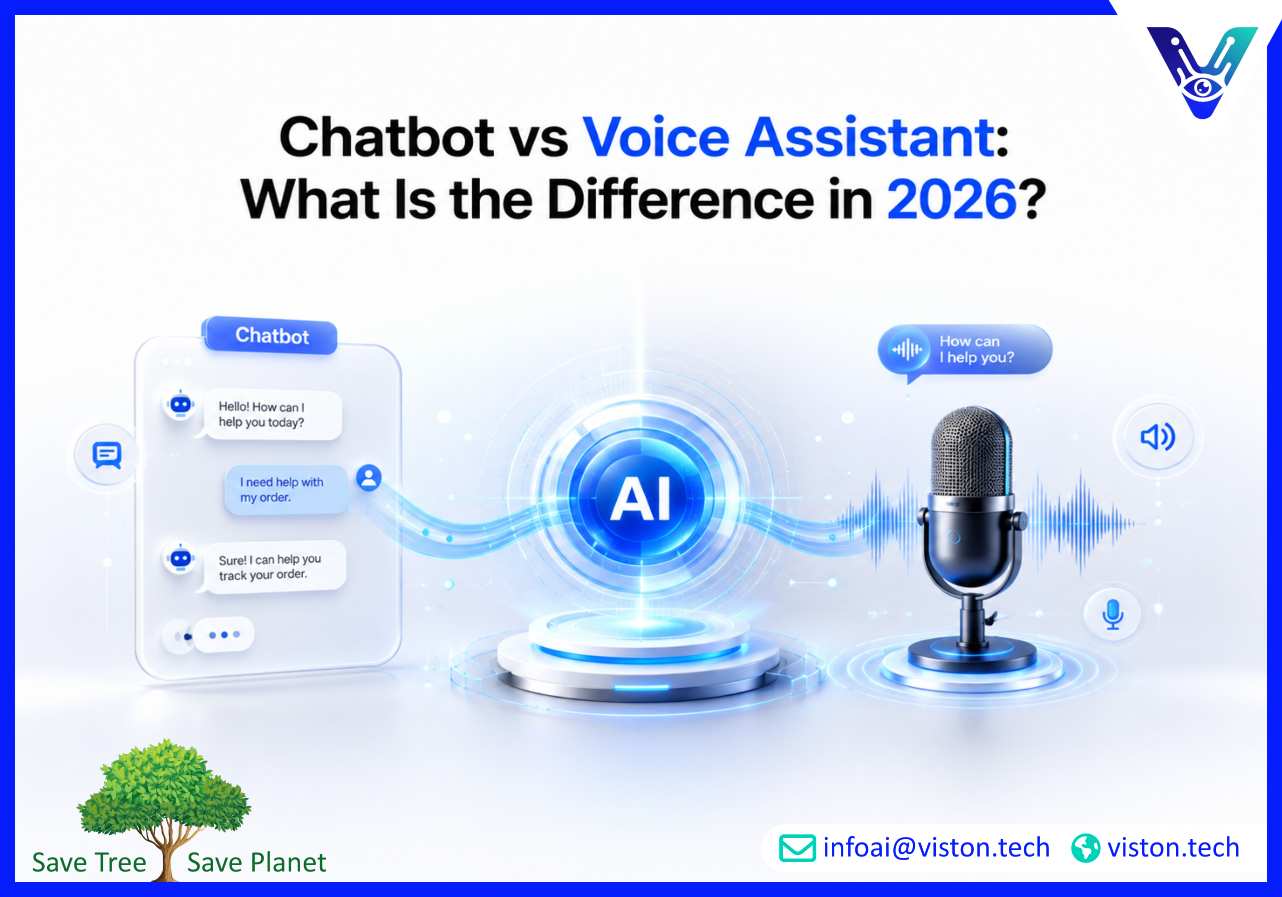
Chatbot vs Voice Assistant: What Is the Difference in 2026?
Understanding the difference between chatbot and voice assistant technology helps businesses choose the right conversational interface for customer service, sales, internal support, and workflow automation. Although both systems can use conversational AI, they differ in how users interact, how responses are delivered, and what technical infrastructure is required.
What Is the Difference Between a Chatbot and a Voice Assistant?
The main difference between a chatbot and a voice assistant is the communication channel. A chatbot primarily communicates through written text, while a voice assistant receives spoken input and usually responds through synthesized speech.A chatbot commonly appears on a website, mobile application, customer portal, social messaging platform, or internal business system. Users type questions, select menu options, upload information, or click suggested actions. The chatbot interprets the input and returns a written response, link, form, recommendation, or automated action.A voice assistant allows users to speak naturally through a telephone, mobile application, smart device, vehicle interface, kiosk, headset, or connected workplace system. It uses automatic speech recognition to convert speech into machine-readable input, processes the request, and uses text-to-speech or a native audio model to deliver a spoken response.
A chatbot is usually text-first
Text chatbots are well suited to interactions where users need to read detailed information, compare options, follow links, complete forms, or keep a written record. They can answer product questions, qualify leads, track orders, create support tickets, guide users through troubleshooting, and retrieve information from connected business systems.Some modern chatbots accept voice notes or generate audio, but their primary experience remains screen-based. This makes them practical for websites, messaging platforms, ecommerce stores, SaaS products, and employee portals.
A voice assistant is audio-first
A voice assistant is designed for spoken conversation. It must recognise different accents, speech speeds, pronunciations, interruptions, background noise, and domain-specific terminology. It also needs to respond quickly enough for the interaction to feel natural.Voice-enabled assistants are particularly valuable when typing is inconvenient, unsafe, inaccessible, or too slow. Examples include telephone customer service, hands-free warehouse operations, in-vehicle assistance, appointment scheduling, field service, healthcare administration, and voice-controlled workplace systems.
Both may use the same conversational intelligence
The distinction is not necessarily the intelligence behind the system. A chatbot and a voice assistant may use the same knowledge base, language model, business rules, customer data, integrations, and workflow automation layer.The difference is how the conversation enters and leaves the system. A voice assistant adds speech recognition, audio processing, turn-taking, interruption handling, and speech synthesis to the conversational stack. Modern conversational platforms increasingly support both text and voice through shared orchestration, allowing businesses to maintain consistent answers and workflows across channels.
How Chatbots and Voice Assistants Work
Both technologies typically follow a similar business process: receive a request, identify the user’s intent, retrieve relevant information, decide what action is required, and provide a response. However, voice assistants require additional processing before and after the core conversational logic.
How a chatbot processes a request
The user types a message or chooses an option.
The system analyses the text using rules, natural language processing, or a language model.
The chatbot identifies the intent and relevant details.
It retrieves an answer or interacts with a connected system.
It returns text, buttons, links, documents, forms, or another visual response.
Traditional chatbots may rely on decision trees and predefined scripts. More advanced AI chatbots can understand varied phrasing, maintain conversational context, retrieve approved knowledge, generate responses, and trigger actions through APIs. Not every chatbot is AI-powered, but modern enterprise chatbots increasingly use natural language processing and generative AI.
How a voice assistant processes a request
The user speaks through a microphone, telephone, or connected device.
Automatic speech recognition converts the audio into text or structured representations.
The conversational system determines intent, context, and required action.
The assistant retrieves information or executes a connected workflow.
Text-to-speech or a speech-to-speech model produces the spoken response.
This additional audio layer creates important engineering requirements. The system must manage latency, pauses, overlapping speech, pronunciation, audio quality, silence, and interruptions. It may also need noise suppression, speaker identification, language detection, sentiment analysis, and telephony integration.Current voice systems can combine speech recognition, generative AI, and speech synthesis through a unified interface, reducing some of the integration work previously required to coordinate separate components. However, production systems still need careful testing for real-world audio conditions and business-specific vocabulary.
Interface design differs significantly
A chatbot can display long answers, menus, comparison options, images, order details, and confirmation screens. Users can pause, reread information, and review previous messages.A voice assistant must communicate information in shorter, clearer segments because users cannot easily scan spoken content. It should confirm important details, avoid reading long lists, allow interruptions, and provide a simple way to repeat, correct, or escalate the conversation.
Chatbot vs Voice Assistant: Business Use Cases, Benefits, and Limitations
The right choice depends on the user’s environment, the complexity of the task, the preferred communication channel, and the business outcome being targeted. Neither interface is universally better.
When a chatbot is the better choice
A chatbot is often more effective when users are already working on a screen and need visual information. Common applications include:
Website customer support and product guidance
B2B lead capture and qualification
Ecommerce product discovery and order tracking
Employee IT, HR, and policy support
Account onboarding and form completion
Sharing links, documents, images, and instructions
Managing support requests through messaging channels
Chatbots are relatively discreet, function well in noisy or public environments, and create an immediate written transcript. They also make it easier to present detailed choices and collect structured information.Their limitations appear when users cannot type comfortably, are driving or working with their hands, have accessibility requirements, or need urgent assistance through a telephone channel. Long text exchanges can also create friction on small screens.
When a voice assistant is the better choice
Voice-enabled assistants are useful when speed, accessibility, telephone availability, or hands-free interaction matters. Common applications include:
Automated contact centre conversations
Appointment booking and reminder calls
After-hours customer service
Voice-directed warehouse and logistics tasks
Field service reporting and checklist completion
Hospitality reservations and guest assistance
Employee support through workplace devices
In-vehicle and smart-device interactions
Voice can feel faster and more natural for simple requests. It also expands access for users who have difficulty typing or navigating visual interfaces.However, voice assistants face challenges that text chatbots may avoid. Background noise, accents, unclear audio, specialised terminology, and slow response latency can reduce usability. Spoken conversations may also require stronger privacy controls because audio can contain biometric, personal, financial, or health-related information.
Customer experience differences
A chatbot lets users control the pace of the conversation. They can compose a message carefully, check the response, and return later. This supports tasks involving complex details, reference numbers, addresses, pricing, or written confirmation.A voice assistant creates a more immediate interaction. Users expect quick turn-taking, natural phrasing, and the ability to interrupt. A delay that feels acceptable in text can feel awkward during a spoken exchange. Voice design therefore requires close attention to response latency, prompt length, confirmation rules, error recovery, and human handover.
Cost and implementation differences
A basic chatbot is generally simpler to implement because it does not require a complete audio processing layer. Costs may include conversation design, language-model usage, knowledge preparation, integrations, hosting, analytics, testing, and ongoing optimisation.A voice assistant may include those costs plus telephony, speech recognition, speech synthesis, audio streaming, voice selection, interruption management, call routing, recording controls, and specialised monitoring. Usage-based charges may depend on call duration, audio processing, model consumption, and telecommunications infrastructure.Businesses should compare the full operating model rather than only the initial development price. A more expensive voice solution may be justified when it automates high call volumes or supports hands-free work, while a chatbot may deliver better value for screen-based customer journeys.
How to Choose Between a Chatbot and a Voice Assistant
Businesses should begin with the user journey rather than selecting a technology because it appears innovative. The best interface is the one that helps users complete the intended task with the least friction and acceptable operational risk.
Evaluate the user’s environment
Consider where and how the interaction happens. A website visitor researching software may prefer a chatbot because they need links, pricing information, and written comparisons. A customer calling about a delayed delivery may prefer a voice assistant because they expect an immediate spoken response.Warehouse employees, drivers, technicians, and healthcare workers may benefit from hands-free voice interaction. Office employees reviewing policies or technical instructions may prefer searchable text.
Assess the complexity of the information
Voice works best when the conversation can be broken into clear steps. It becomes less effective when users must process long lists, compare several products, read legal conditions, or enter complex alphanumeric information.Text chat is better for visually dense content. Voice is better for simple questions, guided tasks, status checks, and transactions that can be confirmed concisely.
Review integration requirements
Useful conversational systems need access to reliable business data. Depending on the use case, this may include CRM, ERP, helpdesk, ecommerce, appointment, identity, payment, inventory, or knowledge-management systems.Businesses should determine what the assistant may read, what it may update, when authentication is required, and when human approval is necessary. The system must also handle failed integrations safely rather than confirming an action that did not occur.
Plan for security, privacy, and governance
Both chatbots and voice assistants may process personal or commercially sensitive data. Appropriate controls can include encryption, role-based access, consent management, data minimisation, retention rules, audit logging, redaction, authentication, and tested escalation procedures.Voice projects require additional decisions about call recording, transcript storage, speaker identification, synthetic voice use, and biometric data. Requirements should be assessed according to the organisation’s industry, operating markets, and intended workflows.
Consider a multimodal approach
Many businesses do not need to choose only one channel. A shared conversational platform can support a chatbot on the website and a voice assistant on the telephone while using the same approved knowledge, workflow logic, customer context, and analytics.A user might begin with voice and receive a secure text link for a form, document, payment, or detailed confirmation. This combination can provide the convenience of speech without forcing complex visual tasks into an audio-only interaction.
How Viston AI Supports Voice-Enabled Assistant Development
Viston AI’s Voice-Enabled Assistants service is directly relevant to businesses comparing chatbot and voice assistant solutions. The company describes an enterprise-focused approach that combines speech recognition, natural language understanding, generative AI, speech synthesis, analytics, and LLMOps infrastructure for spoken interactions.Its stated capabilities include multi-turn conversation management, multilingual voice support, industry-specific terminology, real-time analytics, model monitoring, version control, and integration with platforms such as CRM, ERP, service management, healthcare, and workforce systems. These capabilities address several areas that distinguish a production voice assistant from a standard text chatbot.Viston AI also positions its service around API connectivity, security controls, auditability, personally identifiable information redaction, role-based access, human intervention points, and ongoing optimisation. These elements are important when voice assistants handle customer accounts, appointments, transactions, workplace processes, or regulated information.For organisations deciding whether to deploy chat, voice, or a combination of both, the practical requirement is a system aligned with the intended channel and workflow. Viston AI’s broader conversational AI and integration capabilities can support businesses that need voice experiences connected to operational systems rather than an isolated voice interface.
Frequently Asked Questions
Is a voice assistant a type of chatbot?
The terms can overlap, but they are not identical. A chatbot is generally associated with text-based conversation, while a voice assistant is designed for spoken interaction. Both can be powered by the same conversational AI, knowledge, and workflow systems.
Which is better for customer service: a chatbot or a voice assistant?
A chatbot is often better for website and messaging support, especially when customers need links or written instructions. A voice assistant is often better for telephone support, urgent requests, accessibility, and hands-free interactions. Many service operations benefit from using both.
Can the same AI system support chat and voice?
Yes. A shared conversational platform can use the same knowledge base, intent logic, customer data, integrations, and governance rules across chat and voice. The voice channel additionally requires speech input, audio output, and voice-specific conversation design.
Are voice assistants more expensive than chatbots?
They are usually more complex because they require speech recognition, speech synthesis, audio streaming, telephony or device integration, and latency management. Actual cost depends on conversation volume, duration, model usage, integrations, languages, security, and support requirements.
Are chatbots more accurate than voice assistants?
Text input avoids speech-recognition errors, so it can be more reliable for names, codes, addresses, and technical terms. A well-designed voice assistant can still achieve strong performance through domain-specific vocabulary, confirmation prompts, noise handling, and fallback options.
Can Viston AI build both chatbot and voice-enabled solutions?
Viston AI offers voice-enabled assistant, enterprise chatbot, natural language processing, multilingual support, and business-system integration services. This allows organisations to evaluate text, voice, or multimodal conversational experiences according to their operational needs.
Conclusion
The difference between chatbot and voice assistant technology is primarily the interaction channel and the infrastructure required to support it. Chatbots are usually best for visual, text-based journeys, while Voice-Enabled Assistants support spoken, telephone, accessible, and hands-free experiences. Businesses should base their choice on user context, task complexity, integration needs, privacy, latency, and operating cost. In many cases, the strongest approach combines chat and voice through shared conversational logic. Viston AI provides relevant voice AI and integration capabilities for organisations seeking a practical, scalable conversational solution.