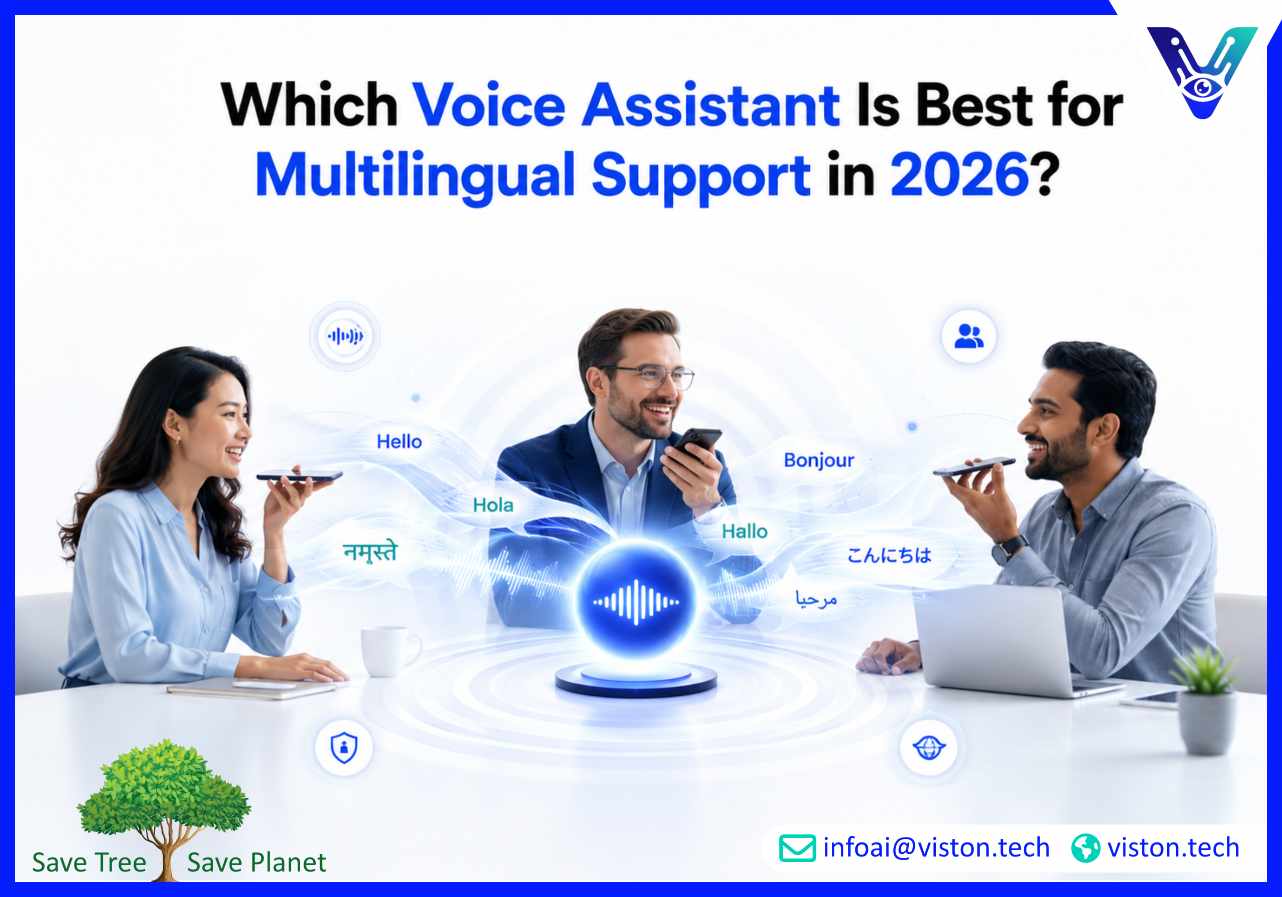
Which Voice Assistant Is Best for Multilingual Support in 2026?
Which voice assistant is best for multilingual support depends on more than the number of languages listed on a product page. Businesses need a solution that understands real accents, dialects, mixed-language speech, industry terminology, and customer intent while delivering secure, accurate, and natural responses across every supported market.
What Makes a Voice Assistant Best for Multilingual Support?
The best multilingual voice assistant is the one that performs reliably in the specific languages, regions, channels, and business workflows an organization needs to support. A platform that offers a long language list may still struggle with regional accents, background noise, code-switching, specialist vocabulary, or natural voice output.For consumer use, a general-purpose assistant may be sufficient for reminders, searches, media controls, and basic device commands. Business environments are more demanding. A customer may need to explain a billing problem, change a booking, ask about a technical product, confirm an order, or provide information required to complete a regulated process.An enterprise voice-enabled assistant must therefore manage the complete conversation, not just convert speech into text. It needs to recognize the language, interpret the user’s intent, retrieve approved information, perform the correct action, generate an appropriate response, and transfer the conversation to a human when necessary.
Language coverage is only the starting point
Language support should be assessed at the feature level. A provider may support a language for speech recognition but not offer equally strong text-to-speech voices, real-time translation, automatic language identification, custom vocabulary, or sentiment analysis in that language.Businesses should confirm whether each required language is supported across:
Automatic speech recognition
Natural language understanding
Text-to-speech generation
Language identification
Translation and localization
Intent recognition and entity extraction
Conversation analytics and quality monitoring
The strongest solution is not necessarily the one with the widest theoretical coverage. It is the one that delivers dependable end-to-end performance in the languages that matter commercially.
Regional language performance matters
Spanish spoken in Spain is not identical to Spanish spoken in Mexico or Argentina. English pronunciation, vocabulary, sentence structure, and customer expectations vary considerably across countries. Similar differences exist across Arabic, French, Portuguese, German, Hindi, Mandarin, and many other languages.A multilingual voice assistant should recognize regional vocabulary, pronunciation patterns, dates, currencies, names, addresses, and culturally specific expressions. It should also produce responses that sound appropriate for the local audience rather than translating every sentence literally from one master language.
Capabilities to Look for in the Best Multilingual Voice Assistant
Organizations comparing voice-enabled assistants should evaluate practical performance rather than relying on a simple feature checklist. The following capabilities have the greatest influence on customer experience, operational reliability, and long-term scalability.
Accurate speech recognition across accents and environments
Automatic speech recognition must work with real customers, not only clean studio recordings. Calls may include background conversations, traffic, weak mobile connections, varying microphone quality, interruptions, or users speaking quickly.A strong assistant should maintain usable recognition accuracy across these conditions. It should also support custom vocabulary for product names, technical terms, locations, employee roles, medical terminology, financial language, or other domain-specific expressions.Testing should include native speakers from the actual markets being served. A system that performs well for formal language may still fail when users speak casually, shorten words, use regional phrases, or pronounce international brand names differently.
Automatic language identification and code-switching
Many users switch between languages during the same conversation. A customer may begin in English, use a local-language phrase, mention an English product name, and return to the original language. This is common in multilingual countries, international workplaces, and customer service environments.The best voice assistant for multilingual support should identify the language quickly and handle code-switching without repeatedly asking the user to select a language. However, automatic detection also needs safeguards. Short answers, names, numbers, and shared words can be difficult to classify, so the assistant should use conversation context and request clarification when confidence is low.
Natural, locally appropriate speech
Text-to-speech quality affects whether users trust and understand the assistant. The voice should be clear, appropriately paced, and capable of pronouncing local names, addresses, abbreviations, currencies, and specialist terminology.Natural output is not only about sounding human. The assistant must use the right tone for the situation. A sales inquiry may require an energetic and helpful style, while a complaint, payment issue, or healthcare interaction requires greater care and restraint.Businesses should evaluate pronunciation, pacing, emphasis, interruption handling, and the consistency of brand tone in every supported language.
Context-aware conversation management
A useful multilingual assistant must remember what has already been said. It should understand references such as “the second order,” “that appointment,” or “the plan I mentioned earlier” without forcing the user to repeat information.Context management becomes more difficult when users change languages or when information is retrieved from several systems. The assistant needs to preserve the customer’s identity, intent, permissions, transaction history, and conversation state throughout the interaction.
Business system integration
A voice assistant cannot resolve many business requests without access to operational systems. It may need to retrieve order information, check appointment availability, create a ticket, update a CRM record, confirm inventory, collect qualified lead information, or trigger a workflow.The best enterprise solution should integrate with relevant CRM, ERP, helpdesk, ecommerce, booking, payment, identity, and knowledge management platforms. It should also pass the full conversation context to a human agent when automation cannot complete the request.
Security, privacy, and governance
Voice interactions can contain names, addresses, account details, health information, financial data, and other sensitive content. Businesses need clear controls for data collection, storage, access, retention, redaction, and deletion.A suitable provider should support role-based access, encryption, audit logs, consent processes, human oversight, and region-specific data handling where required. Regulated organizations must also ensure that language models and translation layers do not expose restricted information or alter critical instructions.
Where Multilingual Voice-Enabled Assistants Create Business Value
Multilingual support is most valuable when it removes a genuine barrier between an organization and its customers, employees, or partners. It should make important services easier to access while reducing repetitive work for human teams.
Customer service and contact centers
A multilingual assistant can answer common questions, retrieve account information, provide order updates, guide troubleshooting, and collect information before escalation. It can extend service outside normal business hours and help organizations support additional markets without creating a separate first-line team for every language.Human support remains essential for sensitive, unusual, or high-risk cases. The assistant should recognize failed conversations, negative sentiment, repeated questions, and explicit requests for an agent. A well-designed handover includes the detected language, customer details, conversation history, completed verification steps, and the reason for escalation.
Sales and lead qualification
International prospects are more likely to continue a conversation when they can explain their needs naturally. A multilingual voice assistant can answer initial product questions, capture requirements, qualify opportunities, schedule meetings, and route leads according to language, location, product interest, or account value.Responses should be localized rather than translated mechanically. Pricing, availability, delivery, legal terms, and sales processes may differ by region. The assistant must retrieve the correct market-specific information instead of applying one answer globally.
Appointments, bookings, and reservations
Voice automation can simplify appointment scheduling, travel enquiries, hospitality reservations, service bookings, and delivery coordination. Users can state their preferred date, location, service, and special requirements conversationally.The system must handle dates, times, time zones, local address formats, names, and confirmation details accurately. It should repeat critical information before finalizing a transaction and provide an alternative channel when speech recognition confidence is too low.
Internal employee support
Global organizations can use voice-enabled assistants to answer HR, IT, policy, onboarding, and workplace questions. Employees may use the assistant to find a document, report an issue, request leave, check a process, or complete a routine workflow.Access controls are especially important. Responses should depend on the employee’s role, location, department, and authorization level. Internal terminology and company-specific abbreviations must also be included in testing and language training.
Hands-free operational workflows
Voice interfaces can support workers who cannot easily use a keyboard or screen. Examples include warehouse employees confirming stock, technicians retrieving instructions, field teams recording inspections, and manufacturing staff completing checklists.These environments require strong noise handling, concise responses, low latency, repeat and confirmation commands, and reliable integration with operational systems. Offline or edge-processing options may also be important where connectivity is inconsistent.
How to Choose and Test a Multilingual Voice Assistant
The selection process should begin with business requirements, not vendor demonstrations. A polished demo in one language does not prove that the assistant will perform reliably across actual markets and workflows.
Define the required language matrix
Create a list of languages, locales, dialects, and common mixed-language combinations. Separate essential launch languages from future expansion languages. For each one, define the required functions, such as recognition, synthesis, translation, analytics, and human-agent routing.Organizations should also document common product names, acronyms, locations, customer phrases, and industry vocabulary. This provides a realistic basis for vendor evaluation.
Test complete tasks, not isolated phrases
Testing should reflect what users are trying to accomplish. Ask native speakers to complete full tasks such as changing a booking, checking a delivery, reporting a problem, requesting a refund, or scheduling a service.Evaluate whether the assistant:
Identifies the correct language
Understands the user’s intent
Captures names, numbers, and dates accurately
Maintains context over several turns
Retrieves the correct market-specific information
Completes the connected workflow
Escalates safely when confidence is low
Measure performance by language
Overall performance averages can hide serious problems. A system may work well in high-resource languages but underperform in smaller markets. Teams should track recognition errors, fallback rate, task completion, average response time, escalation rate, customer satisfaction, and workflow success separately for each language and locale.Failed conversations should be reviewed by people who understand both the language and the business process. The issue may come from speech recognition, translation, knowledge content, conversation design, integration logic, or an unclear policy.
Run a controlled pilot before scaling
A pilot should focus on a small number of high-volume, low-risk tasks. This allows the business to validate language performance, integration reliability, customer acceptance, and support procedures before expanding.The preferred solution should make it practical to add languages, update terminology, change workflows, monitor performance, and roll back unsuccessful model or prompt changes. Multilingual voice AI is an operational capability that requires continuous improvement, not a one-time software installation.
How Viston AI Supports Multilingual Voice Assistant Deployments
Viston AI provides Voice-Enabled Assistants designed around speech recognition, natural language processing, speech synthesis, contextual dialogue, and integration with enterprise systems. Its service is relevant to organizations that need a multilingual assistant tailored to customer service, internal support, sales, booking, or operational workflows rather than a general consumer voice tool.Its voice AI capabilities include dialect-aware language handling, code-switching support, multi-turn conversation management, industry-specific vocabulary, and culturally adapted responses. Viston AI also connects voice experiences with business platforms and custom APIs, enabling assistants to retrieve information, complete actions, update records, and transfer relevant context to human teams.The delivery approach incorporates analytics and model lifecycle management, allowing businesses to monitor intent recognition, completion rates, escalations, sentiment, and language-specific performance after deployment. Governance capabilities such as access controls, auditability, sensitive-data handling, and human intervention points can also be incorporated according to the use case.For organizations operating across multiple markets, this implementation-focused model can be more practical than selecting a fixed assistant solely because it advertises broad language coverage. The solution can instead be designed and tested around the languages, terminology, integrations, risk controls, and service outcomes the organization actually requires.
Frequently Asked Questions
Which voice assistant is best for multilingual customer support?
The best option is an enterprise voice assistant tested in the exact languages, accents, and workflows your customers use. It should combine accurate speech recognition, natural voice output, code-switching, business system integration, analytics, and reliable human escalation.
How many languages should a multilingual voice assistant support?
There is no ideal number. Relevant language coverage is more important than the total count. Businesses should prioritize commercially important languages and confirm that speech recognition, text-to-speech, intent detection, analytics, and integrations work reliably in each one.
Can a voice assistant understand users who switch languages?
Some voice-enabled assistants can support code-switching, but performance varies by language pair, accent, conversation length, and model configuration. Businesses should test common mixed-language conversations using representative speakers before deployment.
Is real-time translation enough for multilingual voice support?
No. Translation does not automatically provide accurate speech recognition, cultural localization, domain terminology, conversation context, or workflow execution. A complete solution must manage the entire interaction from spoken input to business action and spoken response.
What should businesses measure after launching multilingual voice AI?
Track task completion, recognition errors, fallback rate, response latency, escalation rate, customer satisfaction, workflow success, and human handover quality by language. Language-level reporting helps identify performance gaps that overall averages may conceal.
Can Viston AI build a voice assistant for several markets?
Viston AI’s Voice-Enabled Assistants service supports multilingual speech processing, contextual conversations, enterprise integrations, analytics, and ongoing model optimization. Deployments can be structured around the languages, workflows, and governance requirements of different markets.
Conclusion
Determining which voice assistant is best for multilingual support requires testing real business conversations, not simply comparing advertised language counts. The right Voice-Enabled Assistant must understand local accents, mixed-language speech, specialist terminology, and customer intent while completing workflows securely and escalating appropriately. Businesses should evaluate performance separately for every important language and begin with a controlled pilot. Viston AI offers relevant multilingual voice AI, integration, monitoring, and governance capabilities for organizations that need a solution designed around practical service outcomes and international scalability.