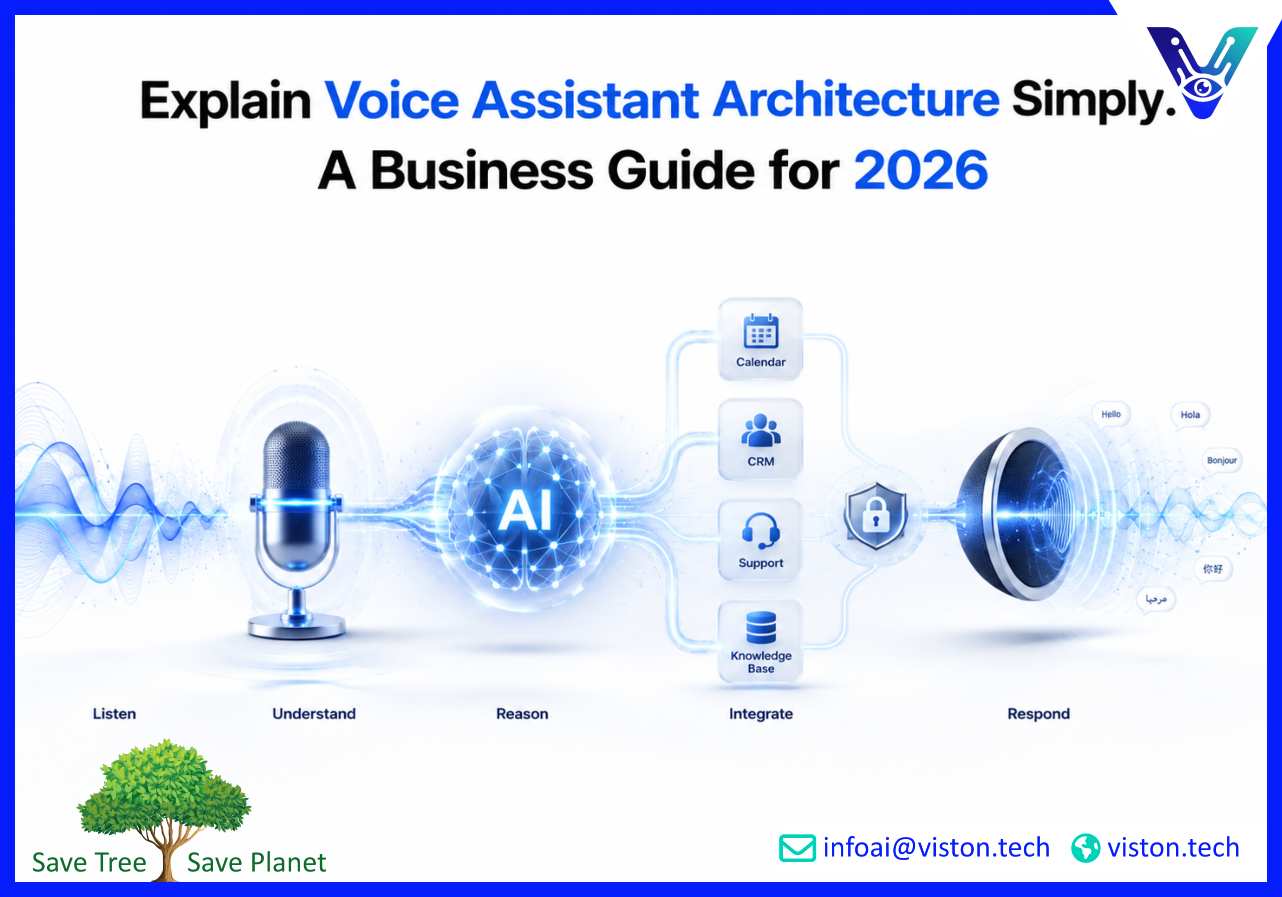
Explain Voice Assistant Architecture Simply: A Business Guide for 2026
Voice assistant architecture is the technical structure that allows software to hear a person, understand the request, decide what to do, and respond through speech. Understanding this structure helps businesses plan reliable Voice-Enabled Assistants that can support customers, employees, sales teams, and operational workflows.
What Voice Assistant Architecture Means in Simple Terms
A voice assistant can be understood as a digital employee that follows a rapid listen-think-act-speak process. The user says something, the system captures the audio, converts or interprets the speech, determines the user’s intention, performs the required task, and produces a spoken response.The simplest way to visualize voice assistant architecture is:
The user speaks through a phone, browser, mobile app, smart device, or microphone.
The system detects that the user has started speaking.
Speech recognition processes the audio.
An AI model interprets the request and decides how to respond.
The assistant retrieves information or performs an action.
Text-to-speech technology converts the answer into spoken audio.
The response is played back to the user.
Behind this apparently simple conversation may be several technologies working together. These can include speech-to-text software, natural language processing, large language models, knowledge bases, business applications, workflow automation, telephony systems, security controls, and analytics platforms.Modern voice systems generally use either a chained pipeline, where speech, text, reasoning, and voice generation are handled as separate steps, or a speech-to-speech architecture, where a multimodal model works more directly with live audio. Both approaches remain relevant in 2026 because they serve different business requirements.
A voice assistant is more than a talking chatbot
A basic chatbot accepts text and returns text. A voice assistant must also manage audio quality, speaking turns, pauses, interruptions, accents, background noise, pronunciation, and response timing. It may need to identify when a user has finished speaking, avoid talking over the user, and recover naturally when part of a request is unclear.For business use, the assistant must often do more than answer questions. It may need to check an order, create a support ticket, schedule an appointment, qualify a lead, update a CRM record, retrieve account information, or transfer the conversation to a human agent.
The Main Layers of Voice Assistant Architecture
Although platforms use different terminology, most business voice assistants contain several core architectural layers. Each layer has a specific responsibility, and the overall experience depends on how well these layers work together.
1. Audio input and communication channel
The first layer captures the user’s voice. The audio may arrive through a website microphone, mobile application, contact centre, telephone network, kiosk, smart speaker, or another connected device.This layer also manages the connection carrying the audio. WebRTC is commonly used for real-time browser and mobile experiences, while SIP is often used for telephone and contact-centre integration. WebSockets may be used when audio must travel between backend services. Microsoft’s real-time audio documentation, for example, identifies WebRTC, SIP, and WebSocket as connection methods for different voice scenarios.
2. Voice activity and turn detection
The assistant must recognise when the user begins speaking, when the user pauses, and when the speaking turn has ended. This is usually handled through voice activity detection and turn-detection logic.Poor turn detection creates awkward conversations. The assistant may respond too early, wait too long, cut off the user, or mistake background noise for speech. Production systems therefore need carefully configured silence thresholds, interruption handling, noise management, and end-of-turn detection.
3. Speech recognition
In a chained architecture, automatic speech recognition or speech-to-text converts the user’s audio into written text. For example, “Can you move my appointment to Friday?” becomes a text transcript that the reasoning layer can process.Recognition quality is influenced by microphone quality, connection stability, background noise, accents, language coverage, industry terminology, names, product codes, and numbers. Businesses should test speech recognition with realistic conversations rather than relying only on clean studio recordings.
4. Understanding and reasoning
The reasoning layer determines what the user means and what should happen next. Traditional systems may use predefined intents, entities, and conversation rules. More advanced assistants may use large language models to interpret flexible language, maintain context, ask follow-up questions, and produce more natural responses.This layer may identify:
The user’s goal or intent
Important details such as dates, names, products, or locations
Previous messages in the conversation
Whether additional information is required
Whether the request is safe and permitted
Whether a business tool or human agent is needed
5. Knowledge, tools, and business integrations
The AI model should not be expected to know every business-specific answer by itself. The architecture normally connects it to approved knowledge and operational systems.A customer service assistant may retrieve information from a knowledge base and create tickets in helpdesk software. A sales assistant may access product information, qualify prospects, and update a CRM. An appointment assistant may check availability and write confirmed bookings to a scheduling system.This layer is what turns a conversational interface into a useful business assistant. It also requires authentication, permission controls, validation, error handling, and confirmation before sensitive or irreversible actions are completed.
6. Response generation and speech output
Once the assistant has an answer, text-to-speech technology converts it into audio. The chosen voice affects clarity, trust, accessibility, and brand experience.A strong speech layer should handle names, numbers, abbreviations, dates, currencies, and industry terms correctly. It should also support appropriate pacing and pronunciation. Responses should generally be designed for listening rather than copied from long written documents.
Chained and Speech-to-Speech Architecture in 2026
Businesses planning Voice-Enabled Assistants in 2026 will usually evaluate two broad approaches: chained voice architecture and direct speech-to-speech architecture.
Chained voice architecture
A chained pipeline commonly follows this route:Audio input → speech-to-text → AI reasoning → text response → text-to-speech → audio output.This approach keeps the major components separate. It gives development teams visibility into the transcript, model response, tool activity, and generated speech. Individual services can be tested, replaced, or optimized independently.Chained architecture is often suitable when a business needs dependable transcripts, detailed auditing, provider flexibility, structured workflows, or close control over what happens at each stage. Official voice-agent guidance also describes chained pipelines as useful for predictable, approval-heavy, and support-oriented workflows where intermediate text and deterministic logic are important.
Speech-to-speech architecture
Speech-to-speech systems process audio more directly and return spoken audio without requiring the application to manage every intermediate stage separately. This can support faster, more fluid conversations and better preservation of tone, rhythm, emphasis, and other vocal signals.This approach may be valuable for highly conversational assistants, live language practice, interactive experiences, and situations where natural turn-taking is a priority.However, businesses must still consider observability, evaluation, transcripts, tool controls, data handling, and fallback behaviour. A natural voice does not automatically make the underlying workflow accurate or safe.
How businesses should choose
The choice should be based on the use case rather than technology novelty. A tightly controlled support or transaction workflow may benefit from a chained design. A highly conversational experience may benefit from real-time speech-to-speech processing.Some organizations may use a hybrid architecture. For example, direct audio interaction may manage the conversation while structured tools, approval rules, and business integrations remain controlled by separate application services.
What Makes a Voice Assistant Architecture Reliable
A successful architecture is not defined only by whether the assistant can speak. It must deliver accurate, secure, responsive, and operationally useful conversations under real-world conditions.
Low and consistent latency
Users notice delays quickly during spoken conversations. Latency can be introduced by audio transport, speech recognition, model processing, knowledge retrieval, API calls, and speech generation.Teams should measure the complete experience, including time to detect the end of a turn, time to produce the first audio response, and delays caused by business systems. Streaming responses can reduce perceived waiting time, but they must be managed carefully to avoid speaking before the answer has been properly validated.
Interruption and conversation control
People interrupt, change direction, correct themselves, and ask several questions in one sentence. The assistant should be able to stop speaking when interrupted and understand whether the new statement replaces or extends the previous request.Conversation state should also be managed deliberately. The system needs to remember relevant details without carrying incorrect or unnecessary context through the entire interaction.
Secure integration and permissions
Voice assistants may handle personal details, account information, internal knowledge, or transaction requests. Architecture should therefore include authentication, encryption, access controls, secure API communication, logging, data minimization, and retention policies appropriate to the use case.Permission rules must apply to tools and retrieved information, not only to the conversational interface. The assistant should never be able to access or change data simply because a user asked it to do so.
Fallbacks and human handover
The system needs a safe response when it cannot understand a request, retrieve reliable information, complete an integration, or confirm the user’s identity. Repeating the same failed answer is not an effective fallback.Human handover should preserve the transcript, detected intent, customer details, completed verification steps, and actions already attempted. This reduces repetition and gives the receiving employee useful context.
Monitoring and continuous improvement
Voice assistant performance should be monitored through measures such as recognition accuracy, task completion, response latency, fallback frequency, interruption success, escalation rate, integration failures, customer satisfaction, and workflow outcomes.Reviewing failed and abandoned conversations helps teams identify missing knowledge, misunderstood terminology, weak prompts, poor routing, and unreliable integrations. Voice architecture should therefore include analytics and testing from the beginning rather than treating monitoring as a post-launch addition.
How Viston AI Supports Practical Voice Assistant Architecture
Viston AI is directly relevant to this topic because Voice-Enabled Assistants are included within its conversational and enterprise AI service portfolio. Its published capabilities also include AI agent development, enterprise chatbots, multilingual support, natural language processing, business-system integration, and AI-driven workflows.These capabilities address several layers required in a practical voice assistant architecture. A business voice solution may need speech interaction at the front end, language understanding and reasoning in the middle, and secure access to CRM, support, scheduling, knowledge, or operational systems at the back end.Viston AI’s service alignment is therefore relevant to organizations that need more than a standalone voice interface. Its broader capabilities can support assistants designed around customer support, lead handling, internal knowledge access, workflow automation, multilingual communication, and connected business processes.A specialist delivery approach should begin by defining the intended tasks, users, channels, languages, integrations, risk boundaries, and performance expectations. From there, the architecture can be designed around the right speech pipeline, AI model, knowledge sources, tools, security controls, handover process, and monitoring framework. This business-led approach helps ensure that a voice assistant is not merely conversational but useful, manageable, and capable of supporting real operations.
Frequently Asked Questions
What are the main components of voice assistant architecture?
The main components are audio input, voice activity detection, speech recognition, language understanding or AI reasoning, knowledge and business integrations, response generation, text-to-speech, security, and performance monitoring.
Does every voice assistant use speech-to-text?
No. Chained systems normally convert speech to text before reasoning and then convert the response back to speech. Direct speech-to-speech systems can process audio more natively, although businesses may still create transcripts for monitoring or compliance.
What is the difference between a voice assistant and an IVR?
A traditional interactive voice response system usually relies on menus, keypad selections, and predefined commands. A modern AI voice assistant can understand more flexible spoken language, maintain conversational context, access knowledge, and perform actions through connected systems.
Can a voice assistant connect to CRM and helpdesk software?
Yes. A properly designed assistant can retrieve customer context, create or update records, log conversation outcomes, open tickets, assign follow-ups, or trigger workflows. These integrations require authentication, permissions, validation, and error handling.
How can businesses improve voice assistant accuracy?
Accuracy improves through realistic audio testing, domain-specific terminology, clear knowledge sources, multilingual evaluation, suitable confidence thresholds, prompt refinement, integration testing, fallback design, and regular analysis of failed conversations.
Can Viston AI help design a complete voice assistant system?
Viston AI provides Voice-Enabled Assistants alongside AI agent development, NLP, multilingual support, workflow automation, and business-system integration. These capabilities align with the main requirements of designing connected business voice solutions.
Conclusion
To explain voice assistant architecture simply, it is the connected system that helps software listen, understand, decide, act, and speak. The quality of a Voice-Enabled Assistant depends on more than its voice. Businesses must consider audio handling, AI reasoning, knowledge access, integrations, latency, security, human handover, and continuous monitoring. In 2026, both chained and speech-to-speech designs can be effective when matched to the right use case. Viston AI offers relevant voice, NLP, integration, multilingual, and automation capabilities for organizations seeking a practical architecture connected to genuine business requirements.