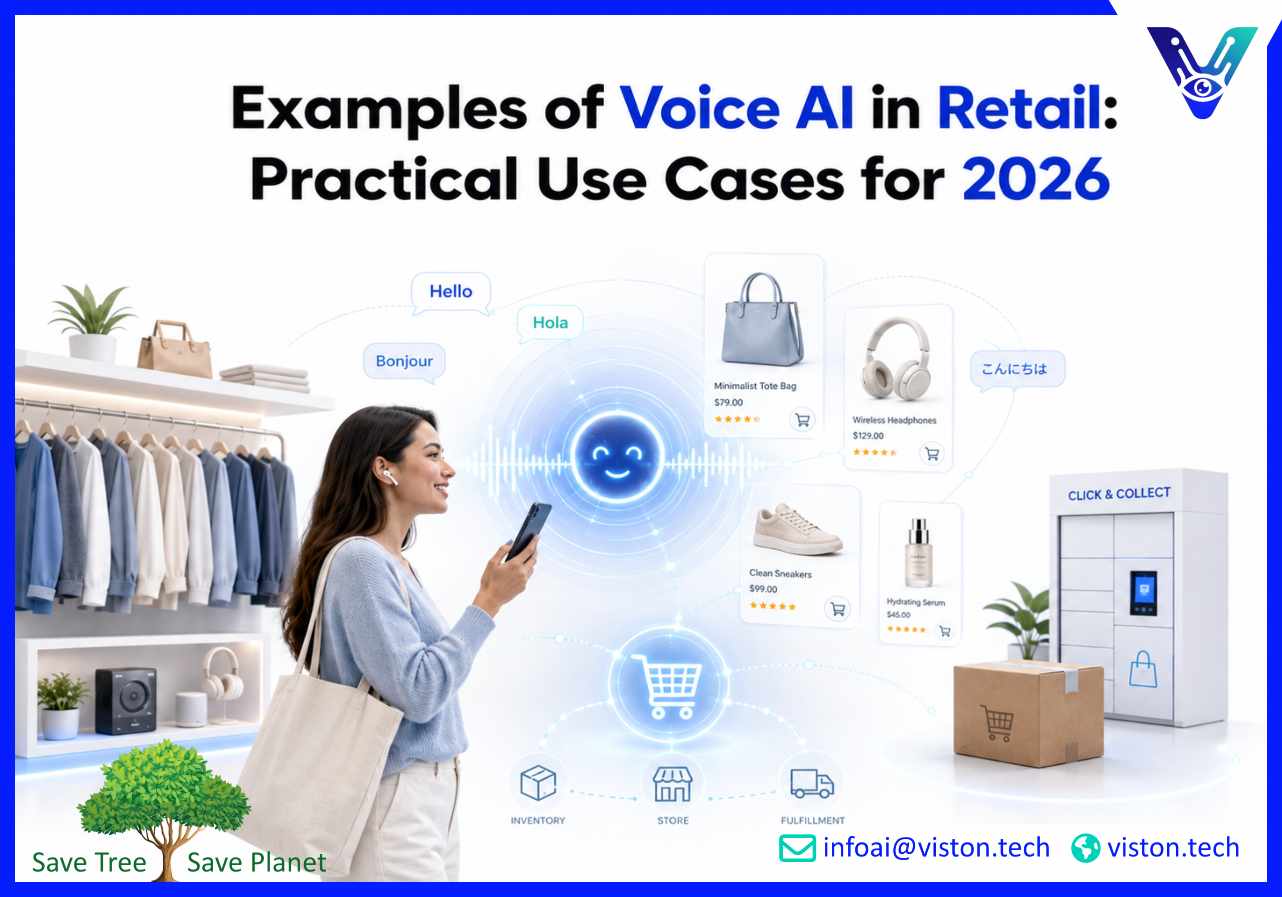
Examples of Voice AI in Retail: Practical Use Cases for 2026
Voice AI in retail is moving beyond simple phone menus and smart-speaker commands. Retailers can now use conversational voice systems to help customers find products, place and manage orders, receive support, and complete tasks, while store and fulfilment teams use hands-free assistants to access information and update operational systems.
What Voice AI in Retail Means in 2026
Voice AI in retail refers to software that listens to spoken language, understands intent, retrieves information, responds naturally, and triggers approved actions. It typically combines speech recognition, language understanding, text-to-speech, business rules, and integrations with commerce, inventory, order, CRM, and contact-centre systems.A useful retail voice assistant does more than transcribe speech. When a customer asks, “Do you have this jacket in a medium near me?”, it must identify the product, size, location, inventory source, and next action before offering reservation, directions, or delivery.Retail voice AI can operate through several channels:
Retailer websites and mobile apps
Telephone customer-service lines
Smart speakers and connected displays
In-store kiosks and digital signage
Headsets or mobile devices used by store associates
Warehouse and fulfilment devices
In 2026, leading implementations are increasingly multimodal: customers can speak, view results, refine choices, and confirm sensitive actions through touch or authentication. Amazon’s Echo Show shopping experience, for example, supports browsing, comparing, and purchasing through voice, touch, or both.
Customer-Facing Examples of Voice AI in Retail
1. Conversational Product Discovery
A voice shopping assistant can help customers search a large catalogue using natural language rather than exact keywords. A shopper might say, “Find waterproof walking shoes under £120 for a wide fit,” or “Show me a quiet blender suitable for a small kitchen.” The assistant can identify product attributes, apply filters, ask clarifying questions, and explain why particular items match.
2. Guided Product Comparison and Recommendations
Voice AI can act as a guided selling assistant. Instead of reading multiple product pages, the customer can ask for the differences between two models, compatibility with an existing item, care requirements, delivery options, or the best choice for a specific use case.Recommendations should use approved product data and current availability. Higher-value or uncertain purchases should be transferred to a human specialist with the conversation context preserved.
3. Voice-Enabled Cart Building and Repeat Ordering
Grocery, pharmacy, office-supply, pet-care, and household retailers can use voice AI to simplify frequent purchases. Customers may ask to add their usual items, repeat a previous order, build a basket from a spoken list, or replace an unavailable product with an approved alternative.The assistant can confirm quantities, suggest substitutions, state the total, and request explicit approval. Payment and high-value changes should use strong authentication rather than a spoken command alone.
4. Stock Checking, Store Discovery, and Reservations
A customer can ask whether an item is available nearby, which branch has a particular size or colour, when a store closes, or whether click-and-collect is available. When connected to real-time inventory and location services, the voice assistant can provide store-specific answers and reserve stock where the retailer’s policy permits.This connects digital discovery with the physical store, but answers should account for inventory delays, damaged stock, and items already being purchased.
5. Order Tracking, Delivery Changes, and Returns
Voice-enabled assistants can handle high-volume service requests such as “Where is my order?”, “Can I change the delivery address?”, “When will my refund arrive?”, or “How do I return this item?” The system can authenticate the customer, retrieve the correct order, explain the current status, and perform actions permitted by policy.Disputed charges, suspected fraud, damaged high-value goods, and policy exceptions should be escalated because they require judgment or additional verification.
6. Voice Customer Service Outside Normal Store Hours
Retailers can deploy voice agents on telephone lines to answer routine questions, capture the reason for contact, perform simple tasks, and route more difficult cases. Unlike a traditional interactive voice response menu, a conversational system allows the caller to explain the issue naturally.The voice agent should preserve a clear route to a person and transfer identity, order details, intent, and attempted resolutions so customers do not need to repeat themselves.
7. Accessible and Multilingual Shopping Assistance
Voice interfaces can make retail services easier to use for customers who have visual impairments, limited mobility, difficulties using a touchscreen, or lower confidence with complex digital navigation. Multilingual voice support can also help retailers serve customers across regions without building a completely separate journey for every language.Retailers should still provide text, touch, and human alternatives, support varied speech patterns, and test with diverse users. Voice should expand access, not become the only option.
Operational Examples of Voice AI in Retail
Voice Assistants for Store Associates
Employees can use a headset or mobile device to ask where an item is located, whether another branch has stock, what a promotion includes, or how to process an unusual return. The assistant can retrieve approved information from product, inventory, policy, and knowledge systems while the employee remains with the customer.Access controls are essential because associate tools may expose internal prices, customer records, or instructions unavailable to the public.
Hands-Free Inventory and Shelf Management
Store teams can report low stock, confirm replenishment, record damaged goods, or request a stock count through spoken commands. A voice workflow can be faster than stopping to type, especially in busy aisles, stockrooms, cold storage, or environments where employees wear gloves.Reliable barcode, location, and product-data integration is more important in these workflows than a highly expressive voice.
Voice-Directed Picking and Fulfilment
In warehouses and dark stores, voice-directed workflows can guide workers through picking sequences, confirm quantities, report substitutions, and update fulfilment status. The system should be optimized for background noise, short commands, product identifiers, and rapid confirmation.Performance should be measured through pick accuracy, task time, error rates, worker adoption, and exception handling.
Employee Training and Policy Support
A retail employee can ask a voice assistant how to handle a product recall, loyalty-card issue, safety incident, refund exception, or equipment problem. The assistant can deliver a concise answer, guide the employee through a checklist, and create a record when needed.Answers should come from current, approved documents. High-risk procedures should require escalation or supervisor approval.
Voice-of-Customer Capture and Analytics
Retailers can analyze transcribed voice interactions to identify recurring product questions, delivery complaints, availability problems, service gaps, and reasons for abandonment. These insights can inform merchandising, content, staffing, product development, and process improvement.Analysis should use consent, data minimization, retention controls, role-based access, and redaction of personal or payment information.
How Retailers Should Evaluate and Implement Voice AI
Start With a Narrow, Measurable Use Case
A retailer should begin with a process that is frequent, clearly defined, and supported by reliable data. Strong starting points include order tracking, store information, inventory lookup, repeat ordering, or associate knowledge search. A focused pilot makes it easier to test accuracy, customer acceptance, integration reliability, and operational value before expanding.
Connect the Assistant to Trusted Systems
Product details should come from the product information system, stock from inventory, orders from order management, and customer details from authorized CRM or commerce records. The assistant should separate verified data from generated explanation.
Design for Retail Conditions
Testing should cover accents, background noise, incomplete requests, similar product names, promotions, stock exceptions, and interrupted conversations. Low latency is also essential.
Build Security and Trust Into Every Action
Retail voice systems may handle addresses, account details, order histories, loyalty information, and payment-related requests. Businesses should apply authentication based on risk, mask sensitive information, limit data retention, maintain audit logs, and require confirmation for purchases, cancellations, refunds, address changes, or account updates.Customers should know they are speaking with AI and how to reach a human. Controls should address inaccurate answers, unauthorized actions, prompt injection, voice spoofing, and recording misuse.
Measure Business and Experience Outcomes
Useful voice AI metrics include intent recognition accuracy, task completion rate, first-contact resolution, transfer rate, abandonment rate, average response latency, order accuracy, customer satisfaction, conversion rate, repeat use, system update accuracy, and cost per successfully completed interaction.A high automation rate is not successful when answers are wrong or customers cannot reach an employee.
How Viston AI Supports Voice AI in Retail
Viston AI is directly relevant to retail voice AI because its Voice-Enabled AI Assistants service combines speech recognition, natural language processing, generative AI, text-to-speech, analytics, and model operations for enterprise deployments. Its published capabilities also include multi-turn conversation management, multilingual support, integration with business systems, and continuous performance monitoring.For retailers, those capabilities can support customer-facing services such as product search, stock enquiries, order placement, delivery tracking, and contact-centre automation. They can also support employee workflows including inventory checks, store knowledge access, and voice-directed operational tasks. Viston AI identifies ecommerce and retail as supported sectors and describes integration options for enterprise platforms and custom APIs, which is important when a voice assistant must retrieve live data rather than provide generic answers.A practical delivery approach should begin with discovery, data and integration assessment, a controlled proof of concept, and measurable acceptance criteria. It should then include security testing, human-handover design, multilingual evaluation where required, deployment monitoring, and ongoing optimization. This makes Viston AI relevant to retailers seeking a specialized voice-enabled assistant rather than a standalone speech interface with limited operational value.
Frequently Asked Questions
What Is the Best Example of Voice AI in Retail?
A clear example is a voice shopping assistant that helps customers find products, compare options, check availability, build a basket, and track an order. The best use case depends on data quality and integration readiness.
Can Voice AI Take Retail Orders Automatically?
Yes. Voice AI can build baskets, repeat purchases, capture delivery details, and place orders through connected commerce and payment systems. Retailers should use strong authentication and confirmation before purchases or sensitive account changes.
How Is Voice AI Used Inside Physical Stores?
Retailers can use voice AI for customer kiosks, associate product lookup, inventory checks, replenishment reporting, employee training, queue support, and hands-free task management. The interface should be tested for noise, accents, device quality, and rapid response.
Does Voice AI Replace Retail Employees?
Voice AI is better suited to repetitive enquiries and structured tasks than situations requiring judgment, empathy, negotiation, or exception handling. Effective implementations support employees and transfer complex conversations with full context rather than attempting to automate every interaction.
What Systems Must a Retail Voice Assistant Integrate With?
Common integrations include ecommerce platforms, product information management, inventory, order management, CRM, loyalty, contact-centre, store-location, knowledge-base, and analytics systems. The required connections depend on the task the assistant is expected to complete.
Can Viston AI Build a Multilingual Retail Voice Assistant?
Viston AI presents multilingual support, speech recognition, natural language processing, business-system integration, analytics, and model monitoring as capabilities within its voice-enabled assistant offering. Retailers should validate required languages, dialects, accuracy targets, privacy controls, and channel integrations during discovery.
Conclusion
The most useful examples of voice AI in retail connect natural conversation to real customer and operational tasks. Product discovery, guided selling, repeat ordering, stock checks, delivery support, associate assistance, and voice-directed fulfilment can all create value when the assistant uses trusted data and well-controlled integrations. Retailers should start with a focused use case, measure task success rather than conversation volume, and protect customer choice, privacy, and access to human support. Viston AI offers relevant Voice-Enabled Assistants capabilities for businesses seeking to design, integrate, monitor, and scale practical retail voice experiences.