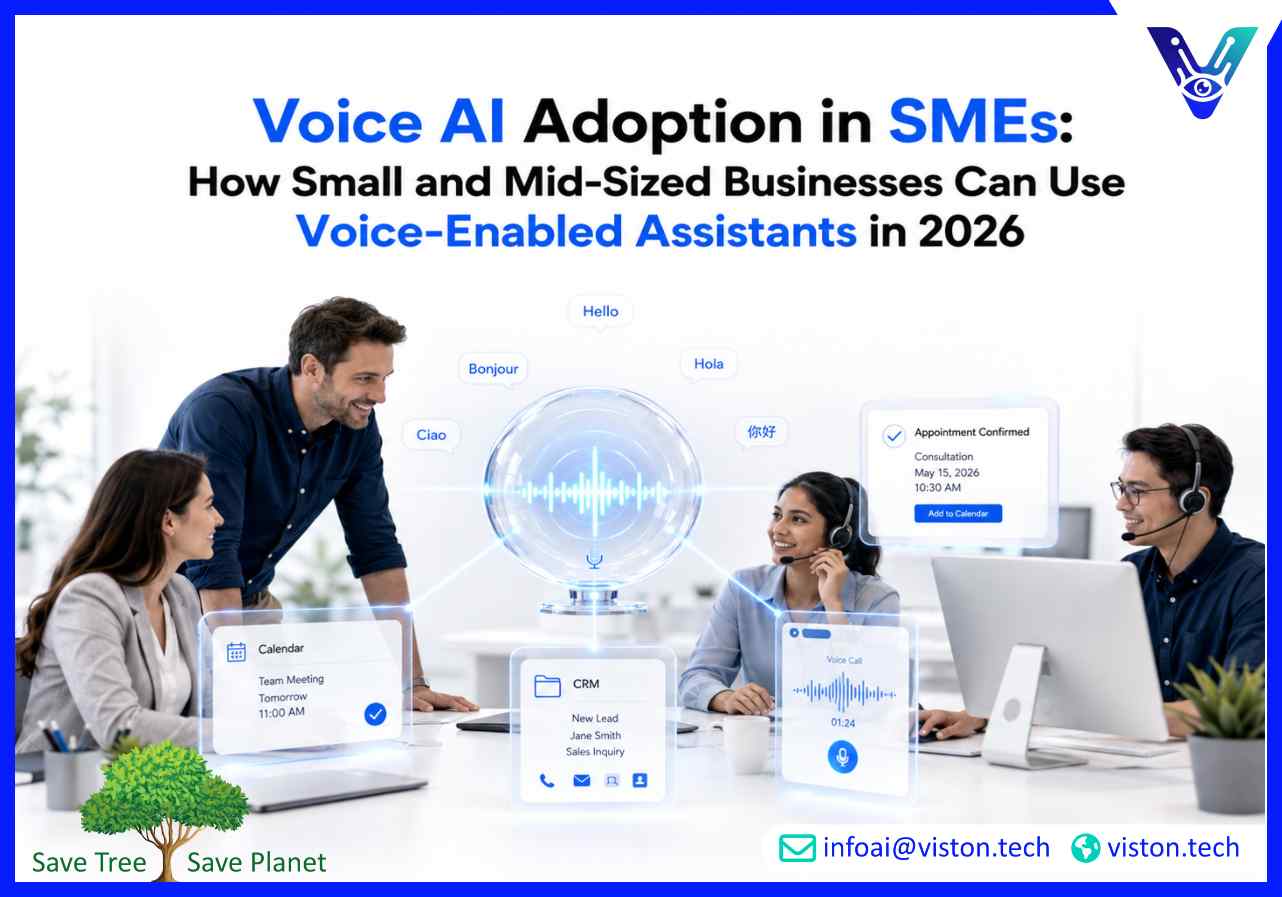
Voice AI Adoption in SMEs: How Small and Mid-Sized Businesses Can Use Voice-Enabled Assistants in 2026
Voice AI adoption in SMEs is becoming a practical business priority as smaller companies look for faster customer response, leaner operations, and more accessible digital service. In 2026, voice-enabled assistants are no longer limited to large enterprises; they can help SMEs automate routine conversations, support teams, and improve customer experience without adding unnecessary complexity.
What Voice AI Adoption in SMEs Really Means
Voice AI adoption in SMEs refers to the use of artificial intelligence systems that can understand spoken language, respond naturally, and complete useful tasks through voice-based interaction. These systems may work through phone lines, websites, mobile apps, smart devices, contact center platforms, WhatsApp-style communication flows, or internal business tools.For small and mid-sized businesses, voice AI is not only about replacing phone agents or adding a futuristic feature. The real value comes from making everyday interactions easier. A customer can ask about availability, book an appointment, check an order, request support, confirm account information, or get product guidance without waiting for a staff member to answer manually.Internally, voice-enabled assistants can support employees by helping them search documents, create tickets, update records, log service notes, access FAQs, or trigger workflows hands-free. This is especially useful for businesses where staff are mobile, customer-facing, or working in environments where typing is inconvenient.
Why SMEs are now considering voice AI
Many SMEs face the same service expectations as larger companies but operate with smaller teams, tighter budgets, and less technical capacity. Customers still expect fast responses, clear answers, and consistent support. Employees still need reliable systems. Managers still need visibility into service quality and operational workload.Voice AI can help close this gap when it is implemented carefully. A well-designed voice assistant can handle repetitive queries, qualify incoming requests, reduce missed calls, support after-hours communication, and route complex issues to the right human team. The goal is not to remove human service; the goal is to protect human time for conversations that need judgment, empathy, or commercial decision-making.
Why Voice AI Matters for SMEs in 2026
In 2026, the expectations around business communication are changing quickly. Customers are more comfortable using conversational interfaces, and employees increasingly expect workplace tools to be faster and easier to use. For SMEs, this creates both pressure and opportunity.A business that depends only on manual phone handling may struggle during peak hours, staff shortages, seasonal demand, or marketing campaigns. A missed call can become a missed sale. A slow response can push a customer to a competitor. A repeated question can take time away from higher-value work.Voice-enabled assistants help SMEs respond more consistently without needing to expand headcount immediately. They can answer common questions, collect information before human follow-up, guide users through simple processes, and keep service available outside normal office hours.
Customer service becomes more responsive
For many SMEs, customer service still depends on small teams answering phones, emails, website messages, and social inquiries. Voice AI can reduce the pressure by handling common requests such as store hours, booking availability, delivery updates, refund steps, pricing questions, product details, and basic troubleshooting.When the assistant cannot resolve the issue, it should escalate the conversation with context. This means the human team receives the customer’s name, reason for contact, previous answers, urgency, and any relevant account details instead of starting from zero.
Operations become easier to manage
Voice AI adoption in SMEs is also valuable for internal workflows. A field technician can log a job update by speaking. A clinic receptionist can use a voice assistant to check appointment slots. A warehouse worker can confirm inventory status without stopping to type. A sales team can capture lead details after a call and push them into a CRM.These use cases matter because SMEs often lose time in small manual steps. Voice-enabled assistants can reduce repetitive admin, improve record accuracy, and make business systems easier for staff to use.
Accessibility and multilingual support improve reach
Voice-based interfaces can make digital services easier for customers who prefer speaking over typing, have limited digital confidence, or need faster support while on the move. For SMEs serving diverse communities, multilingual voice support can also improve communication quality and reduce dependence on a small number of multilingual staff.This does not mean every SME needs a complex multilingual system from day one. A practical approach is to start with the most common customer language needs, then expand as demand and performance data justify it.
Where SMEs Can Use Voice-Enabled Assistants
The best use cases for voice AI are usually repetitive, high-volume, structured, and easy to validate. SMEs should avoid trying to automate every conversation at once. A focused rollout is safer, easier to measure, and more likely to deliver business value.
Customer support and call handling
Voice assistants can answer basic questions, identify customer intent, provide approved information, and route calls to the right person. This is useful for service businesses, ecommerce brands, local retailers, healthcare practices, property firms, education providers, logistics teams, and professional services companies.Common use cases include answering FAQs, checking order status, explaining service steps, collecting issue details, confirming appointments, and creating support tickets. The assistant should know when to stop and transfer the customer to a human agent.
Appointment booking and scheduling
SMEs that rely on appointments can use voice AI to help customers book, reschedule, cancel, or confirm appointments. This can reduce phone interruptions and improve booking availability outside business hours.The assistant must be connected to the right calendar or scheduling system to avoid double bookings. It should also confirm key details such as service type, preferred time, contact information, location, and cancellation rules.
Lead capture and qualification
Voice AI can help SMEs capture inquiries from prospects and qualify them before a sales conversation. Instead of asking a salesperson to manually gather every detail, the assistant can ask structured questions about need, budget, timeline, location, company size, and preferred follow-up method.When connected to a CRM, this information can be stored automatically and routed to the right team member. This improves speed-to-lead and reduces the chance of losing inquiries during busy periods.
Internal workflow assistance
Voice-enabled assistants can support employees with internal knowledge search, policy questions, IT helpdesk requests, task creation, meeting notes, job status updates, stock checks, and reporting workflows. This is especially useful when employees work away from desks or need quick answers during operational tasks.For SMEs, internal voice AI should be simple, permission-aware, and connected only to trusted sources. Employees need confidence that the assistant gives approved answers and does not expose restricted information.
How SMEs Should Approach Voice AI Adoption
Voice AI adoption in SMEs should be treated as a business improvement project, not just a technology purchase. The right approach starts with a clear problem, a narrow use case, reliable data, and measurable success criteria.
Start with one high-value workflow
An SME should begin by identifying where voice automation can remove friction. Good starting points include missed calls, repetitive support questions, appointment scheduling, lead intake, order updates, or internal ticket creation. These workflows usually have clear rules and visible business impact.A narrow pilot helps the business test whether customers actually use the assistant, whether the system understands common requests, and whether staff receive better information from automated handoffs.
Prepare trusted business knowledge
A voice assistant is only as reliable as the information it uses. SMEs should prepare approved FAQs, service descriptions, pricing rules, support steps, booking policies, escalation rules, and customer communication guidelines before deployment.Outdated or inconsistent information can create poor customer experiences. For example, if a website page, staff script, and voice assistant all give different answers, customers will lose trust quickly. A single source of truth is essential.
Connect voice AI to existing systems
The strongest voice AI use cases usually require integration. A voice assistant becomes more useful when it can connect with calendars, CRM systems, helpdesk tools, ecommerce platforms, payment workflows, order management software, knowledge bases, or internal databases.Integration allows the assistant to complete tasks instead of only answering questions. It can book an appointment, create a ticket, update a customer record, check delivery status, or assign a lead to sales. For SMEs, integration should be practical and phased. Start with the systems that support the selected workflow, then expand as the use case matures.
Build in human handoff and control
Voice AI should not trap customers in automation. A reliable assistant must recognize uncertainty, sensitive issues, frustration, complaints, urgent requests, and complex cases. It should escalate cleanly and provide human teams with useful context.SMEs should also define what the assistant is allowed to say and do. This includes boundaries around refunds, medical advice, legal statements, financial decisions, account changes, and any process requiring human approval.
Measure performance from the beginning
SMEs should track practical KPIs such as call containment, successful task completion, missed-call reduction, booking conversion, lead quality, escalation rate, customer satisfaction, average response time, and workflow success rate. These metrics show whether the voice assistant is improving the business or simply adding another channel to manage.Performance review should continue after launch. Real conversations reveal new phrases, missing intents, unclear answers, and workflow gaps. Regular optimization is what turns a basic voice assistant into a dependable business tool.
How Viston AI Supports Voice AI Adoption in SMEs
Viston AI is relevant to voice AI adoption in SMEs because its Voice-Enabled Assistants service focuses on building conversational AI systems that combine speech recognition, natural language processing, generative AI, business system integration, analytics, and responsible AI governance. These capabilities match the practical needs of smaller businesses that want voice automation to solve real service and operational problems rather than act as a standalone novelty.For SMEs, the value of working with a specialist provider is in reducing implementation risk. A voice assistant needs accurate intent recognition, clear conversation design, approved knowledge sources, secure data handling, reliable handoff rules, and integration with tools such as CRM, scheduling, helpdesk, ecommerce, or internal workflow systems. Viston AI’s broader AI service portfolio also includes AI chatbot development, multilingual support, NLP and text analysis, AI automation, custom AI development, model monitoring, and AI strategy services, which can support phased adoption as an SME’s needs mature.This makes its approach suitable for businesses that want to start with focused voice automation, measure performance, and expand responsibly. Instead of treating voice AI as a one-time deployment, Viston AI can support the design, integration, monitoring, and optimization work needed to keep voice-enabled assistants useful, scalable, and aligned with business outcomes.
Frequently Asked Questions
What is voice AI adoption in SMEs?
Voice AI adoption in SMEs means using AI-powered voice assistants to understand spoken requests, respond naturally, and complete business tasks such as answering customer questions, booking appointments, qualifying leads, creating tickets, or supporting internal workflows.
Is voice AI affordable for small and mid-sized businesses?
Voice AI can be affordable when SMEs start with a focused use case instead of a large, complex deployment. Costs depend on conversation volume, integrations, language support, customization, security needs, and ongoing optimization.
What are the best first use cases for SME voice AI?
The best first use cases are usually repetitive and easy to structure. Examples include missed-call handling, appointment booking, customer FAQs, order status updates, lead intake, support ticket creation, and internal knowledge search.
Does voice AI replace human staff?
Voice AI should not replace human judgment. Its strongest role is handling routine interactions, collecting information, and routing conversations so staff can focus on complex, sensitive, or high-value work.
What risks should SMEs consider before adopting voice AI?
SMEs should consider accuracy, data privacy, customer consent, poor escalation, system integration quality, outdated knowledge, and unclear responsibility for ongoing improvement. A controlled pilot with clear guardrails reduces these risks.
Can Viston AI help SMEs implement voice-enabled assistants?
Yes. Viston AI’s Voice-Enabled Assistants service is aligned with SME voice AI adoption because it supports conversational AI development, speech recognition, NLP, multilingual capability, system integration, analytics, governance, and ongoing optimization.
Conclusion
Voice AI adoption in SMEs is becoming a practical way to improve customer service, reduce repetitive workload, and make business systems easier to use. In 2026, the most successful SME deployments will not be the biggest or most complex; they will be the ones focused on clear workflows, accurate business knowledge, reliable integrations, and measurable outcomes. Voice-enabled assistants can help smaller businesses respond faster, support teams more effectively, and scale communication without losing human control. With a structured implementation approach, providers such as Viston AI can help SMEs adopt voice AI in a way that is useful, manageable, and commercially relevant.