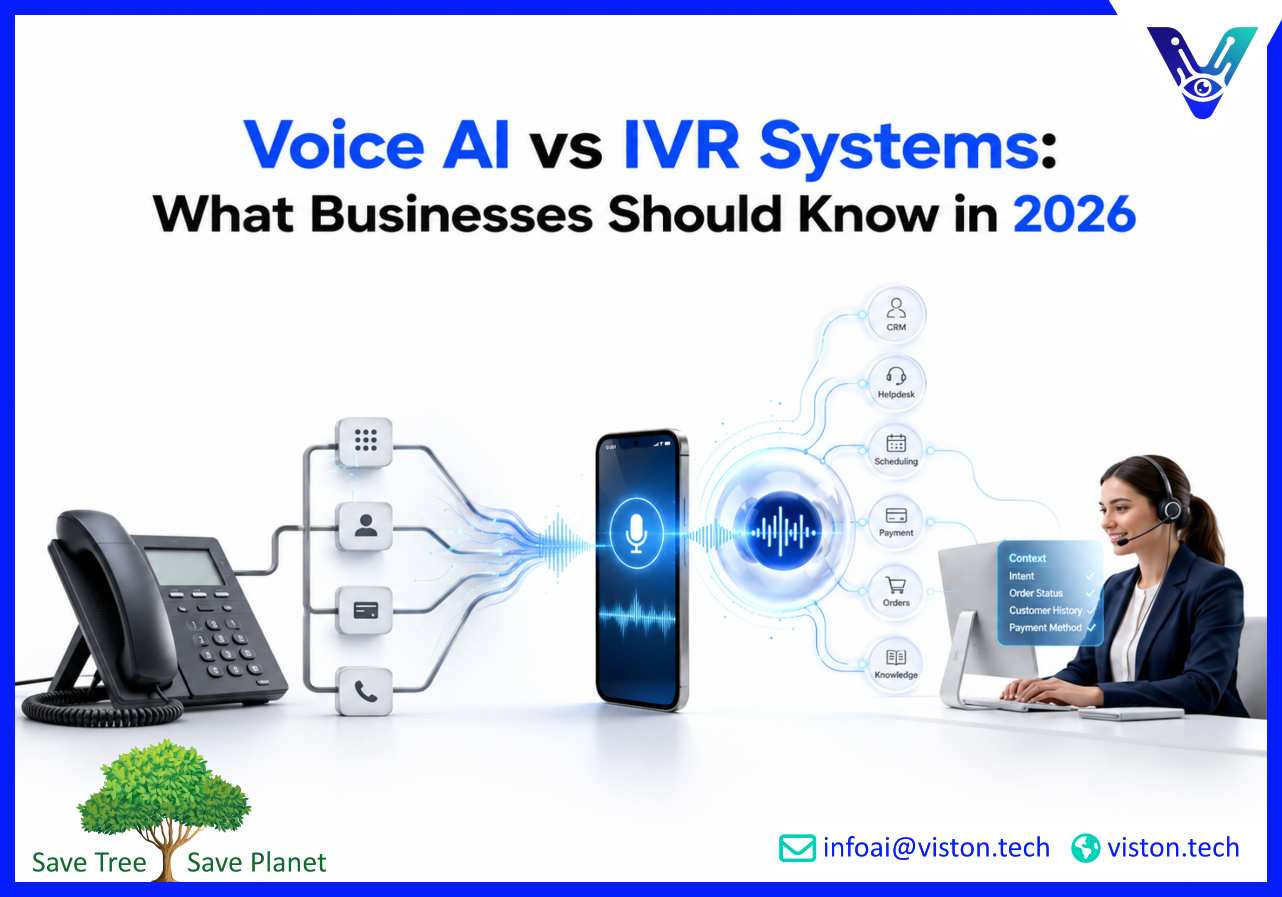
Voice AI vs IVR Systems: What Businesses Should Know in 2026
Voice AI vs IVR systems is now a practical business decision, not just a contact center technology comparison. Companies need phone automation that understands real customer intent, reduces wait times, protects service quality, and connects conversations to business workflows.
Voice AI vs IVR Systems: What Is the Real Difference?
Traditional IVR systems are menu-based call routing tools. They usually ask callers to press numbers or say limited commands such as “billing,” “support,” or “sales.” Their main purpose is to direct callers to the right queue, collect basic information, and reduce manual call handling before a human agent becomes involved.Voice AI systems work differently. They use speech recognition, natural language understanding, dialogue management, and text-to-speech technology to hold more flexible conversations. Instead of forcing callers through a fixed menu, a voice-enabled assistant can understand phrases such as “I need to change my delivery address,” “my payment failed,” or “I want to speak to someone about my policy renewal.”The difference matters because modern customers rarely think in menu structures. They explain problems in their own words. A rigid IVR may work for simple routing, but it often struggles when the caller needs a multi-step process, personalized answer, account-specific action, or contextual support.
How IVR systems typically operate
An IVR system follows predefined logic. The caller chooses from a menu, the system maps that choice to a department or workflow, and the call moves forward based on the selected path. This can be effective for simple use cases such as office hours, basic account balance checks, payment routing, appointment confirmation, or queue selection.The weakness is that IVR systems depend heavily on how well the menu is designed. If the caller does not understand the options, has a problem that does not fit the menu, or makes a mistake, the experience can become slow and frustrating.
How voice AI assistants operate
Voice AI assistants are designed to interpret intent, extract important details, maintain context, and respond conversationally. A customer can describe the issue naturally, and the assistant can ask follow-up questions, retrieve information from connected systems, complete a workflow, or escalate the conversation with context.For example, instead of asking callers to press one for delivery and two for returns, a voice AI assistant can understand: “My order arrived damaged and I need a replacement.” It can identify the issue type, ask for the order number, check the order record, explain the next steps, create a return request, and pass the case to an agent if approval is required.
Why Businesses Are Reconsidering IVR in 2026
In 2026, customer expectations around phone support are higher. People expect fast answers, natural interactions, fewer repeated questions, and smoother handoffs between automation and human teams. Businesses also need automation that can scale without damaging trust.Many IVR systems were built for call deflection and queue management. That is still useful, but it is no longer enough for businesses that handle complex support, sales qualification, bookings, claims, payments, onboarding, field service, internal IT requests, or multilingual customer communication.
Rigid menus create unnecessary friction
One of the biggest IVR problems is friction. Callers must listen to options, remember numbers, repeat details, and often wait before reaching the right person. If the menu is too long, unclear, or outdated, the caller may choose the wrong option or abandon the call.Voice AI reduces this friction by starting with the caller’s intent. The caller does not need to learn the company’s internal departments. The system can interpret the request and guide the next step based on meaning, not just menu selection.
Businesses need better context, not just routing
IVR systems often route calls but do not solve the underlying issue. Voice AI can be connected to CRM platforms, helpdesk tools, booking systems, payment systems, knowledge bases, order management platforms, and internal workflow tools. This allows the assistant to provide answers and take action within approved business rules.For decision-makers, this is a major difference. A phone system that only routes calls may reduce some workload, but a voice-enabled assistant can reduce repetitive tasks, improve first-contact resolution, and create better operational data.
Customer service teams need smarter escalation
Escalation is not a failure when it happens at the right time. The problem is poor escalation. Traditional IVR systems may transfer callers without enough context, forcing customers to repeat themselves. Voice AI can provide agents with a summary of the conversation, detected intent, customer details, attempted resolution, sentiment signals, and recommended next action.This makes human support more efficient and less frustrating. Agents spend less time gathering basic information and more time resolving the issue.
Where Voice AI Performs Better Than Traditional IVR
Voice AI is strongest when the business needs more than simple menu routing. It is especially valuable for high-volume, repetitive, or context-heavy interactions where customers expect quick support but still need accurate handling.
Natural language call handling
Voice AI allows callers to speak naturally. This is useful for customer support, appointment scheduling, claims intake, troubleshooting, account servicing, product recommendations, and lead qualification. Instead of saying only “yes,” “no,” or a department name, callers can explain the issue in their own words.This makes the experience feel less mechanical and helps the business capture more accurate intent data. Over time, teams can analyze common questions, failed conversations, escalation patterns, and customer pain points.
Multi-step workflow automation
A traditional IVR may collect a number or route a call, but voice AI can support multi-step workflows. It can ask qualifying questions, validate information, retrieve records, update a ticket, trigger a follow-up message, schedule an appointment, or start an internal process.For example, a service business can use voice AI to confirm customer identity, understand the request, check technician availability, book a visit, send confirmation, and update the CRM. This turns phone automation into a workflow engine rather than a call filter.
Personalized support through integrations
When integrated with business systems, a voice-enabled assistant can provide personalized answers. It may check order status, verify account information, confirm appointment times, review case history, retrieve plan details, or guide users through internal support steps.This is where voice AI becomes commercially valuable. The assistant is not simply answering generic FAQs. It is using business context to support real customer or employee needs.
Multilingual and accessibility support
Voice AI can help businesses serve users across languages, accents, and accessibility needs when the system is designed and tested properly. This is useful for companies operating across regions, serving diverse customer bases, or handling support where typing is inconvenient.For industries such as healthcare, retail, finance, travel, logistics, education, and home services, voice-based support can make information easier to access while reducing pressure on human teams.
When IVR Still Makes Sense and How to Choose the Right Approach
Voice AI does not make every IVR system obsolete. Some businesses still benefit from a simple IVR, especially where call volumes are low, use cases are basic, or the main need is department routing. The right decision depends on customer expectations, call complexity, integration requirements, budget, compliance risk, and support goals.
IVR is suitable for simple and predictable call flows
An IVR can work well when callers usually need one of a few fixed options. Examples include checking business hours, selecting a department, confirming a booking, making a basic payment, or routing calls by language or location.If the business does not need account-specific responses, natural language understanding, workflow automation, or advanced analytics, a traditional IVR may be enough. The important requirement is to keep menus short, clear, and updated.
Voice AI is better for complex or high-volume interactions
Voice AI becomes more valuable when callers have varied questions, when agents spend too much time on repetitive work, or when the business needs automation connected to customer records and operational systems.Common signs that a business has outgrown traditional IVR include high call abandonment, repeated transfers, long menu trees, poor first-contact resolution, frequent “wrong department” calls, multilingual support pressure, and agents repeatedly asking for information the customer already provided.
A hybrid model is often the most practical transition
Many businesses do not need to replace IVR overnight. A hybrid model can use voice AI for the highest-value or highest-volume intents while keeping IVR logic for simple routing or fallback paths. This allows teams to modernize phone automation in stages.A practical rollout may start with a few use cases, such as appointment booking, order status, lead qualification, password reset, policy lookup, or support triage. Once performance is proven, the business can expand to more advanced workflows.
Key evaluation factors for buyers
When comparing voice AI vs IVR systems, buyers should evaluate more than the interface. The real questions are operational:
Can the system understand natural caller intent accurately?
Can it handle interruptions, corrections, accents, and noisy environments?
Does it integrate with CRM, helpdesk, ERP, scheduling, payment, or knowledge systems?
Can it escalate to human agents with full context?
Does it provide analytics on intent, resolution, sentiment, drop-offs, and workflow success?
Does it support compliance, consent, data protection, audit trails, and access controls?
Can it be improved continuously after launch?
The best solution is not the one with the most impressive demo. It is the one that performs reliably in real conversations, aligns with business rules, protects customer data, and improves measurable outcomes.
How Viston AI Helps Businesses Move Beyond Traditional IVR
Viston AI is directly relevant to the voice AI vs IVR systems discussion because its Voice-Enabled Assistants service focuses on building conversational AI experiences that understand spoken language, manage context, and support business workflows. Instead of treating voice automation as a static phone menu, Viston AI approaches it as an intelligent assistant layer connected to customer service, sales, operations, and internal support processes.Its voice-enabled assistant capabilities include natural language processing, speech recognition, context management, real-time analytics, multilingual support, business system integration, and LLMOps-led monitoring. These capabilities are important for organizations that want to reduce dependency on rigid IVR paths while maintaining control, reliability, and measurable performance.For businesses in customer-facing or operations-heavy industries, Viston AI can help design voice experiences around practical use cases such as support triage, appointment handling, lead qualification, order updates, account assistance, employee helpdesk requests, and workflow automation. Its approach is especially relevant where voice AI must connect with CRM, helpdesk, ERP, knowledge base, or custom business systems.The value is not simply replacing an IVR menu with a more modern voice. The value is creating a voice assistant that understands intent, follows business rules, escalates appropriately, and improves over time through performance data. For companies evaluating voice automation in 2026, this kind of specialist delivery can help reduce implementation risk and create a more scalable customer experience.
Frequently Asked Questions
What is the main difference between voice AI and IVR systems?
The main difference is flexibility. IVR systems usually follow fixed menu paths, while voice AI systems understand natural speech, identify intent, manage context, and can complete workflows through business system integrations.
Is voice AI better than IVR for customer service?
Voice AI is usually better for complex, high-volume, or personalized customer service because it can understand real customer requests and automate more than basic routing. IVR may still work well for simple call direction and predictable menu options.
Can voice AI replace an existing IVR system?
Yes, voice AI can replace or modernize an IVR system, but many businesses start with a hybrid approach. They automate priority use cases first, measure performance, and then expand voice AI across more call flows.
What should businesses consider before moving from IVR to voice AI?
Businesses should assess call volume, customer pain points, integration needs, compliance requirements, language support, escalation rules, reporting needs, and the quality of their existing knowledge base or workflow documentation.
Does voice AI need integration with business systems?
Integration is not always required for simple voice FAQs, but it is essential for high-value use cases. CRM, helpdesk, scheduling, payment, order management, and knowledge base integrations allow voice AI to provide personalized answers and complete real tasks.
Can Viston AI help with voice AI implementation?
Yes. Viston AI provides Voice-Enabled Assistants designed around natural language understanding, speech recognition, multilingual support, analytics, workflow automation, and integration with business systems for practical enterprise and service-led use cases.
Conclusion
Voice AI vs IVR systems is ultimately a question of customer experience, operational efficiency, and business readiness. IVR can still support simple routing, but voice AI is better suited to organizations that need natural conversations, personalized support, smarter escalation, and workflow automation. In 2026, businesses should evaluate phone automation based on resolution quality, integration depth, compliance, analytics, and scalability. For companies ready to move beyond rigid menus, Voice-Enabled Assistants can create faster, more useful, and more adaptable voice experiences. Viston AI offers relevant expertise for businesses looking to modernize voice interactions with a practical, integrated approach.