
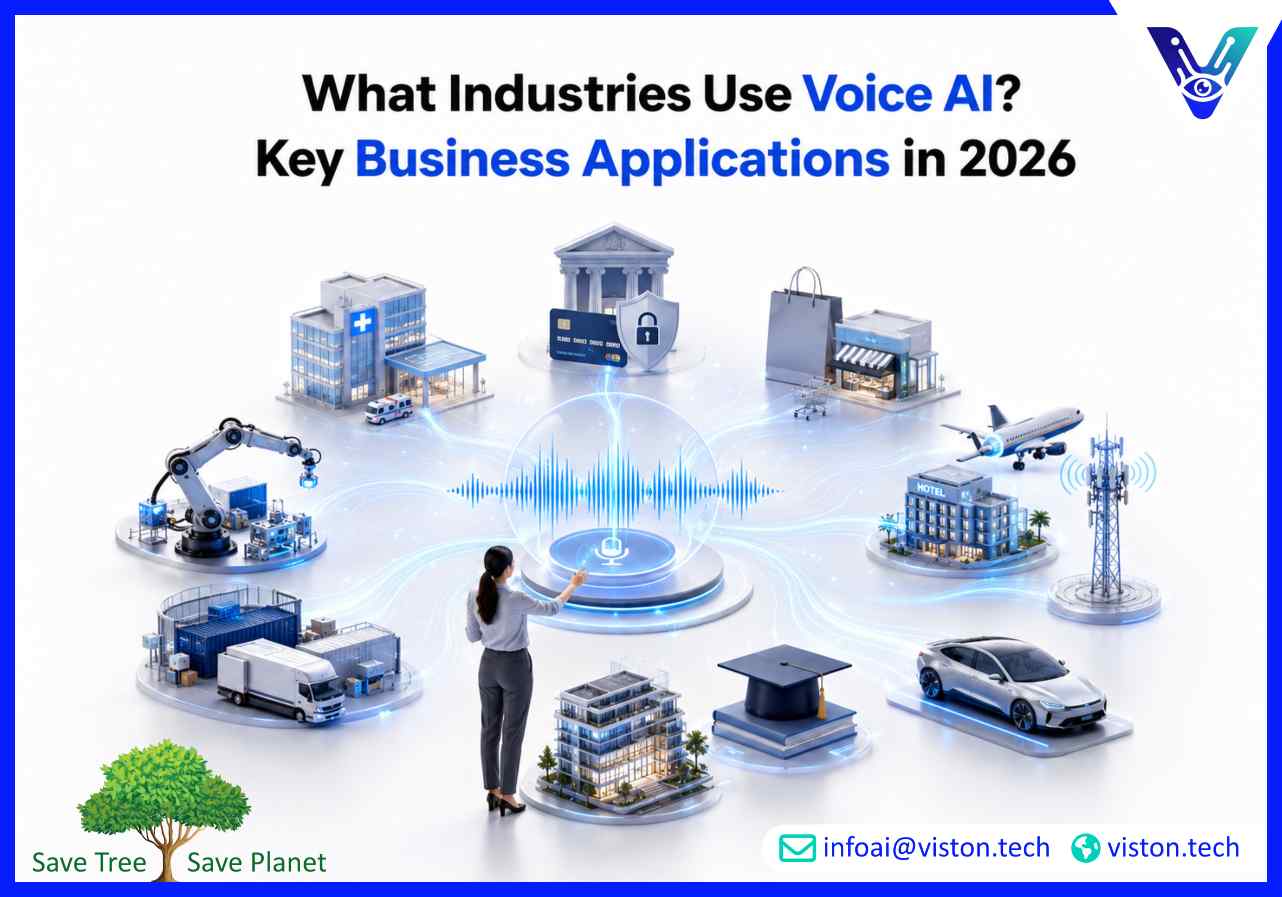
Understanding what industries use voice AI helps business leaders identify where spoken automation can reduce service pressure, improve accessibility, accelerate workflows, and support customers around the clock. In 2026, voice-enabled assistants are being considered across customer-facing, operational, sales, and employee-support environments.
Voice AI combines automatic speech recognition, natural language understanding, dialogue management, business-system integration, and text-to-speech technology. Together, these capabilities allow users to speak naturally with an automated assistant rather than navigate rigid phone menus or complete every task manually.
The technology is most valuable where organizations manage frequent conversations, repetitive requests, time-sensitive updates, multilingual audiences, or hands-busy working environments. A voice-enabled assistant may answer questions, retrieve approved information, collect structured details, schedule appointments, update records, route requests, or trigger workflows in connected systems.
Modern voice platforms can also support real-time speech generation, multiple languages, streaming audio, contextual conversations, and integration with enterprise applications. However, successful deployment depends on more than a natural-sounding voice. Businesses need accurate intent recognition, low response latency, secure data handling, reliable integrations, clear escalation rules, and ongoing performance monitoring.
Industries commonly exploring or using voice AI include:
Healthcare organizations can use voice-enabled assistants for appointment scheduling, reminders, prescription-refill requests, patient navigation, routine administrative questions, post-visit follow-ups, and internal staff support. Voice interfaces may be particularly useful for patients who have difficulty using complex digital portals.
Healthcare implementations require strict controls. The assistant must distinguish administrative support from clinical judgment, protect sensitive information, obtain appropriate consent, follow access rules, and escalate urgent or uncertain situations to qualified staff. High-volume, predictable administrative conversations are generally safer starting points than diagnosis or treatment recommendations. Healthcare providers are already evaluating voice agents across administrative, financial, and selected clinical-support workflows.
Banks, lenders, fintech companies, and insurers can apply voice AI to balance enquiries, payment-status questions, card-service requests, loan information, policy servicing, claims intake, renewal reminders, fraud-alert routing, and customer authentication workflows.
These industries need strong identity verification, transaction controls, audit trails, data minimization, and human approval for sensitive actions. An assistant may collect information and guide a customer through a process, but high-risk transactions, disputed decisions, vulnerable-customer cases, and complex financial guidance should follow controlled escalation paths.
Retailers can use voice AI for product enquiries, store information, order tracking, returns guidance, stock checks, loyalty-program support, delivery updates, and post-purchase service. Sales-focused assistants may also help users find products, compare suitable options, or complete an assisted purchase.
Integration quality is critical. The assistant needs accurate access to product catalogues, inventory, customer profiles, order systems, promotions, and fulfilment information. Without real-time data, even a fluent voice experience can provide outdated availability or incorrect delivery expectations.
Hotels, airlines, travel agencies, restaurants, and booking platforms can use voice-enabled assistants for reservations, itinerary questions, check-in information, property services, schedule updates, baggage enquiries, cancellation policies, and multilingual guest support.
Voice AI is particularly relevant in travel because demand can change suddenly during delays, weather disruption, seasonal peaks, or major events. The system should recognize when a request involves compensation, accessibility needs, safety, distressed travellers, or complex itinerary changes that require a trained human agent.
Telecom providers, energy companies, water suppliers, and internet service providers often receive large volumes of predictable calls. Voice AI can support billing enquiries, service activation, outage information, appointment scheduling, account updates, usage questions, plan information, and first-line troubleshooting.
Effective implementations connect the assistant to customer records, network-status information, field-service schedules, and ticketing systems. During widespread outages, the technology can provide consistent updates at scale while allowing human teams to focus on vulnerable customers, complex faults, and priority incidents.
Logistics companies can use voice AI for shipment tracking, delivery confirmation, driver support, dispatch coordination, warehouse enquiries, inventory verification, proof-of-delivery workflows, and customer status updates.
Voice-directed workflows can also help employees work hands-free in warehouses, vehicles, and distribution centres. In these environments, the assistant must perform reliably despite noise, accents, protective equipment, weak connectivity, and specialized product or location codes.
Manufacturers, engineering companies, maintenance providers, and field-service teams can deploy voice assistants for inspection checklists, maintenance logging, equipment information, safety prompts, spare-parts lookup, incident reporting, and technician guidance.
The strongest use cases reduce the need to stop work and enter data manually. However, voice AI should not replace established safety procedures or qualified engineering judgment. Instructions must come from controlled technical sources, and safety-critical actions should include confirmations, permissions, and clear escalation rules.
Real estate agencies, developers, rental platforms, and property managers can use voice AI to qualify enquiries, answer property questions, schedule viewings, collect maintenance requests, provide application updates, and route tenants or buyers to the correct team.
For lead handling, the assistant can capture location preferences, property type, budget range, timeline, and contact details before updating a CRM. Sensitive discussions involving contracts, affordability, disputes, or legal obligations should be passed to an appropriate professional.
Schools, universities, training providers, and education platforms can use voice assistants for admissions enquiries, course information, timetable support, campus navigation, student-service routing, language practice, accessibility, and internal administrative help.
Deployments involving children, assessments, student records, or personalized learning require careful privacy and safeguarding controls. Institutions should also make it clear when a learner is interacting with an automated system and provide access to human support.
Automotive businesses can apply voice AI in connected vehicles, dealership service, roadside assistance, maintenance booking, vehicle-information systems, fleet operations, and driver-support applications. Hands-free interaction is especially relevant where visual or manual interfaces could distract the user.
Safety boundaries are essential. Entertainment, navigation, and routine vehicle information may be suitable for automation, while emergency situations and vehicle-control functions require rigorous validation, restricted permissions, and dependable fallback behaviour.
Voice AI is not equally suitable for every conversation. The strongest initial use cases are usually frequent, structured, measurable, and supported by reliable business data. They should provide a clear user benefit without requiring excessive judgment or creating unacceptable risk.
Good candidates often include:
Complex complaints, emergency situations, regulated advice, emotionally sensitive conversations, unusual exceptions, and high-value decisions normally require a human-in-the-loop design. The assistant can collect context and prepare a handover, but the customer should be transferred before automation creates frustration or risk.
Organizations should also avoid measuring success only through call containment. A low transfer rate is not valuable when users receive incomplete answers. Better measures include task-completion rate, first-contact resolution, user satisfaction, intent accuracy, appropriate escalation, workflow success, response latency, and the accuracy of updates written to business systems.
Businesses should begin by identifying a specific workflow rather than purchasing voice technology without a defined purpose. Review call volumes, repetitive intents, average handling times, service gaps, abandonment points, seasonal demand, and tasks that create avoidable manual work.
A voice assistant needs access to reliable information. Buyers should identify the systems of record for customer data, appointments, orders, products, tickets, policies, inventory, and workflow status. They should also determine whether APIs, webhooks, CRM connectors, or middleware are available.
Testing should reflect genuine operating conditions, including background noise, varied accents, interruptions, incomplete sentences, uncommon names, technical terminology, code-switching, and ambiguous requests. A scripted demonstration is not enough to prove production readiness.
Voice interactions may capture personal, financial, health, employment, or biometric information. Procurement teams should evaluate encryption, retention policies, access control, consent management, redaction, audit logging, hosting options, model providers, and the treatment of recorded conversations.
The assistant should know when it lacks confidence, when a request falls outside scope, and when a customer needs a person. After launch, teams should review failed conversations, fallback patterns, escalation reasons, user sentiment, integration errors, and newly emerging intents.
Viston AI is directly relevant to businesses researching what industries use voice AI because Voice-Enabled Assistants are part of its published enterprise AI service portfolio. Its service combines speech recognition, natural language processing, context management, speech synthesis, enterprise integration, analytics, and model-operations capabilities for conversational voice applications.
The company describes industry applications across healthcare, finance and banking, retail, manufacturing, logistics, hospitality, education, automotive, real estate, telecommunications, and other operational environments. Its approach also includes connections with CRM, ERP, service-management, healthcare, HR, and custom business systems so assistants can retrieve information and complete approved workflows rather than operate as isolated call-answering tools.
For organizations evaluating voice automation, this integration-led approach is important. A useful voice assistant must understand industry terminology, follow business rules, access current data, transfer conversations with context, and provide measurable operational reporting. Viston AI also presents multilingual support, role-based access, audit trails, PII handling, testing, deployment management, and continuous performance monitoring as components of its voice-assistant offering.
These capabilities may be relevant to companies seeking a tailored voice-enabled assistant for customer service, employee support, sales qualification, scheduling, operational guidance, or connected workflow automation.
Industries with high call volumes, repetitive enquiries, scheduling needs, multilingual users, or hands-free workflows often benefit most. These include healthcare, finance, insurance, retail, travel, telecom, logistics, manufacturing, real estate, and utilities.
No. Voice AI can also support sales qualification, employee helpdesks, warehouse operations, field-service reporting, appointment management, training, inspections, inventory checks, dispatch coordination, and internal knowledge access.
Yes. Small businesses can use focused voice assistants for appointment booking, missed-call handling, lead capture, FAQs, order updates, and after-hours enquiries. A narrow, well-integrated use case is usually more practical than automating every conversation at once.
Healthcare, banking, insurance, public services, employment, and other regulated sectors generally require stronger privacy, identity, consent, auditability, access-control, and human-review measures because conversations may involve sensitive data or significant decisions.
Modern systems can support multiple languages and regional speech patterns, but performance varies by language, accent, acoustic environment, terminology, and training data. Businesses should test the assistant with representative users before deployment.
Viston AI presents Voice-Enabled Assistants as a customizable enterprise service covering industry terminology, multilingual conversations, analytics, system integration, security controls, deployment, and ongoing optimization.
What industries use voice AI depends largely on conversation volume, workflow structure, data availability, user needs, and risk. Healthcare, finance, retail, travel, telecom, logistics, manufacturing, real estate, education, and automotive organizations all have practical applications for Voice-Enabled Assistants. The strongest results come from automating clearly defined tasks, integrating reliable business systems, protecting sensitive information, and preserving human support for complex situations. Viston AI offers relevant voice-assistant development capabilities for businesses seeking secure, scalable, and operationally connected voice experiences.
