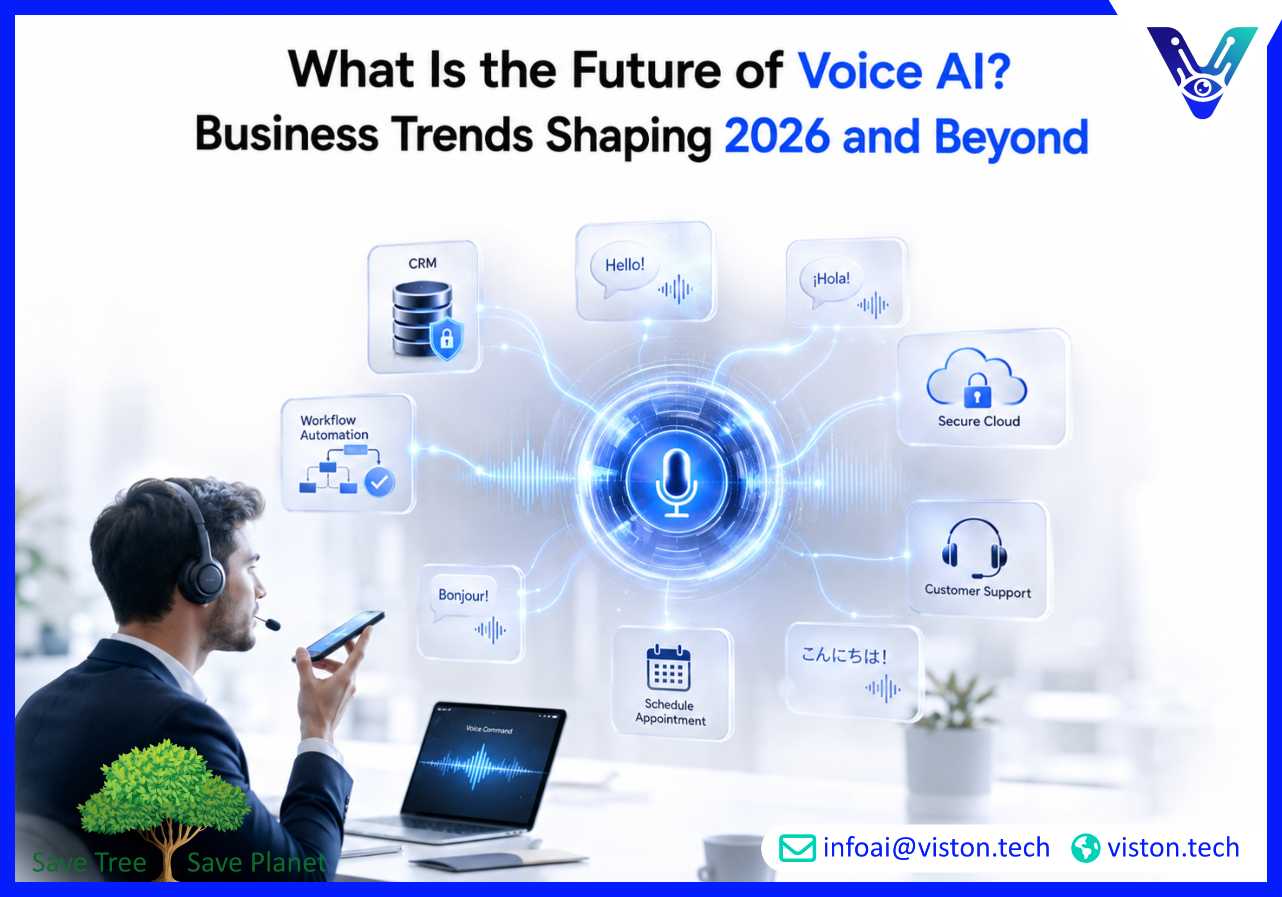
What Is the Future of Voice AI? Business Trends Shaping 2026 and Beyond
The future of voice AI is moving beyond simple question-and-answer assistants. In 2026, businesses are adopting voice-enabled systems that understand context, complete tasks, connect with operational platforms, support multiple languages, and provide natural interactions across customer service, sales, employee support, and business workflows.
What the Future of Voice AI Means for Businesses
Voice AI refers to artificial intelligence systems that can understand spoken language, interpret user intent, generate relevant responses, and communicate through natural-sounding speech. Modern voice-enabled assistants combine automatic speech recognition, natural language processing, generative AI, text-to-speech technology, business data, and workflow automation.The next stage of voice AI will be defined less by how human a digital voice sounds and more by what the assistant can accomplish. Businesses will expect voice systems to identify customers, retrieve information, complete approved transactions, update records, schedule appointments, qualify leads, create support tickets, and transfer complex cases to employees with the full conversation context.This shift is turning voice interfaces into operational tools rather than standalone communication channels. A voice assistant may begin a conversation through a telephone call, continue it through a mobile application, send a confirmation by email or messaging, and record the outcome in a customer relationship management platform.
Voice assistants will become task-oriented AI agents
Traditional voice bots usually follow scripts, menu trees, or predefined intent flows. Future systems will operate more like controlled AI agents. They will interpret a goal, determine which systems or tools are required, perform a sequence of approved actions, and confirm that the requested outcome has been completed.For example, a customer may ask to change a delivery date. Instead of reading a general policy, an advanced voice assistant could verify the customer, check the order management system, identify available dates, update the delivery, notify the logistics team, and send confirmation.This agentic capability will make voice AI more useful, but it will also require stronger permissions, validation rules, audit trails, and human oversight. Businesses will need to define exactly what an assistant can access, what it can change, and which requests require employee approval.
Conversation quality will depend on context
Future voice-enabled assistants will be expected to remember relevant information during a conversation, understand follow-up questions, handle interruptions, and respond without forcing users to repeat details. Context may include the customer’s account, previous interactions, current order, product ownership, language preference, or stage in a service process.This does not mean every conversation should be stored indefinitely. Context handling must be designed around consent, data minimization, retention policies, and access control. The most effective systems will balance personalization with privacy rather than collecting unnecessary information.
Major Voice AI Trends Shaping 2026 and Beyond
The future of voice AI will be shaped by improvements in speech models, faster processing, multimodal interaction, multilingual capabilities, enterprise integration, and responsible AI governance. Voice is increasingly becoming part of a broader conversational platform rather than a separate technology.
1. Faster and more natural speech-to-speech interaction
Older voice systems often process a conversation through several separate stages: converting speech to text, sending the text to a language model, generating a response, and converting the response back into speech. Each handoff can introduce delay or misunderstanding.Newer speech-to-speech approaches are reducing these delays and making conversations more fluid. Future assistants will respond more quickly, recognize when a person interrupts, adjust their speaking pace, and handle pauses without assuming the conversation has ended. Current enterprise evaluations increasingly treat latency, interruption handling, telephony compatibility, and production reliability as core requirements rather than optional features.
2. Multilingual and accent-aware assistants
Voice AI will increasingly be designed for multilingual use from the beginning. Global businesses need assistants that can understand regional accents, switch languages during a conversation, pronounce names correctly, and communicate using appropriate local terminology.Simply translating a script is not enough. A reliable multilingual assistant must be tested separately for each language, dialect, channel, and use case. Product names, addresses, numbers, technical terminology, dates, and cultural expectations may all be expressed differently.Multilingual orchestration is becoming a central enterprise requirement because inconsistent performance across languages can create unequal service quality and operational risk. Industry analysis for 2026 identifies multilingual, multimodal, and real-time orchestration as major directions for enterprise voice experiences.
3. Multimodal customer and employee journeys
Voice will work alongside text, images, screens, documents, and applications. A customer may speak to an assistant while viewing available products, receive a payment link by text, upload a document, or review a summary before confirming an action.This is especially valuable when voice alone is inefficient. Long reference numbers, complex forms, detailed pricing options, legal terms, and visual troubleshooting instructions are often easier to present on a screen. Future voice AI will recognize when another channel is more appropriate and move the user between channels without losing context.
4. Voice AI embedded in business systems
The usefulness of a voice assistant depends heavily on its integrations. Future systems will be connected to CRM platforms, helpdesk software, scheduling tools, ERP systems, knowledge bases, ecommerce platforms, payment workflows, identity services, and internal databases.These connections allow the assistant to provide account-specific answers and complete business processes. They also create technical responsibilities. Integration teams must control authentication, field mapping, error handling, retry logic, data synchronization, and permissions.A voice assistant should never claim that a task has been completed merely because a user requested it. The underlying workflow must confirm success, record the action, and provide a reliable response when a connected system is unavailable.
5. Greater use of edge and hybrid processing
Some future voice experiences will process more information on local devices or private infrastructure. Edge processing can reduce latency, support limited offline functionality, and lower the amount of sensitive audio that must be transmitted to external services.Many enterprise deployments will use a hybrid model. Wake-word detection, noise reduction, or basic commands may be processed locally, while more complex reasoning and workflow execution use controlled cloud infrastructure. The correct architecture will depend on security requirements, connectivity, performance, cost, and the sensitivity of the use case.
Where Voice AI Will Create the Most Business Value
Voice AI will not replace every human conversation. Its strongest business value will come from high-volume, repeatable interactions where people benefit from immediate assistance and where the requested task can be completed safely through structured systems.
Customer service and contact centers
Voice-enabled assistants can answer routine questions, authenticate users, retrieve account information, process simple service requests, and collect details before transferring a call. This can reduce queue pressure and give human agents more time for emotionally sensitive, unusual, or commercially important cases.The future contact center will use AI before, during, and after calls. An assistant may handle routine conversations independently, provide real-time guidance to employees, summarize calls, classify outcomes, update records, and recommend follow-up actions.Success should be measured through resolution quality, customer satisfaction, transfer accuracy, repeat-contact rate, average handling time, workflow completion, and compliance—not simply the number of calls automated.
Sales, qualification, and appointment management
Voice AI can respond to enquiries, ask qualification questions, schedule meetings, confirm attendance, and route opportunities to the appropriate sales representative. It may also support existing customers with renewals, product information, or account reviews.However, automated outbound calling requires careful legal and reputational management. Businesses must consider consent, identification, calling restrictions, recording rules, and disclosure requirements in every relevant jurisdiction. In the United States, the Federal Communications Commission has confirmed that AI-generated voices fall within restrictions covering artificial or prerecorded voice calls.
Internal employee assistance
Employees will increasingly use voice to search company knowledge, report incidents, request IT support, complete administrative tasks, and retrieve operational information while working hands-free.Voice interfaces may be particularly valuable in warehouses, field service, manufacturing, healthcare operations, logistics, and other environments where employees cannot easily use a keyboard. The assistant could check inventory, read instructions, record inspection results, create maintenance requests, or guide a worker through an approved procedure.Internal assistants still require strong identity and access management. Employees should only receive information and actions permitted by their role, location, department, and level of authorization.
Accessibility and inclusive digital services
Voice AI can make digital services easier to use for people who have difficulty typing, navigating complex interfaces, reading small screens, or using touch controls. It can also help users complete tasks while driving, working with equipment, or managing other responsibilities.Accessibility should be treated as a design requirement rather than a side benefit. Businesses should test voice experiences with diverse users, provide alternative interaction methods, support slower speech patterns, and ensure that users can reach a human when the system cannot understand them.
How Businesses Should Prepare for the Future of Voice AI
Organizations should approach voice AI as a service-design and operational transformation project, not simply as the purchase of a speech model. A successful assistant requires clear use cases, reliable integrations, well-governed data, realistic testing, ongoing monitoring, and defined human responsibilities.
Begin with a focused business problem
The strongest starting point is usually a high-volume process with clear rules and measurable outcomes. Examples include appointment scheduling, order status, password support, lead qualification, service-ticket creation, delivery confirmation, or internal knowledge retrieval.A narrow first deployment makes it easier to test accuracy, control risk, identify integration issues, and demonstrate value. The scope can then be expanded based on real conversation data rather than assumptions.
Evaluate the full voice AI stack
Businesses should assess more than voice quality. Provider evaluation should include speech recognition accuracy, latency, interruption handling, noise performance, multilingual support, telephony integration, workflow capability, data security, analytics, model monitoring, escalation design, and deployment options.Teams should test the assistant using real accents, background conditions, terminology, and customer behaviour. A polished demonstration in a quiet environment does not prove that a system will work reliably during production calls.
Build governance before scaling
Voice systems may process personal identifiers, account details, payment information, health-related information, employee data, and recorded conversations. Businesses need policies covering consent, storage, retention, access, redaction, vendor use, incident response, and deletion.Governance should also address hallucinated answers, unauthorized actions, bias, voice cloning, fraud, and disclosure. Frameworks such as the NIST AI Risk Management Framework can help organizations structure how they govern, map, measure, and manage AI risks.Regulatory expectations are also becoming more specific. The European Union’s AI Act entered into force in August 2024, with additional provisions and transparency obligations applying through a phased implementation timeline. Organizations operating in or serving the European market should assess how those requirements affect voice-based systems before deployment.
Keep humans responsible for sensitive decisions
Voice AI should support employees rather than obscure accountability. High-risk, disputed, emotional, regulated, or financially significant interactions should include clear escalation paths. A human should be able to review what the system understood, what information it accessed, and which actions it attempted.Businesses should also design failure behaviour deliberately. When confidence is low, information conflicts, or an integration fails, the assistant should ask for clarification, provide a safe alternative, or transfer the interaction instead of improvising.
How Viston AI Supports the Future of Voice-Enabled Assistants
Viston AI provides Voice-Enabled AI Assistant services designed around enterprise conversational interactions. Its service offering combines speech recognition, speech synthesis, natural language processing, context management, business-system integration, analytics, and model lifecycle management. These capabilities align with the direction of voice AI as it moves from isolated voice bots toward connected assistants that can support real operational workflows.The company’s voice service includes multilingual capabilities, multi-turn conversation support, intent classification, sentiment analysis, monitoring, and integration with enterprise platforms and custom APIs. This is relevant for organizations planning customer service automation, internal assistance, hands-free workflows, or voice interfaces connected to CRM, ERP, service-management, and knowledge systems.Viston AI’s broader capabilities in AI agents, chatbot development, NLP, workflow automation, system integration, MLOps, and model monitoring can also support the technical work surrounding a voice deployment. Rather than treating voice as a standalone interface, businesses can connect it to approved data, permissions, workflows, escalation procedures, and performance reporting.For organizations evaluating the future of voice AI, this integration-focused approach is important. Long-term value will depend on whether an assistant can operate securely, communicate naturally, complete useful tasks, and improve through structured monitoring without creating unmanaged operational risk.
Frequently Asked Questions
What is the future of voice AI?
The future of voice AI is centred on contextual, task-oriented assistants that can understand natural speech, access approved business information, complete workflows, and communicate across voice, text, and visual channels. These systems will become more multilingual, responsive, integrated, and governed.
Will voice AI replace human customer service agents?
Voice AI will automate many routine conversations, but it is unlikely to replace human service teams completely. Employees will remain essential for complex decisions, complaints, negotiations, sensitive situations, exceptions, and conversations requiring empathy or judgment.
Which industries will benefit most from voice AI?
Voice AI can support customer service, healthcare administration, financial services, retail, hospitality, logistics, manufacturing, real estate, education, automotive services, telecommunications, and field operations. Its value is highest where spoken interaction is convenient and workflows can be completed safely.
What are the main risks of future voice assistants?
Key risks include privacy breaches, inaccurate responses, unauthorized actions, fraud, voice impersonation, biased performance, poor escalation, regulatory non-compliance, and unreliable integrations. These risks should be managed through access controls, testing, monitoring, disclosure, audit trails, and human oversight.
Will voice AI work without an internet connection?
Some functions can run locally, including wake-word detection, basic commands, and limited speech processing. Complex reasoning, large knowledge retrieval, and integrated workflows may still require cloud or private-network access. Hybrid architectures will become increasingly common.
How can Viston AI help businesses adopt voice-enabled assistants?
Viston AI supports Voice-Enabled AI Assistants through speech and language technology, multilingual conversation design, enterprise integration, analytics, workflow automation, and model monitoring. These capabilities can help businesses move from an initial voice use case to a connected and scalable deployment.
Conclusion
The future of voice AI will be defined by assistants that do more than speak naturally. They will understand context, connect with business systems, complete approved tasks, support multiple languages, and move smoothly between communication channels. Businesses considering Voice-Enabled Assistants should focus on practical use cases, integration quality, latency, security, governance, accessibility, and measurable outcomes. Organizations that build these foundations early will be better positioned to use voice AI as a reliable operational capability. Viston AI offers relevant development, integration, automation, and monitoring capabilities for companies preparing to adopt this next generation of conversational technology.