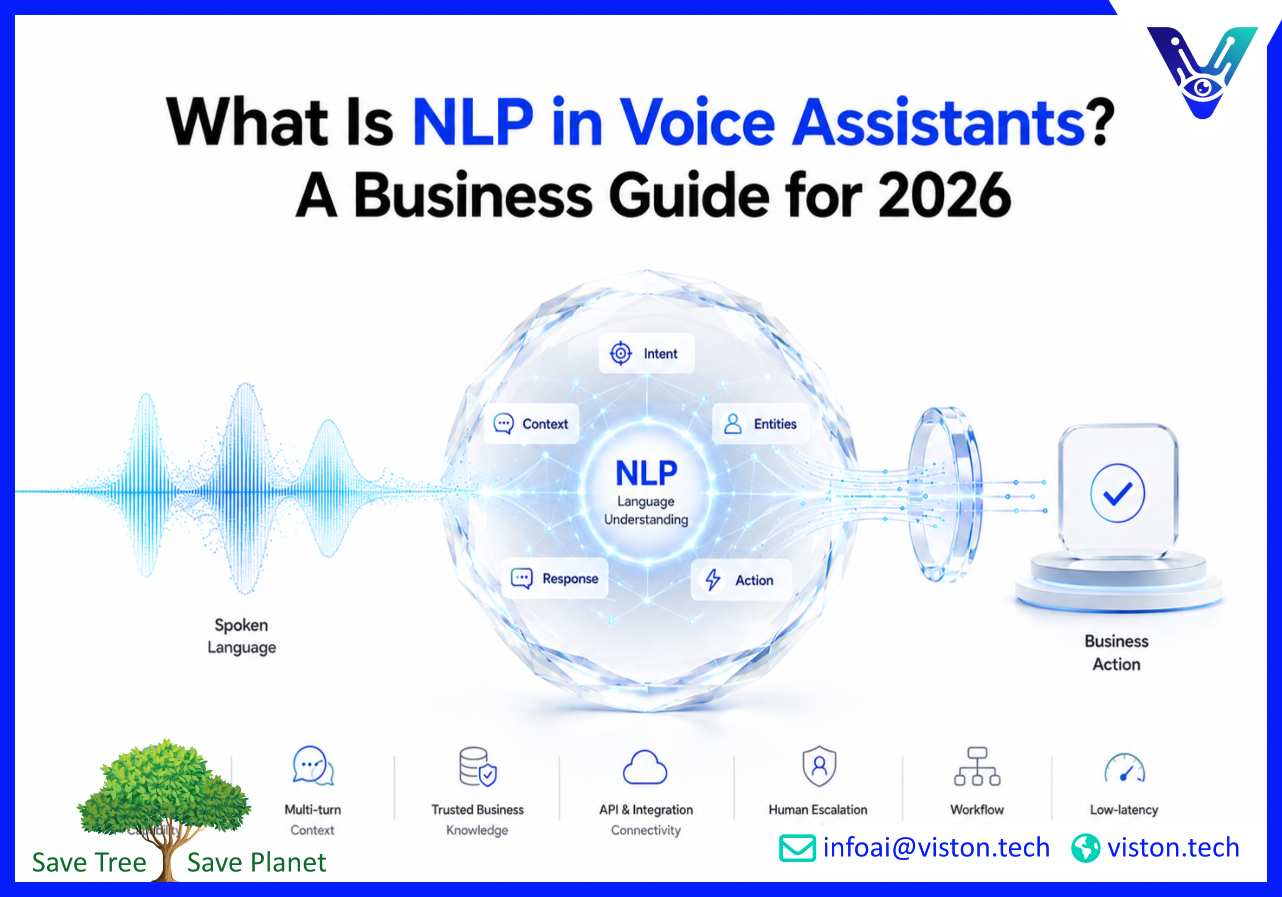
What Is NLP in Voice Assistants? A Business Guide for 2026
NLP in voice assistants is the technology that helps software interpret spoken language, identify what a user means, and produce a relevant response or action. For businesses, it is the intelligence layer that turns a voice interface from a simple speech recorder into a practical conversational tool.
What NLP in Voice Assistants Actually Means
Natural language processing, or NLP, is a field of artificial intelligence that enables computers to work with human language. In a voice assistant, NLP helps the system understand words, sentence structure, context, intent, and sometimes sentiment after speech has been captured. IBM describes NLP as technology that enables computers to recognize, understand, and generate text and speech.It is important to separate NLP from speech recognition. Automatic speech recognition converts audio into text. NLP then analyzes that text to determine what the speaker wants. Text-to-speech technology performs the final step by turning the assistant’s response back into audible speech. These components work together, but they solve different problems.For example, a customer may say, “I need to move my delivery to Friday afternoon.” Speech recognition transcribes the sentence. NLP identifies the intent as rescheduling a delivery, extracts “Friday afternoon” as the preferred time, checks whether more information is needed, and passes the request to a scheduling or order-management workflow.
NLP, NLU, and NLG Are Related but Different
NLP is the broad discipline. Natural language understanding, or NLU, focuses on interpreting meaning, while natural language generation, or NLG, helps create a suitable response. IBM notes that NLU is a branch of NLP focused on meaning and context, while NLG is used by voice assistants to formulate spoken responses.In business systems, these capabilities are combined with language models, knowledge bases, APIs, and workflow automation. The result can manage multi-step conversations, request missing details, retrieve approved information, and trigger actions in connected systems.
How NLP Works Inside a Voice Assistant
A voice interaction may feel immediate, but several stages occur between the user speaking and the assistant replying. The exact architecture varies. Some systems use a modular pipeline with separate speech-to-text, language-processing, and text-to-speech services. Newer speech-to-speech models can combine several stages within one real-time model. AWS documented this distinction in 2026, noting that integrated voice models can combine speech recognition, language understanding, speech generation, tool use, and interruption handling.
1. Capturing and Transcribing Speech
The assistant first receives an audio stream from a phone line, mobile application, smart device, website, or embedded system. Speech recognition converts the audio into text. Performance can be affected by background noise, microphone quality, accents, speaking speed, code-switching, domain terminology, and connection quality.
2. Detecting the User’s Intent
Intent detection identifies the goal behind an utterance. “Where is my order?”, “Has my package shipped?”, and “Can you track delivery 4821?” may all map to an order-status intent. Good NLP design recognizes these variations without forcing users to memorize exact commands.
3. Extracting Entities and Details
Entities are the specific values needed to complete a task. They may include dates, account numbers, product names, locations, quantities, appointment types, or customer identifiers. In the delivery example, the assistant may need the order number, preferred date, and time window before it can continue.
4. Managing Context Across Turns
Real conversations are rarely completed in one sentence. A user may say, “Book a consultation next week,” then add, “Tuesday would be better.” Context management allows the assistant to understand that Tuesday refers to the consultation already being discussed. It also helps the system maintain state, confirm critical details, and avoid repeatedly asking the same question.
5. Selecting a Response or Action
After understanding the request, the assistant may retrieve an answer, search an approved knowledge base, call an API, update a CRM record, create a ticket, schedule an appointment, or transfer the conversation to a human. NLP translates human language into structured instructions that software and business systems can use. IBM describes this role as turning a user’s words into machine actions.
6. Generating and Speaking the Reply
The response is prepared in language appropriate to the user and converted into speech. The assistant should sound clear, concise, and natural because users cannot scan a spoken answer as easily as a webpage. Effective voice responses usually confirm the action, provide the essential result, and explain the next step without unnecessary detail.
Why NLP Matters for Business Voice Assistants in 2026
Businesses do not invest in voice-enabled assistants merely to recognize words. They need systems that understand requests accurately, complete useful tasks, and support a consistent customer or employee experience. NLP determines whether a voice assistant can handle real language rather than rigid menu choices.
More Natural Customer Interactions
Traditional interactive voice response systems often require callers to choose numbered options or use limited phrases. NLP allows users to describe their needs in their own words. A caller can say, “I was charged twice,” rather than navigate several menus to find billing support. This reduces friction and helps route the conversation correctly.
Faster Service and Workflow Automation
When NLP is connected to business systems, a voice assistant can complete repetitive tasks during the conversation. Common examples include checking order status, booking appointments, qualifying leads, resetting credentials, updating contact details, collecting service information, and creating support tickets.Business value comes from successful completion, not simply answering a call. Measure task completion, transfer quality, latency, intent accuracy, customer satisfaction, and workflow success.
Better Handling of Multilingual and Domain-Specific Language
Modern businesses may need to support multiple languages, regional expressions, accents, and industry terms. NLP models can be adapted with domain vocabulary, example utterances, pronunciation guidance, and approved business knowledge. This is especially important where customers use product codes, medical terms, technical abbreviations, or local language variations.
Context-Aware Escalation
A well-designed assistant should know when automation is no longer appropriate. Repeated misunderstanding, high-risk requests, complaints, cancellations, fraud indicators, or emotionally sensitive situations may require a human agent. NLP can help detect these signals and create a structured handover summary so the user does not need to repeat the entire conversation.
Improved Accessibility and Availability
Voice interfaces can help people who find typing difficult, need hands-free access, or use services while mobile. They can also extend service availability. Accessible design still requires clear language, tolerance for pauses and corrections, and alternatives when voice is unsuitable.
What Makes NLP Effective in a Voice-Enabled Assistant
Strong NLP performance depends on system design, business data, conversation design, integration quality, and ongoing optimization. A general language model alone is not enough for reliable business deployment.
Clear Use Cases and Intent Design
The project should start with defined tasks, required data, business rules, escalation points, and success criteria. Broad goals such as “answer every customer question” make testing difficult. Focused use cases produce clearer training data and measurable outcomes.
Accurate and Governed Knowledge
The assistant needs approved information from product documentation, policies, FAQs, CRM records, service databases, or internal knowledge bases. Content should have owners, review cycles, permissions, and source-of-truth rules. When information is missing or conflicting, the system should ask for clarification or escalate rather than invent an answer.
Business-System Integration
NLP identifies what the user wants, but integrations allow the assistant to act. A booking request may require calendar access. Order support may require an ecommerce or ERP connection. Lead qualification may require CRM updates. Integration design should address authentication, permissions, error handling, duplicate records, latency, and audit logs.
Low-Latency Conversation Design
Voice interactions are sensitive to delay. Long pauses make users think the system has failed. Teams should optimize speech processing, model response time, API calls, and audio generation. The assistant should also support interruption, correction, and confirmation so users can recover naturally when the conversation changes.
Testing Beyond Ideal Phrases
Testing should include accents, noise, ambiguous requests, interruptions, uncommon names, mixed-language speech, and unexpected responses. Both component and end-to-end testing matter because a correct transcript can still produce the wrong intent or a failed workflow.
Privacy, Security, and Human Oversight
Voice systems may process personal, account, payment, health, or employee information. Businesses need data minimization, secure transmission, retention rules, access controls, consent practices, and clear escalation paths appropriate to their jurisdiction and use case. Human review remains important for high-impact decisions and conversations where the assistant lacks confidence.
How Viston AI Applies NLP to Voice-Enabled Assistants
Viston AI is relevant to this topic because its service portfolio includes Voice-Enabled Assistants, Natural Language Processing Solutions, AI Chatbot and Virtual Assistant Development, multilingual support, and integration with business systems. Its official site presents these capabilities as connected parts of a broader conversational AI and automation offering.For businesses, that combination matters because an effective voice assistant requires more than speech recognition. It needs language understanding, conversation logic, trusted knowledge, operational integrations, and a reliable path from spoken request to completed action. This is particularly useful when the assistant must understand domain language, gather structured details, and hand complex or sensitive conversations to employees with context.Viston AI’s service alignment is relevant to customer-service automation, lead handling, employee assistance, knowledge access, and appointment workflows. Its listed NLP capabilities also support multilingual interaction, text analysis, and structured information extraction.A practical delivery approach should cover use-case discovery, conversation mapping, data and integration assessment, model selection, testing, deployment, and monitoring. This keeps the assistant focused on measurable tasks while addressing accuracy, security, latency, scalability, and user experience.
Frequently Asked Questions
What Is NLP in Voice Assistants?
NLP in voice assistants is the AI technology used to interpret spoken language, identify intent and important details, manage conversational context, and prepare a relevant response or action. It operates alongside speech recognition and text-to-speech technology.
Is Speech Recognition the Same as NLP?
No. Speech recognition converts audio into text. NLP analyzes the language to understand meaning and decide what should happen next. A voice assistant normally needs both capabilities.
How Does NLP Improve Voice Assistant Accuracy?
NLP improves accuracy by recognizing different ways users express the same intent, extracting details such as dates or account numbers, maintaining context, and using business-specific language and knowledge. Accuracy still depends on speech quality, data quality, model design, and testing.
Can NLP Voice Assistants Understand Multiple Languages?
Yes, provided the selected speech and language models support the required languages and are tested with relevant accents, vocabulary, and code-switching patterns. Multilingual deployment also requires localized conversation design and approved content.
What Business Tasks Can NLP-Powered Voice Assistants Handle?
They can support tasks such as appointment booking, order tracking, lead qualification, customer verification, FAQ handling, ticket creation, employee helpdesk requests, and call routing. The assistant must be integrated with the systems needed to complete each task.
How Can Viston AI Support an NLP-Based Voice Assistant Project?
Viston AI offers services related to Voice-Enabled Assistants, NLP, virtual assistant development, multilingual support, and business-system integration. These capabilities are relevant to designing, connecting, deploying, and improving voice assistants for defined business workflows.
Conclusion
NLP in voice assistants is the language intelligence that turns spoken requests into understandable intents, structured data, useful responses, and business actions. In 2026, effective Voice-Enabled Assistants require strong speech processing, contextual understanding, trusted knowledge, secure integrations, realistic testing, and well-designed human handovers. Businesses should evaluate solutions by task success and user experience rather than by how human the voice sounds. Viston AI’s combination of voice, NLP, multilingual, virtual assistant, and integration capabilities makes it relevant for organizations planning practical voice automation around clearly defined workflows.