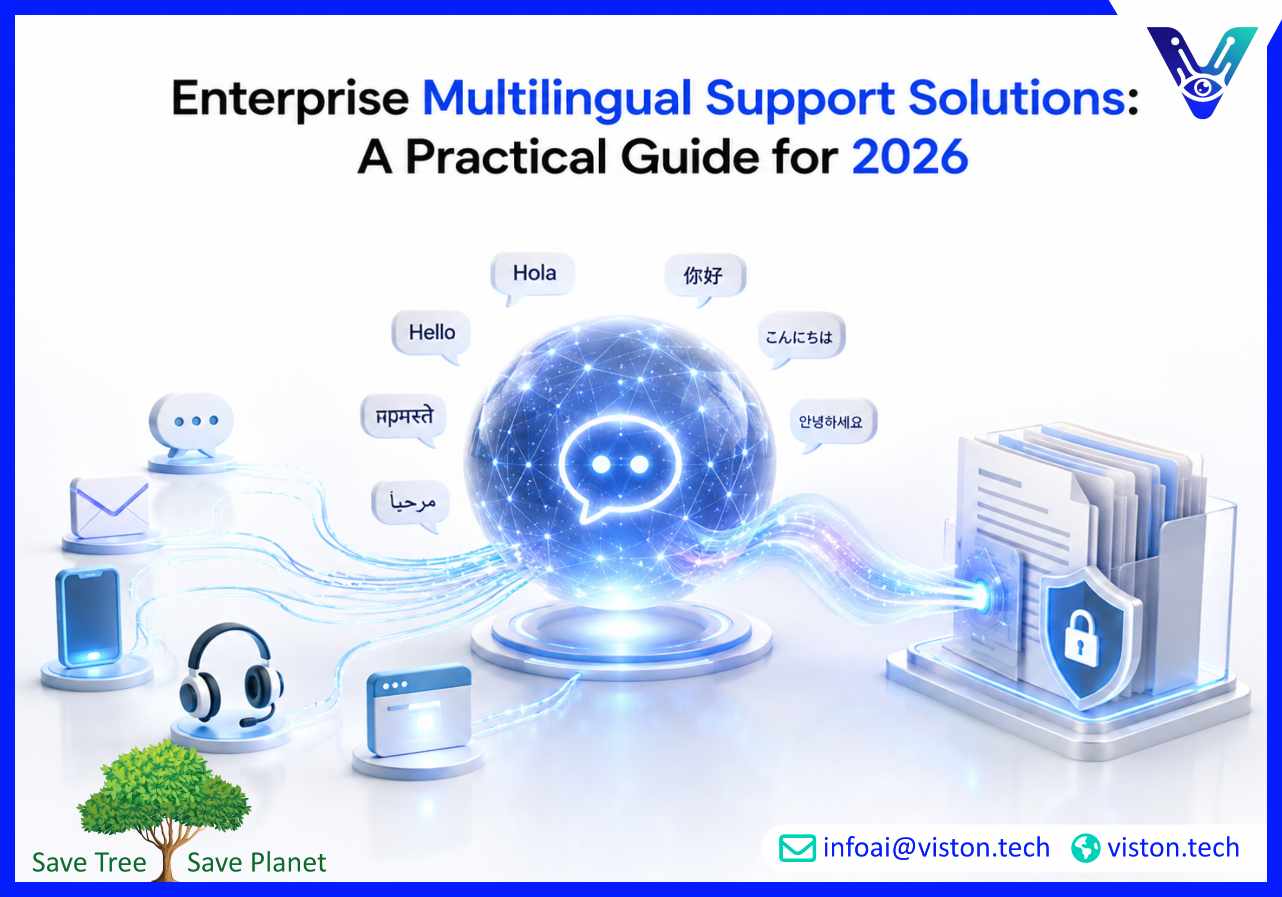
Enterprise Multilingual Support Solutions: A Practical Guide for 2026
Enterprise multilingual support solutions help global businesses serve customers consistently across languages, regions, channels, and time zones. In 2026, the challenge is no longer simple translation. Enterprises need secure, context-aware support systems that preserve meaning, follow business rules, connect with operational platforms, and escalate complex conversations to the right human team.
What Enterprise Multilingual Support Solutions Actually Involve
Enterprise multilingual support is an operating capability that allows customers, employees, partners, or users to receive accurate assistance in their preferred language. It may cover website chat, mobile applications, email, messaging platforms, social channels, contact centres, voice assistants, self-service portals, and internal helpdesks.A complete solution combines language technology with customer-service workflows. The system must detect the user’s language, understand intent, retrieve approved information, preserve brand terminology, complete permitted actions, and maintain context when a case moves between automated and human support. Translation is only one part of that process.
Translation, localization, and multilingual service are different
Translation converts content from one language to another. Localization adapts language, tone, examples, terminology, date formats, currencies, measurements, and cultural references for a specific market. Multilingual support goes further by delivering an end-to-end service experience in which the customer can ask questions, complete tasks, receive updates, and escalate issues without being forced back into a default language.
The core components of an enterprise solution
Automatic language and locale detection
Multilingual natural language understanding and intent recognition
Approved knowledge bases and retrieval workflows
Real-time translation or native-language generation
Terminology management and brand-voice controls
CRM, helpdesk, ecommerce, ERP, identity, and ticketing integrations
Human handover with translated conversation context
Language-level analytics, quality testing, and model monitoring
Enterprises should not assume that strong English performance will transfer equally to every language. Research continues to show meaningful performance gaps between high-resource and lower-resource languages, even in advanced multilingual enterprise systems. Language-by-language evaluation is therefore essential rather than optional.
Why Enterprise Multilingual Support Solutions Matter in 2026
Global customers increasingly expect the same service quality regardless of language. They do not separate language support from the wider customer experience. Slow replies, inconsistent terminology, repeated explanations, and poor escalation feel like service failures, even when the underlying cause is a language limitation.For enterprises, the operational challenge is scale. Hiring native-language teams for every market and every operating hour can be difficult, especially when demand fluctuates. At the same time, relying entirely on generic machine translation introduces risks around tone, accuracy, privacy, and domain-specific meaning. A modern solution must balance automation with specialist oversight.
Consistent service across markets
Centralized multilingual support helps organizations apply the same policies, knowledge, and service standards across countries while allowing approved local differences. A customer asking about an order in Spanish and another asking in German should receive answers based on the same current operational data, not two disconnected support processes.
Faster access without removing human judgment
AI-enabled multilingual support can handle repetitive requests such as order tracking, account questions, appointment booking, basic troubleshooting, product guidance, onboarding, and ticket creation. This reduces waiting time and gives human specialists more capacity for complaints, exceptions, negotiation, regulated advice, and emotionally sensitive conversations.
Better global growth decisions
Multilingual conversation data can reveal unmet demand, recurring product issues, regional terminology, service gaps, and common objections. When analytics are segmented by language and market, leadership teams can see whether a problem is global or localized. This supports better decisions about product expansion, staffing, documentation, training, and market entry.
Capabilities That Make Multilingual Support Reliable at Enterprise Scale
The quality of enterprise multilingual support solutions depends less on the number of advertised languages and more on how well each required language performs in real business situations. Procurement teams should examine the complete delivery model, including data, integrations, governance, human review, and ongoing optimization.
Domain-aware language understanding
General language fluency is not enough for technical, financial, medical, legal, manufacturing, logistics, or SaaS support. The system must understand product names, abbreviations, policy terms, error codes, account fields, and industry-specific expressions. It should also recognize that customers may mix languages, use informal spelling, switch scripts, or describe the same intent in several ways.
Knowledge and workflow integration
A multilingual assistant becomes useful when it can access approved business information and perform authorized actions. This may include retrieving an order, checking inventory, creating a support ticket, updating a CRM record, scheduling an appointment, verifying account status, or presenting the correct policy for a user’s region.Integration must preserve access controls. The solution should retrieve only the information the user and the support workflow are permitted to access. It should also log actions clearly so teams can audit what information was used, what response was provided, and whether an automated update succeeded.
Privacy, security, and responsible AI controls
Multilingual support systems often process personal data, account details, transcripts, and behavioral signals. Enterprises should define lawful purposes, retention rules, data minimization, regional hosting requirements, encryption, authentication, role-based access, and human oversight before deployment. Regulatory guidance emphasizes that AI development and deployment may involve distinct processing purposes that must be assessed and documented appropriately.Governance must also cover answer boundaries. The system should know when to provide information, when to request verification, when to avoid making a decision, and when to involve a qualified person. This is particularly important where a response could affect health, finance, employment, eligibility, contracts, or legal rights.
Language-specific quality assurance
Enterprise testing should compare performance by language, intent, channel, and risk level. Useful measures include intent accuracy, answer correctness, first-contact resolution, fallback rate, escalation rate, customer satisfaction, translation quality, workflow completion, and human handover quality.A single global average can hide serious problems. A solution may perform strongly in three languages and poorly in a fourth. Teams should establish minimum acceptance thresholds for every production language and use native reviewers or subject-matter experts where errors could create material risk.
How to Select and Implement the Right Multilingual Support Approach
Successful implementation starts with business priorities, not a language count. Enterprises should identify which customer journeys, markets, and channels create the greatest service pressure or commercial opportunity. A phased rollout usually provides better control than launching every language and workflow at once.
Define the operating scope
Document the users, languages, regions, channels, support hours, use cases, integrations, and escalation teams involved. Separate low-risk informational requests from workflows that require identity checks, personal data, payments, regulated information, or human approval.
Evaluate providers on evidence, not demos
A polished demonstration in one language does not prove enterprise readiness. Buyers should request testing with their own terminology, customer questions, policies, and edge cases. They should examine how the solution handles low-confidence answers, unsupported languages, code-switching, spelling errors, sensitive data, interrupted workflows, and transfer to human agents.Key evaluation criteria include integration flexibility, deployment architecture, security controls, auditability, language-level reporting, knowledge governance, support for regional variants, model monitoring, change management, and ongoing optimization. Buyers should also clarify pricing for messages, tokens, channels, integrations, language expansion, human review, and maintenance.
Build a controlled rollout and improvement cycle
Prioritize a small set of valuable, repeatable use cases.
Prepare approved multilingual knowledge and terminology.
Integrate the required business systems and access controls.
Test each language with real queries and failure scenarios.
Launch to a limited audience with clear human fallback.
Review language-level performance and refine continuously.
After launch, teams should review unresolved conversations, incorrect translations, abandoned workflows, repeated escalations, and negative feedback. Improvements may involve better source content, revised prompts, additional intent examples, glossary updates, integration fixes, or new routing rules. Multilingual support is an ongoing operational capability, not a one-time software installation.
How Viston AI Supports Enterprise Multilingual Service Delivery
Viston AI offers Multilingual Support as part of its conversational AI and enterprise automation services. Its published service scope includes multilingual AI chatbots, natural language processing, language and intent handling, localization, omnichannel deployment, intelligent routing, performance analytics, and connections to business systems such as CRM platforms and knowledge bases.This combination is relevant to organizations that need more than standalone translation. A multilingual support environment must connect language understanding with current business information, approved conversation flows, secure workflows, and reliable escalation. Viston AI’s approach is positioned around these operational requirements, including centralized knowledge management, language-specific customization, API-based integration, monitoring, and continuous optimization.For global support teams, the practical value lies in designing one governed service framework that can operate across web chat, mobile applications, messaging channels, voice experiences, and internal or customer-facing portals. The company’s capabilities may suit enterprises looking to automate routine multilingual requests while preserving human involvement for complex, sensitive, or high-value cases.A sensible engagement should begin with discovery, language and use-case prioritization, data and knowledge preparation, integration planning, testing, and measurable acceptance criteria. This helps ensure the solution is aligned with real service outcomes such as faster resolution, consistent answers, cleaner handovers, stronger coverage, and better visibility into performance by language and market.
Frequently Asked Questions
What are enterprise multilingual support solutions?
They are systems and services that help large organizations deliver customer or employee support across multiple languages. They combine language detection, translation or multilingual generation, knowledge retrieval, workflow automation, business-system integration, analytics, and human escalation.
Is machine translation enough for enterprise customer support?
Not usually. Machine translation can support speed and coverage, but enterprises also need localization, terminology controls, approved knowledge, privacy safeguards, workflow integration, quality testing, and human review for sensitive or complex conversations.
How should a business choose which languages to launch first?
Prioritize languages using customer demand, ticket volume, revenue opportunity, service risk, market strategy, and current staffing limitations. Begin with clearly defined use cases and expand after each language meets agreed quality and operational thresholds.
What integrations are important for multilingual support?
Common integrations include CRM, helpdesk, knowledge base, ecommerce, ERP, order management, identity, scheduling, payment, analytics, and contact-centre platforms. The correct integrations depend on which tasks the system must complete.
How is multilingual support performance measured?
Track answer accuracy, intent recognition, first-contact resolution, fallback rate, escalation rate, customer satisfaction, workflow success, response time, and handover quality separately for each language, market, and channel.
Can Viston AI support a phased multilingual rollout?
Viston AI’s published delivery model includes discovery, data preparation, model development, testing, integration, deployment, monitoring, and optimization. That structure is compatible with a phased approach in which enterprises begin with priority languages and expand based on measured performance.
Conclusion
Enterprise multilingual support solutions are most valuable when they combine language capability with accurate knowledge, secure integrations, controlled workflows, human escalation, and continuous quality management. In 2026, enterprises should evaluate these systems by real service outcomes rather than advertised language counts. A phased, governed approach can improve global coverage while reducing inconsistency and operational friction. Viston AI provides relevant Multilingual Support capabilities for organizations seeking an integrated approach to conversational service, automation, analytics, and cross-language customer experience.