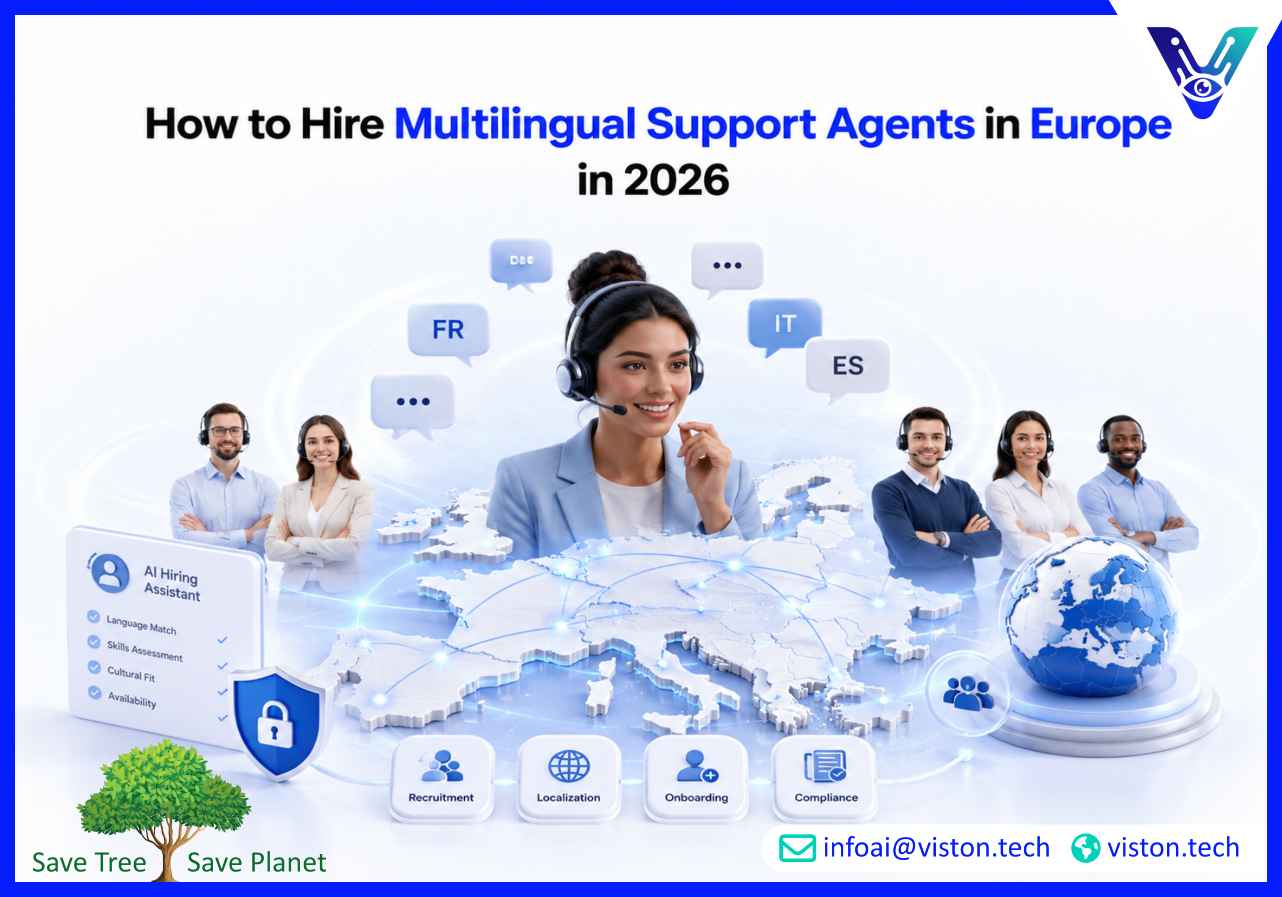
How to Hire Multilingual Support Agents in Europe in 2026
Knowing how to hire multilingual support agents in Europe is essential for companies serving customers across different countries, languages, and time zones. The right hiring model improves service quality, while the wrong one creates inconsistent answers, compliance risk, high turnover, and costly operational complexity.
What Businesses Need Before Hiring Multilingual Support Agents in Europe
Europe is not a single-language support market. The European Union alone has 24 official languages, while regional preferences and country-specific communication styles add further complexity. Start with customer demand rather than hiring for every possible language.Review ticket volume, sales activity, customer value, escalation rates, and service hours by country and language. This shows where dedicated human support is justified and where multilingual AI, self-service, or shared-language coverage may be sufficient.
Define language coverage by business priority
Separate languages into practical service tiers. Tier-one languages may require dedicated agents because they represent high customer volume, regulated interactions, or strategic markets. Tier-two languages may be covered by pooled multilingual agents. Lower-volume languages can often use AI-assisted first-line support with access to a specialist human when needed.Do not assume English-only support is enough. Customers may use English during evaluation but expect local-language help for billing, complaints, returns, troubleshooting, or contracts. Precise language matters most in sensitive and complex interactions.
Write a role profile based on real support work
A multilingual support role should specify more than fluency. Define the channels, ticket complexity, products, shift patterns, escalation responsibilities, CRM or helpdesk tools, and performance measures.Useful selection criteria include:
Professional spoken and written proficiency in each required language
Knowledge of local terminology, tone, etiquette, and customer expectations
Experience with ticketing, CRM, knowledge base, and communication platforms
Ability to troubleshoot, document cases, and follow escalation procedures
Commercial awareness for retention, renewals, upselling, or lead qualification where relevant
Comfort working with AI-assisted replies, translation tools, and automated workflows
Native-level fluency can matter, but a structured work sample provides better evidence than self-reporting. Candidates should complete realistic written, live, and difficult-customer tasks in the language they will use.
Choose the Right European Hiring and Delivery Model
The best way to hire multilingual support agents in Europe depends on control, speed, budget, language volume, and legal presence. Most businesses choose between direct employment, an employer of record, an outsourced support provider, or a distributed contractor model. Each option creates different responsibilities and risks.
Direct local employment
Direct employment provides strong control over training, culture, performance, and customer experience. It is well suited to strategic markets with stable ticket demand. However, hiring employees in another European country may require local employer registration, payroll administration, social security contributions, tax handling, employment contracts, leave policies, and compliance with national labour law.Minimum pay, probation, notice, collective agreements, working time, holiday, and termination rules vary by country. Review the hiring plan locally rather than relying on one European template.
Employer of record arrangements
An employer of record can employ an agent locally for a company without an entity there. This can accelerate entry, but buyers should examine local coverage, payroll accuracy, data handling, fees, and the responsibility split.This model suits market testing or small teams, although it may become less economical as headcount grows.
Outsourced multilingual support
An outsourcing provider can combine recruiting, workforce management, quality assurance, and multi-language coverage. This suits high-volume, seasonal, or extended-hours operations, but quality depends on governance.Evaluate whether agents are dedicated or shared, how training is handled, which locations process customer data, and how turnover is managed. Contract terms should define service levels, quality measures, security responsibilities, business continuity, and access to performance data.
Contractors and remote specialists
Independent contractors can provide flexible language coverage, especially for low-volume markets or specialist use cases. However, a contractor should operate as a genuinely independent provider. When the company controls hours, methods, tools, exclusivity, and day-to-day work like an employer, worker-classification risk may arise under national rules.Remote work can still affect tax, social security, safety, monitoring, and data access. A remote contract does not remove local obligations.
How to Assess, Hire, and Onboard Multilingual Support Talent
A reliable hiring process should test language ability, support judgement, technical confidence, and cultural fit. Strong agents understand intent, resolve problems, document accurately, and protect customer trust.
Use a structured multilingual assessment
After screening, use job-related exercises. Ask candidates to handle frustration, explain a process simply, summarize a handover, and identify when escalation is necessary. Test both formal and conversational language.Use qualified reviewers for each language. Automated language scores may support screening, but they should not be the sole basis for hiring. In Europe, AI used for recruitment and employment decisions is subject to increasing regulatory scrutiny. Employers should understand how screening tools work, assess bias and accuracy, provide appropriate transparency, and preserve meaningful human oversight.
Evaluate operational skills
Language skills alone do not guarantee support quality. Test active listening, empathy, ownership, clear writing, accurate data entry, and judgement. In technical or regulated services, agents must follow approved workflows.Also test system skills. Multilingual support may involve CRM records, helpdesk tickets, knowledge retrieval, order systems, translation assistance, and automated routing.
Build a localized onboarding programme
Onboarding should cover products, customer journeys, service policies, escalation paths, tone of voice, privacy requirements, and regional differences. Translate or localize the knowledge base before expecting agents to deliver consistent answers. A poorly maintained English source document will create inconsistent support when agents must interpret it independently.Create approved glossaries for product names, technical terms, legal phrases, billing language, and expressions that should not be translated literally. Calibrate quality before agents work independently.Give new hires clear escalation rules for billing, technical, legal, security, fraud, and management issues. Language agents must remain connected to the wider operation.
How to Scale Multilingual Support Without Losing Quality
Scalable European support combines skilled people, localized knowledge, workflow automation, and multilingual AI. Humans should handle judgement, empathy, negotiation, and specialist work while automation manages predictable demand.
Use a human-and-AI service model
Multilingual AI can answer common questions, identify language and intent, retrieve approved information, collect customer details, summarize conversations, and route cases to the right team. It can also provide draft replies for agents, but those replies need quality controls, especially for complaints, regulated advice, refunds, safety issues, and contractual matters.Escalation must be easy. Human agents need the conversation history, detected language, account context, and attempted actions so customers do not repeat themselves.
Protect customer and employee data
European multilingual support frequently involves personal data from customers, applicants, and employees. GDPR-aligned operations require a clear lawful basis, transparency, purpose limitation, data minimization, appropriate retention, access controls, security, and accountability. Cross-border data transfers and external support vendors require particular attention.Call recording, screen monitoring, sentiment analysis, and AI-assisted quality review require a legitimate, proportionate purpose, clear notices, restricted access, and documented controls.
Measure performance by language and market
Aggregated reporting can hide weak performance in smaller languages. Track service levels by language, country, channel, and issue type. Useful measures include first-contact resolution, customer satisfaction, response time, quality score, escalation rate, repeat contact, translation correction rate, schedule adherence, and cost per resolved case.Review feedback and failed conversations regularly. Rising escalation may indicate weak knowledge coverage, while high handling time may reflect product complexity or missing integrations. Separate people issues from process and technology issues.
How Viston AI Supports Multilingual Customer Service Teams in Europe
Viston AI is relevant to businesses hiring multilingual support agents because its service focuses on the technology layer that helps human teams manage language demand at scale. The company provides multilingual AI chatbot support designed for customer interactions across languages, time zones, channels, and business systems.Its capabilities include multilingual conversational AI, intent recognition, real-time translation and localization, omnichannel deployment, intelligent routing, escalation, analytics, and centralized knowledge management. These functions can support European service operations by handling routine enquiries, collecting context before handover, and directing complex cases to an appropriately skilled agent.Viston AI should not be treated as a recruitment agency for human support staff. Its role is to help organizations design and deploy AI-supported multilingual service workflows. That distinction is useful for companies deciding how many agents to hire, which languages need dedicated coverage, and which interactions can be automated safely.Across European markets, an integration-led approach can reduce fragmented answers between web chat, apps, messaging, and human helpdesks. It also provides language-specific performance data. Value comes from approved knowledge, reliable escalation, integration, security, and continuous monitoring—not translation alone.
Frequently Asked Questions
What is the best way to hire multilingual support agents in Europe?
The best model depends on ticket volume, target countries, language demand, and desired control. Direct hiring suits strategic markets, an employer of record supports faster local entry, outsourcing handles broader scale, and contractors can cover specialist or low-volume needs.
Which languages should a European support team cover first?
Prioritize languages using customer volume, revenue, growth plans, complaint risk, and case complexity. Do not choose only by population size. Use actual customer and support data to identify where local-language service will create the greatest operational and commercial value.
How can a company test a candidate’s language ability?
Use realistic written and spoken work samples reviewed by a qualified speaker. Test customer communication, comprehension, terminology, tone, summarization, and escalation judgement. General fluency certificates alone do not prove that someone can handle professional support interactions.
Can multilingual AI replace support agents?
Multilingual AI can automate repetitive enquiries, assist with translation, retrieve approved knowledge, and route conversations. Human agents remain important for complex, emotional, sensitive, regulated, or high-value cases. A hybrid model is usually more reliable than complete automation.
What compliance issues matter when hiring support agents in Europe?
Businesses should consider country-specific employment law, payroll, tax, social security, working time, leave, worker classification, data protection, monitoring, and cross-border data transfers. Requirements vary by country, so one contract or policy should not be applied across Europe without local review.
How can Viston AI support a multilingual service operation?
Viston AI can support the technology and automation layer through multilingual chatbots, localization, intent recognition, omnichannel workflows, intelligent routing, human escalation, system integration, and language-level analytics. It does not replace the need for a suitable human hiring model.
Conclusion
To hire multilingual support agents in Europe successfully, businesses need more than a list of languages and job vacancies. They need a demand-based coverage plan, the right employment model, structured language testing, localized onboarding, country-specific compliance, and clear performance controls. Multilingual Support works best when skilled agents are supported by accurate knowledge, connected systems, and responsible automation. Viston AI can contribute to that operating model through multilingual conversational AI, routing, integration, and analytics, helping European customer service teams scale routine support while preserving human expertise for the interactions that need it most.