
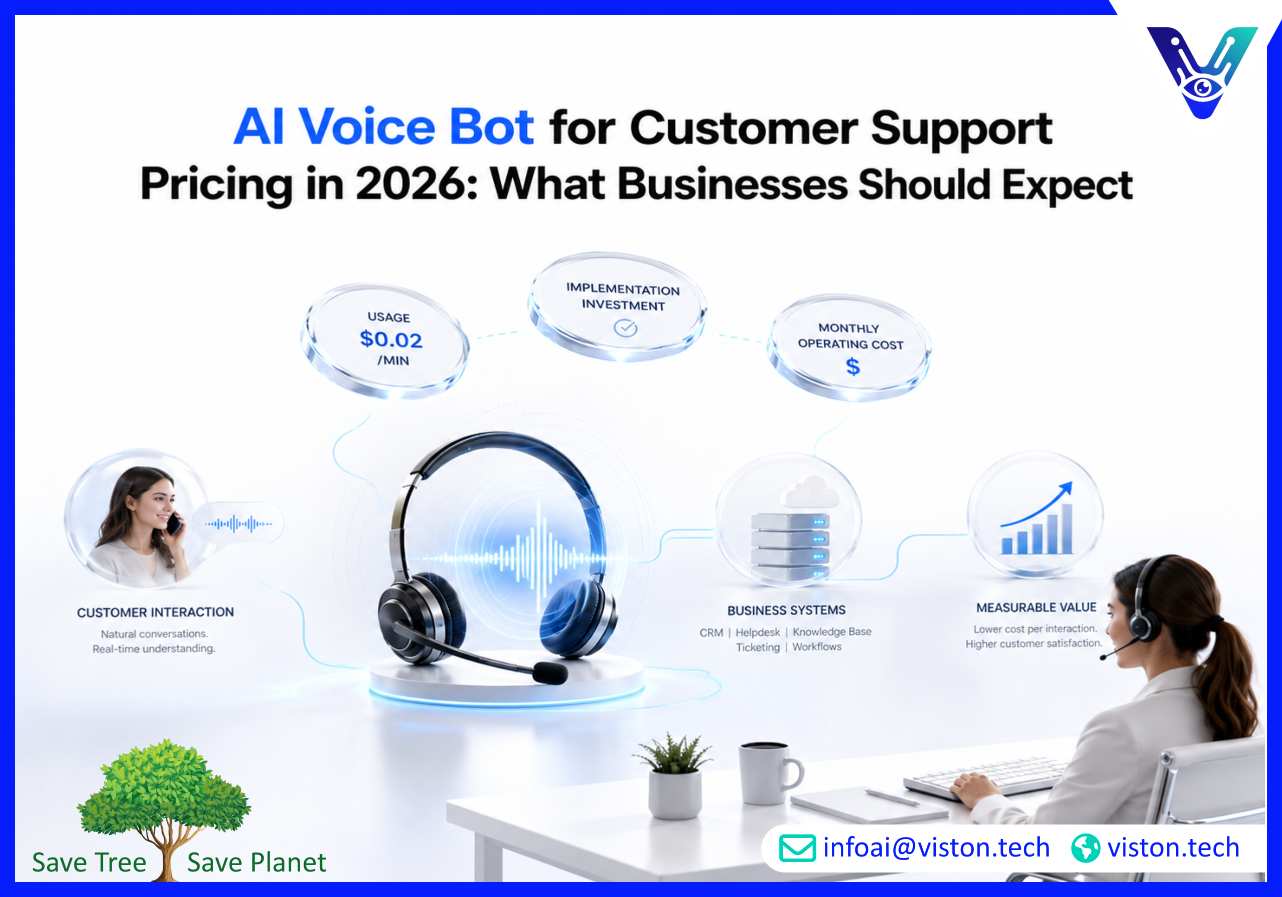
AI voice bot for customer support pricing matters because businesses are no longer buying simple phone automation. In 2026, they are evaluating conversational systems that understand speech, resolve routine issues, integrate with business tools, and reduce pressure on support teams without damaging customer experience.
AI voice bot pricing is not the cost of one chatbot feature. It is the total cost of designing, deploying, operating, and improving a voice-enabled assistant that can answer customer calls, understand intent, retrieve information, complete workflows, and escalate to human agents when needed.
A basic voice bot may only answer frequently asked questions or route calls. A production-ready customer support voice bot usually requires automatic speech recognition, natural language understanding, dialogue management, text-to-speech, telephony integration, CRM or helpdesk connectivity, analytics, compliance controls, and ongoing optimization. These layers directly affect pricing.
Businesses often compare providers by monthly subscription or per-minute rates, but the real investment depends on call volume, complexity, accuracy requirements, languages, integration depth, and support expectations. A small business handling simple appointment calls may need a lightweight deployment. A contact center handling billing issues, order status, complaints, authentication, and refunds needs a more advanced system.
Most AI voice bot pricing falls into one or more of the following models:
For customer support, the cheapest plan is rarely the best benchmark. A low-cost voice bot that misunderstands customers, fails to update tickets, or escalates too often can increase support costs instead of reducing them. Pricing should be evaluated against resolution quality, customer satisfaction, agent productivity, and operational reliability.
The price of an AI voice bot depends on how much business responsibility the system carries. A voice bot that answers store hours is very different from one that verifies customers, checks account records, processes cancellations, updates support tickets, or manages multilingual conversations across regions.
Usage is one of the biggest pricing drivers. Many platforms charge based on minutes used, number of calls handled, or successful resolutions. Longer calls increase costs because the system must process speech, interpret language, generate responses, and maintain conversation context for more time.
Businesses should estimate monthly call volume, average call duration, peak concurrency, and expected growth. A support team receiving 2,000 short calls per month will have a very different cost profile from a contact center managing 100,000 calls with long troubleshooting flows.
Voice bots rely on automatic speech recognition to understand what customers say and text-to-speech to respond naturally. Higher-quality speech recognition, better accent handling, noise tolerance, speaker diarization, and natural-sounding voices can increase cost but often improve completion rates.
For customer support, voice quality matters because customers judge the experience quickly. Robotic responses, long pauses, poor pronunciation, or repeated misunderstandings can cause abandonment and complaints. Businesses should evaluate latency, clarity, pronunciation control, and performance in real call conditions.
Modern AI voice bots often use large language models to interpret context, summarize calls, generate responses, and support multi-turn conversations. More advanced reasoning, retrieval from knowledge bases, sentiment detection, and agent-assist features may increase usage costs.
The goal is not to use the most expensive model for every call. A well-designed system routes simple tasks through efficient workflows while reserving advanced language processing for complex or ambiguous interactions. This architecture can control costs while preserving quality.
Customer support voice bots become more valuable when they connect with CRM, helpdesk, ticketing, ecommerce, billing, order management, knowledge base, and contact center platforms. Integration allows the bot to retrieve customer data, create tickets, update records, check order status, authenticate users, and pass context to agents.
Integration is also where implementation costs often rise. API quality, legacy systems, data mapping, authentication, workflow rules, and testing all affect the final price. Businesses should ask whether integration work is included in the platform fee or charged separately.
Support calls may include personal data, payment information, health details, account records, or contractual information. This makes security and compliance important pricing factors. Requirements such as encryption, PII redaction, consent management, audit trails, role-based access, data retention controls, and regional privacy alignment may increase implementation and operating costs.
Regulated industries such as healthcare, financial services, insurance, telecom, and public services need stronger governance than a basic customer inquiry bot. In these cases, security architecture should be treated as part of the core solution, not an optional add-on.
AI voice bot for customer support pricing varies widely, but most businesses should budget across three layers: platform usage, implementation, and ongoing improvement. Looking only at per-minute rates gives an incomplete view of total cost.
Many AI voice bot platforms use per-minute pricing, often influenced by speech processing, telephony, language model usage, and voice synthesis. Entry-level or simple deployments may be available through monthly subscriptions, while enterprise-grade deployments are usually custom quoted.
As a practical planning range, businesses may see usage-based voice AI pricing from low cents per minute to higher per-minute rates for premium voices, multilingual support, advanced models, compliance controls, or high-concurrency infrastructure. Monthly costs can remain modest for low-volume support teams, but they increase quickly when call volume, call duration, and automation scope grow.
Implementation costs depend on how much the voice bot must be tailored to the business. A simple FAQ voice bot may require limited configuration. A customer support bot that handles account-specific queries, order changes, refunds, troubleshooting, identity checks, and ticket creation needs deeper planning and engineering.
Custom implementation may include conversation design, intent mapping, knowledge base preparation, workflow logic, integrations, testing, security configuration, reporting dashboards, escalation design, and agent handover rules. For enterprise support environments, this work can become the most important part of the investment because it determines whether the bot performs reliably in real conversations.
Voice bots need continuous improvement after launch. Customer questions change, products change, policies change, and new failure patterns appear in real calls. Ongoing costs may include transcript review, fallback analysis, prompt refinement, model evaluation, knowledge base updates, workflow optimization, compliance reviews, and performance reporting.
Businesses should avoid treating launch as the finish line. A voice bot that is monitored and optimized can improve resolution rates over time. A bot that is not maintained may become inaccurate, increase escalations, and frustrate customers.
A useful budgeting process starts with five questions:
For most businesses, the best first deployment focuses on high-volume, repeatable support needs such as order status, appointment scheduling, password resets, service availability, billing FAQs, delivery updates, lead qualification, and ticket creation. These use cases are easier to measure and usually provide clearer ROI than trying to automate every support call at once.
AI voice bot pricing should be evaluated through business outcomes, not just software cost. The right question is not “Which provider is cheapest?” It is “Which solution can resolve the right support calls safely, accurately, and at a cost that improves the service operation?”
Cost per resolved conversation is more useful than cost per minute alone. A bot that costs slightly more per minute but resolves more calls successfully may deliver better value than a cheaper bot that escalates frequently. Businesses should calculate how many calls are completed without agent intervention and compare that with agent handling costs.
Customer support leaders should track first-call resolution, containment rate, escalation rate, average handle time, customer satisfaction, call abandonment, and ticket quality. These metrics show whether the voice bot is reducing workload or simply shifting problems from one channel to another.
A strong voice bot should help agents, not block customers. When escalation is needed, it should pass the customer’s intent, call summary, authentication status, sentiment, and attempted resolution to the human agent. This reduces repetition and improves handover quality.
Voice bot quotes can look similar while covering very different scopes. Buyers should confirm whether pricing includes telephony, speech recognition, text-to-speech, LLM usage, integrations, analytics, hosting, security controls, reporting, testing, support, and optimization.
It is also important to ask about overage fees, peak concurrency, call recording storage, data retention, custom voices, additional languages, sandbox environments, support response times, and future workflow changes. These items often determine the real cost after launch.
A focused pilot helps validate pricing assumptions before a large rollout. The pilot should include a clear use case, measurable success criteria, integration requirements, and a defined escalation path. Good pilot use cases include appointment booking, order tracking, ticket creation, account FAQs, delivery updates, or after-hours support.
Once the business proves resolution quality, customer acceptance, and operational savings, the voice bot can expand into more complex workflows. This phased approach reduces risk and helps teams make pricing decisions based on evidence rather than assumptions.
Viston AI is relevant to AI voice bot for customer support pricing because its Voice-Enabled Assistants service focuses on enterprise-grade conversational voice systems rather than basic call scripts. Its offering connects speech recognition, natural language processing, generative AI, speech synthesis, LLMOps, real-time analytics, and enterprise integration architecture to support voice interactions at scale.
For support teams, this matters because pricing depends heavily on design and operational depth. A customer support voice bot needs to understand intent, manage multi-turn conversations, connect with CRM or helpdesk tools, retrieve approved knowledge, trigger workflows, and escalate safely when human support is required. Viston AI’s service positioning includes integration with enterprise platforms such as CRM, service management, healthcare, HR, and custom systems, along with multilingual support, analytics, monitoring, and governance capabilities.
This makes the company relevant for businesses that want a voice bot investment tied to practical outcomes: lower repetitive call volume, faster response times, better ticket quality, improved after-hours coverage, and more consistent customer handling. Instead of treating pricing as a standalone software subscription, Viston AI’s approach is aligned with building voice-enabled assistants around use cases, workflows, security requirements, and measurable support performance.
Costs vary by call volume, conversation length, voice quality, integrations, compliance needs, and support model. Many providers combine usage-based pricing with implementation and ongoing optimization fees. Enterprise deployments are usually custom quoted.
Usage-based pricing works well when call volume is predictable and the use case is simple. Enterprise or managed pricing is usually better when the bot needs CRM integration, ticketing workflows, compliance controls, multilingual support, and continuous optimization.
No. Per-minute pricing is only one part of total cost. Businesses should also consider implementation, telephony, integrations, knowledge base preparation, security configuration, reporting, testing, support, and ongoing improvement.
Yes, when it automates high-volume and repeatable calls accurately. Cost reduction depends on self-service resolution rate, escalation quality, customer satisfaction, average handle time reduction, and how well the bot integrates with support systems.
A pricing proposal should clarify platform fees, usage rates, implementation scope, integrations, telephony costs, languages, security features, analytics, support levels, maintenance, overage charges, and expected success metrics.
Yes. Viston AI’s Voice-Enabled Assistants service is aligned with customer support voice bot planning because it covers speech technology, conversational AI, enterprise integrations, analytics, monitoring, and scalable deployment considerations.
AI voice bot for customer support pricing in 2026 should be evaluated as a business investment, not just a software fee. The right budget depends on call volume, automation scope, voice quality, integrations, compliance, support needs, and ongoing optimization. Businesses that focus only on the lowest per-minute rate may miss the larger cost of poor resolution, weak handovers, or failed workflows. A practical pricing decision starts with clear use cases, realistic call data, measurable support KPIs, and a phased rollout plan. For organizations exploring Voice-Enabled Assistants, Viston AI offers relevant capabilities for designing support voice bots that connect technology cost with operational value.
